

Learning Notes for Class 4 – ‘The Railway Children’ (New Oxford Modern English): Includes summary, character sketches, vocabulary, textbook question–answers, and moral insights. Ideal for CBSE/ICSE literature support.
Learning Notes: Summary, Vocabulary, Characters, Themes & Morals – ‘The Railway Children’
An Overview of ‘The Railway Children’:
The story follows three siblings-Roberta, Peter, and Phyllis move to the countryside with their mother. They live near a railway station and have many adventures. They help people, make new friends, and wait for their father to return. The story teaches us kindness, courage, and hope.
SUMMARY of this Chapter ‘The Railway Children’
SUMMARY
Here’s a simple summary of the lesson “The Railway Children”
The story is about three children—Roberta (Bobbie), Peter, and Phyllis. At first, they lived happily with their parents in a red-brick house. They were lucky children who had everything they needed—pretty clothes, toys, a warm house, and loving parents. Their father was kind, never angry, and very clever at fixing things. Their mother played with them, read stories, and even wrote poems.
One day, Peter got a model engine on his tenth birthday. It was his favourite gift, but after three days, it broke with a loud bang. Peter felt very sad. Soon he also caught a cold and had to stay in bed. When Father returned from the country, Peter showed him the broken engine. Father examined it carefully and promised to repair it with solder and a new valve. He also told the children that girls are as clever as boys and can help in mending things too. Just then, there was a knock at the door, hinting that something unexpected was about to happen.
कहानी तीन बच्चों—रोबर्टा (बॉबी), पीटर, और फिलिस—की है। शुरू में वे अपने माता-पिता के साथ लाल ईंटों के घर में बहुत खुशी से रहते थे। वे भाग्यशाली बच्चे थे जिनके पास सुंदर कपड़े, खिलौने, आरामदायक घर और प्यारे माता-पिता थे। पिता बहुत दयालु थे, कभी गुस्सा नहीं करते थे और चीज़ें ठीक करने में माहिर थे। माँ उनके साथ खेलतीं, कहानियाँ सुनातीं और मज़ेदार कविताएँ भी लिखतीं।
पीटर के दसवें जन्मदिन पर उसे एक मॉडल इंजन मिला। वह उसका सबसे प्यारा तोहफ़ा था, लेकिन तीन दिन बाद वह अचानक फट गया। पीटर बहुत दुखी हुआ और उसे ज़ुकाम भी हो गया। जब पिता गाँव से लौटे, तो पीटर ने उन्हें टूटा इंजन दिखाया। पिता ने इंजन को ध्यान से देखा और वादा किया कि वह इसे सोल्डर और नया वाल्व लगाकर ठीक करेंगे। उन्होंने बच्चों से यह भी कहा कि लड़कियाँ भी लड़कों जितनी होशियार होती हैं और इंजन ठीक करने में मदद कर सकती हैं। तभी अचानक दरवाज़े पर दस्तक हुई, जिससे कहानी में आगे कुछ नया होने का संकेत मिलता है।
SUMMARY of the whole Novel-The Railway Children
Summary of The Railway Children
🌧️ Beginning with Mystery and Change
The story begins with a happy family living in London. Suddenly, their father is taken away under mysterious circumstances, and the children—Roberta, Peter, and Phyllis—must move with their mother to a small countryside cottage near a railway station. The reason for their father’s absence is kept secret, creating suspense and emotional tension.
कहानी एक खुशहाल परिवार से शुरू होती है। अचानक पिता को रहस्यमय तरीके से ले जाया जाता है और बच्चों को माँ के साथ गाँव के एक छोटे घर में रहना पड़ता है। पिता की अनुपस्थिति का कारण छुपाया जाता है, जिससे रहस्य और भावनात्मक तनाव पैदा होता है।
Kid Line:
“We don’t know where Father is—but we’ll be brave.”
“हमें नहीं पता पापा कहाँ हैं—पर हम बहादुर बनेंगे।”
🚂 Adventures by the Railway
The children explore the railway and make new friends, including the kind Old Gentleman who travels by train. They help injured people, rescue a baby, and even prevent a train accident. These acts show their courage, kindness, and growing maturity.
बच्चे रेलवे के पास नई दुनिया खोजते हैं और कई साहसिक काम करते हैं। वे घायल लोगों की मदद करते हैं, एक बच्चे को बचाते हैं और एक ट्रेन दुर्घटना को रोकते हैं। ये घटनाएँ उनके साहस और समझदारी को दर्शाती हैं।
Kid Line:
“Always help when you can—even if you’re small.”
“जब भी मदद कर सको, करो—चाहे तुम छोटे ही क्यों न हो।”
💔 Truth and Tears
Roberta secretly learns the truth: her father has been wrongly imprisoned. She writes to the Old Gentleman, asking for help. This moment is full of emotion and quiet strength, as Bobbie carries the burden alone to protect her siblings.
रॉबर्टा को चुपचाप सच्चाई पता चलती है—उसके पिता को गलत तरीके से जेल में डाला गया है। वह वृद्ध सज्जन को पत्र लिखती है और मदद माँगती है। यह पल भावनाओं और साहस से भरा होता है।
Kid Line:
“Sometimes, being brave means keeping a secret.”
“कभी-कभी बहादुरी का मतलब होता है एक राज़ रखना।”
🌈 A Joyful Reunion
In the end, the Old Gentleman helps free their father. The story concludes with a joyful reunion at the railway station—Bobbie sees her father and runs to him, crying “Oh Daddy, my Daddy!” It’s a heartwarming ending that celebrates hope, kindness, and family.
अंत में वृद्ध सज्जन की मदद से पिता को रिहा कर दिया जाता है। कहानी का समापन रेलवे स्टेशन पर भावनात्मक पुनर्मिलन से होता है—रॉबर्टा अपने पिता को देखकर दौड़ती है और कहती है, “ओह, मेरे पापा!” यह एक सुखद अंत है जो आशा, दया और परिवार का जश्न मनाता है।
Kid Line:
“Happy endings come when hearts stay kind.”
“खुशहाल अंत तब आते हैं जब दिल दयालु रहते हैं।”
VOCABULARY With Meanings
Vocabulary: (Meanings)
Selected words and phrases with their meanings are provided to help students easily understand the lesson ‘The Railway Children.’
| Word / Phrase | Meaning | Meaning in Hindi |
|---|---|---|
| suburban children | children living outside the main city | शहर के बाहर (उपनगर में) रहने वाले बच्चे |
| red brick fronted house | a house with red bricks in front | सामने से लाल ईंटों वाला घर |
| to keep up with | to try to do as well as others | बराबरी करने की कोशिश करना |
| funny pieces of poetry | small, amusing poems | मजेदार कविताएँ |
| special occasions | important or festive times | खास मौके |
| lucky children | children who have everything they need | भाग्यशाली बच्चे |
| lovely warm house | a nice, comfortable house | सुंदर और आरामदायक घर |
| never cross – never unjust | never angry or unfair | न कभी गुस्सा करते, न कभी अन्याय करते |
| over and done with | finished completely | पूरा होकर खत्म हो गया |
| dreadful change | sudden and very bad change | भयानक/भयंकर बदलाव |
| full of charm | very attractive or delightful | बहुत आकर्षक, मनभावन |
| lasted | continued for a period of time | चला/टिका रहा |
| went off | exploded suddenly | फट गया |
| toy people | small toy figures like people | खिलौनों के आदमी |
| in the tender | in the coal-carriage behind the engine | इंजन के पीछे वाले डिब्बे (कोयले वाला हिस्सा) में |
| bits | small broken pieces | छोटे-छोटे टुकड़े |
| measles | a childhood disease with red spots | खसरा (लाल दाने वाली बीमारी) |
| gruel | thin, watery porridge | पतला दलिया |
| REAL | (here) proper or solid food, not light food | असली/पक्का खाना |
| clever with fingers | skillful at making and repairing things | हाथ से चीज़ें बनाने या सुधारने में निपुण |
| veterinary surgeon | animal doctor | पशु-चिकित्सक |
| mend | to repair | ठीक करना/मरम्मत करना |
| fire away | go ahead and say what you want | बोल डालो / कह डालो |
| fetch | to bring something | ले आना |
| unsteady voice | weak, shaking voice | कांपती/कमज़ोर आवाज़ |
| rather | certainly / of course | ज़रूर / अवश्य |
| solder | soft metal used for joining broken parts | धातु जोड़ने वाली तार/टांका |
| valve | a part controlling flow of steam in engine | वाल्व (भाप/गैस को नियंत्रित करने वाला पुर्जा) |
| stoker (misprint “stocker”) | person who feeds coal into engine | इंजन में कोयला डालने वाला व्यक्ति |
CHARACTER SKETCHES
Character Sketches of the characters in ‘The Railway Children’.
Here are concise character sketches for The Railway Children, highlighting their key traits in compact paragraphs.
👧 Roberta (Bobbie)
Roberta is the eldest of the three children. She is thoughtful, brave, and deeply caring—especially toward her siblings and mother. Bobbie often takes the lead in difficult situations and shows great emotional strength, especially when she discovers the truth about her father. Her kindness and maturity make her the heart of the family.
👦 Peter
Peter is curious, clever, and sometimes a bit impulsive. He loves trains and often takes charge when solving practical problems. Though he can be stubborn, he’s loyal and quick-thinking, especially when helping others. His sense of adventure and growing sense of responsibility shine throughout the story.
👧 Phyllis
Phyllis is the youngest and most innocent of the siblings. She is cheerful, playful, and often says funny or unexpected things. Though she doesn’t always understand what’s happening, her honesty and sweetness bring warmth to the family. She represents the carefree spirit of childhood.
👩 Mother
The children’s mother is gentle, strong, and hardworking. She hides her worries to protect her children and writes stories to earn money. Her quiet resilience and loving nature help the family stay hopeful during tough times. She’s a symbol of grace and courage.
👴 The Old Gentleman
Kind, wise, and generous, the Old Gentleman becomes a silent guardian for the children. He helps them in times of need—especially when their mother is ill and later when Bobbie seeks help for her father. His quiet support shows how small acts of kindness can change lives.
MORAL LESSONS from ‘The Railway Children’ story.
Moral Box: Lesson from the Story
“Kindness, courage, and hope can carry us through even the darkest tunnels.”
When life changes suddenly, staying united as a family and helping others brings light and healing.
“दयालुता, साहस और उम्मीद हमें अंधेरे समय में भी आगे बढ़ने की ताकत देती है।”
जब जीवन अचानक बदलता है, तो परिवार का साथ और दूसरों की मदद हमें सच्ची खुशी की ओर ले जाती है।
Textbook Questions & Answers – ‘The Railway Children’ | Class 4 New Oxford Modern English
COMPREHENSION
1. Answer the following questions.
a. How many children are there in the family?
b. What jobs do Peter and Roberta want to do when they grow up?
c. Who is James?
d. What good qualities do mother and father have?
e. Which is Peter’s favourite birthday present and what happens to it three days after his birthday?
f. After a few days of illness, what does Peter do that shows us he is feeling better?
ANSWERS:
3 sets of answers are given. Click to see the set you want.
Answer Set – 1
a. How many children are there in the family?
Ans. There are three children in the family—Roberta, Peter, and Phyllis.
b. What jobs do Peter and Roberta want to do when they grow up?
Ans. Peter wants to be an engineer when he grows up. Roberta wants to be an engine-driver or a firewoman.
c. Who is James?
Ans. James is the children’s pet dog.
d. What good qualities do mother and father have?
Ans. Mother is loving, caring, and creative. She plays with the children, tells them stories, and writes poems for them.
Father is kind, never angry, never unfair, and very clever at repairing things.
e. Which is Peter’s favourite birthday present and what happens to it three days after his birthday?
Ans. Peter’s favourite birthday present is a model engine. Three days after his birthday, the engine suddenly bursts with a loud bang and breaks.
f. After a few days of illness, what does Peter do that shows us he is feeling better?
Ans. Peter sits up in bed and asks for a large pie to eat. This shows that he is feeling better.
Answer Set – 2
a. There are three children.
b. Peter wants to be an engineer. Roberta wants to be an engine-driver or a stoker (a person who looks after the engine/fire).
c. James is the family dog.
d. Mother plays with the children, reads to them, helps with homework and writes stories and poems for them.
Father is kind (never angry or unfair) and very clever with his hands — he can mend many things.
e. His favourite present is a model engine. Three days later it suddenly “went off with a bang” and was badly damaged.
f. He sits up in bed and asks for something real to eat — he asks eagerly for a large pie.
Answer Set – 3
a. How many children are there in the family?
Ans. There are three children in the family: Roberta (the eldest), Peter (who is ten years old) and Phyllis (the youngest). They all live together with their Mother and Father.
b. What jobs do Peter and Roberta want to do when they grow up?
Ans. Peter wants to be an engineer when he grows up. He loves model engines and trains.
Roberta (Bobbie) dreams of working on the railway too — she says she would like to be an engine-driver or even help as a stoker / fireman (someone who looks after the engine’s fire). Their father also encourages them and says girls can be as clever as boys.
c. Who is James?
Ans. James is the family dog. He is a pet and part of the children’s happy home. When Peter’s model engine exploded, James got so frightened that he ran outside and did not come back that day.
d. What good qualities do mother and father have?
Ans. Mother is caring and loving. She plays with the children, helps them with homework, reads stories aloud, writes stories for them, and makes funny little poems for special occasions.
Father is kind, never angry or unfair, and always ready to play a game with the children. He is very clever with his hands — he can fix broken toys, mend the doll’s cradle, and even acted like a vet for the wooden rocking-horse. He is patient and helpful.
e. Which is Peter’s favourite birthday present and what happens to it three days after his birthday?
Ans. Peter’s favourite present is a model engine (a toy steam engine). It is the most special gift he receives. Three days after his birthday the engine “went off with a bang” — it broke or exploded. The toy people in the tender were broken to bits, James ran away in fright, and Peter felt very sad.
Ans. After being in bed for a few days, Peter sits up suddenly and says he hates gruel and wants something REAL to eat. He asks eagerly for a large pie. Then he eats some of the pie, and after that his cold gets better. These actions (sitting up, asking for and eating solid food) show he is feeling stronger and better.
These questions are more difficult. Discuss them first. [HOTS]
g. How long is the children’s father away for? What does Peter want him to do when he returns? Why does Peter have to wait?
h. What clues are there in the story that something is going to happen that will change the children’s lives?
Answers:
Answer Set – 1
g. How long is the children’s father away for? What does Peter want him to do when he returns? Why does Peter have to wait?
Ans. The children’s father is away for four days. Peter wants him to repair his broken model engine. He has to wait until Father finishes his dinner, because Mother tells him not to disturb Father before that.
h. What clues are there in the story that something is going to happen that will change the children’s lives?
Ans. The story says the children did not know how happy they were until life in the Red House was “over and done with.” It also mentions that a dreadful change came suddenly. At the end, the knock at the front door gives a clue that something important is about to happen.
Answer Set – 2
g. How long is the children’s father away for? What does Peter want him to do when he returns? Why does Peter have to wait?
Ans. The children’s father is away in the country for four days. During this time, Peter’s model engine breaks with a loud bang. Peter loves the engine very much and is deeply upset. He knows that his father is very good at fixing things, so he hopes that when Father comes back, he will be able to mend the broken engine with his clever hands.
But Peter has to wait patiently before talking about the engine, because his mother asks him not to disturb Father until after he has eaten his dinner. Even though it is very hard for Peter to stay quiet (as he is eager and worried), he controls himself and waits till Father finishes eating. This shows Peter’s respect for his parents and also teaches the importance of patience.
h. What clues are there in the story that something is going to happen that will change the children’s lives?
Ans. There are several small hints in the story that prepare us for a big change in the children’s happy life:
- In the beginning, the narrator says that the children were happy but “they did not know HOW happy till the pretty life in the Red House was over and done with.” This tells us directly that their comfortable life will soon end.
- The phrase “The dreadful change came quite suddenly” also acts as a warning. It makes the reader curious and a little worried about what will happen next.
- At the end of the passage, when Father is talking about fixing the engine, there is an unexpected knock at the door. This sudden interruption hints that something serious or surprising is about to happen, leading to the change in their lives.
These clues build suspense in the story and prepare the reader for a turning point in the children’s happy world.
Answer Set – 3
g. How long is the children’s father away for? What does Peter want him to do when he returns? Why does Peter have to wait?
Ans. The children’s father is away in the country for four days. During this time, Peter’s beloved model engine breaks down. Peter wants his father to repair the broken engine because Father is very skillful with his hands and can mend almost anything. However, Peter has to wait patiently until after Father finishes his dinner. Mother tells him not to disturb Father before that. Although it is very hard for Peter to wait, he controls himself and only talks about the engine later. This shows Peter’s respect for his parents and his ability to wait, even when he is very eager.
h. What clues are there in the story that something is going to happen that will change the children’s lives?
Ans. The story gives a few hints that a big change is coming:
- At the beginning, the children live a happy, lucky life in a red-brick house with their caring parents. The author then says they “did not know HOW happy” they were until that life was “over and done with”. This clearly suggests that their happiness will not last.
- It also says, “The dreadful change came quite suddenly.” These words warn us that their comfortable life will be replaced by something very different.
- Finally, at the end of the passage, when Father is speaking to the children, there is a knock at the front door. The knock creates suspense. It shows that someone has arrived with news or an event that may bring about the change in their lives.
Together, these clues prepare the reader to expect that the children’s life in the red-brick house is about to end, and a new, harder life will soon begin.
2. Answer the questions about this line from the story.
…and the youngest was Phyllis, who tried to keep up with the other children.
a. Who is Phyllis?
b. How old is Phyllis’s brother? How old do you think Phyllis is?
c. Why does Phyllis have to try hard to keep up with the others? Why is it hard for her to do what they can do?
Answer:
a. Who is Phyllis?
Ans. Phyllis is the youngest child in the family. She is the little sister of Roberta and Peter.
b. How old is Phyllis’s brother? How old do you think Phyllis is?
Ans. Phyllis’s brother, Peter, is ten years old. Since Phyllis is younger than Peter, she must be around seven or eight years old.
c. Why does Phyllis have to try hard to keep up with the others? Why is it hard for her to do what they can do?
Ans. Phyllis tries hard to keep up because she wants to join her older brother and sister in their games and activities. It is hard for her because she is younger and smaller, and she may not have the same strength, speed, or skills as Roberta and Peter. That is why she often finds it difficult to do everything that they can do.
WORKING WITH WORDS
A RAILWAY CROSSWORD (see the book for the full question)
Answer:
🔽 DOWN
- A chart containing the information you need to catch a train → Timetable
- Someone who means to travel by train → Passenger
- The raised area beside a train in a station, which passengers get on and off trains → Platform
- A train needs one of these in order to move; cars and motorbikes have one too → Engine
➡️ ACROSS
- To travel by train, you need to buy one of these → Ticket
- A train track with only one track → Singleline
- An underground passageway cut into a hill, for example → Tunnel
- An underground railway, called the Tube in England and the Metro in France → Subway
- This type of train goes fast, making fewer stops along its route → Express
Note: There seems mistake in Down (3) and Across (2) boxes.
LEARNING ABOUT LANGUAGE
ARTICLES
1. Add articles (a, an, the) to the following, where necessary. Four of the blanks do NOT require an article.
Once upon…….time there lived……. king who was…….fine man……..kingdom he ruled was…….very large and all ….. people who lived in it….. were happy and prosperous. One day there was……earthquake. Then…….great flood of….water came pouring down from……. mountains and swept away…….palace and most of …… city. Many of….people were drowned but…king sent his army and carried
everyone to some high ground. In this way he saved many people from…….death.
Answer:
Once upon a time there lived a king who was a fine man. The kingdom he ruled was (no article) very large and all the people who lived in it (no article) were happy and prosperous. One day there was an earthquake. Then a great flood of (no article) water came pouring down from the mountains and swept away the palace and most of the city. Many of the people were drowned but the king sent his army and carried everyone to some high ground. In this way he saved many people from (no article) death.
Explanator-Notes: No article needed in these four places:
- “very large” (adjective phrase)
- “water” (uncountable noun in general sense)
- “death” (used in abstract/general sense)
- “were happy and prosperous” (descriptive clause)
NOUNS
2. Underline the nouns in the following sentences.
a. Once upon a time there was an old man called Ramji.
b. One day he took his dog and went to the forest.
c. Suddenly out of the bushes came a fierce tiger.
d. Ramji was afraid, but his dog feared no man or creature.
e. It took one step towards the tiger and barked.
f. Ramji stood with his back against a tree.
g. Soon the tiger ran into the forest.
h. Ramji went home and told his wife about their brave pet.
i. ‘Well done!’ she said in a loud voice, and the dog wagged its tail.
j. Ramji, his wife and their dog sat by the fire and ate biscuits.
Answer:
a. Once upon a time there was an old man called Ramji.
b. One day he took his dog and went to the forest.
c. Suddenly out of the bushes came a fierce tiger.
d. Ramji was afraid, but his dog feared no man or creature.
e. It took one step towards the tiger and barked.
f. Ramji stood with his back against a tree.
g. Soon the tiger ran into the forest.
h. Ramji went home and told his wife about their brave pet.
i. ‘Well done!’ she said in a loud voice, and the dog wagged its tail.
j. Ramji, his wife and their dog sat by the fire and ate biscuits.
PRONOUNS
3. Underline all the pronouns in the following sentences about Joan of Arc.
a. Joan of Arc lived in France many years ago.
b. One day another country attacked her beloved France.
c. The soldiers came and burnt its villages.
d. Joan met the General; she asked him for a horse.
e. Then she rode it into the battle.
f. She beat the army which was attacking them.
g. Unfortunately, many people did not like her.
h. They thought she was a witch.
i. She was arrested and put in jail.
j. Today, you can see many statues of her in France; she is a national heroine.
Answer:
- a. Joan of Arc lived in France many years ago.
(No pronoun) - b. One day another country attacked her beloved France.
her - c. The soldiers came and burnt its villages.
its - d. Joan met the General; she asked him for a horse.
she, him - e. Then she rode it into the battle.
she, it - f. She beat the army which was attacking them.
She, them - g. Unfortunately, many people did not like her.
her - h. They thought she was a witch.
They, she - i. She was arrested and put in jail.
She - j. Today, you can see many statues of her in France; she is a national heroine.
you, her, she
ADVERBS
4. Underline all the adverbs in the following sentences.
a. Lakshmi walked slowly down the street towards the river.
b. She put her feet into the swiftly running water.
c. ‘Oh!’ she said aloud, ‘it’s very cold!’
d. Suddenly she heard someone shouting loudly down the river.
e. She ran quickly along the bank.
Answer:
a. Lakshmi walked slowly down the street towards the river.
b. She put her feet into the swiftly running water.
c. ‘Oh!’ she said aloud, ‘it’s very cold!’
d. Suddenly she heard someone shouting loudly down the river.
e. She ran quickly along the bank.
USING ‘WHO’ OR ‘WHICH’ (see the book for the full question)
Answer:
This is a matching exercise where we use who for people and which for things.
A → B Matching
- This is the man → who met me on the road.
- This is the map → which helped me find the cave.
- This is the path → which he told me to go along.
- This is the wicked wizard → who lived in the cave.
- This is the hat of the wizard → which I brought back to show you.
✅ Final Answer:
- This is the man who met me on the road.
- This is the map which helped me find the cave.
- This is the path which he told me to go along.
- This is the wicked wizard who lived in the cave.
- This is the hat of the wizard which I brought back to show you.
COMPOSITION
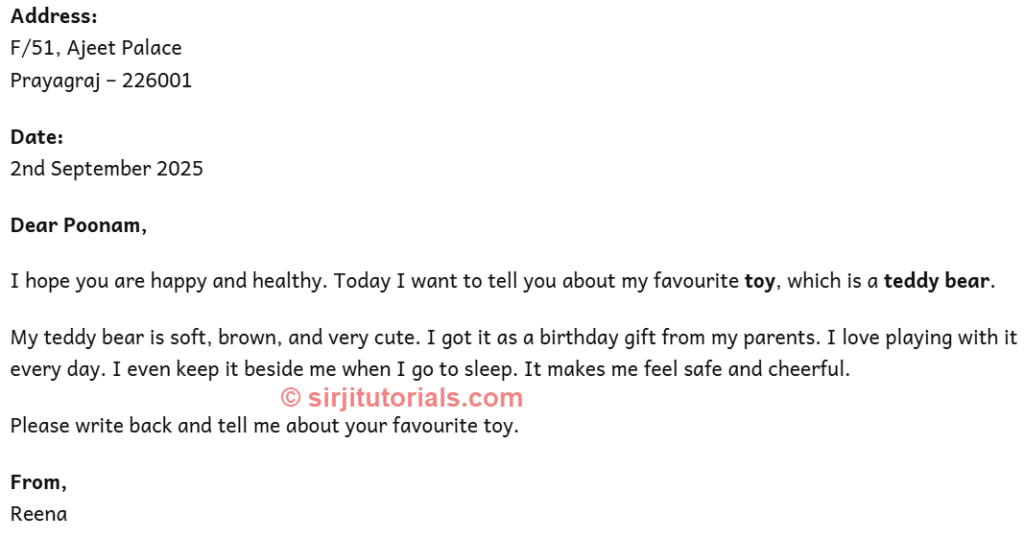
Write a letter to a friend to tell them all about your favourite game, toy, or hobby. Tell them why you like it and how you play with or use it.
Answer:
We are giving here sample letters following the same format as shown in the book. Three letetrs are given for All three versions: – Favourite Toy, Favourite Game, Favourite Hobby
SAMPLE LETTER – 1 (Favourite Game)
Address:
123, Green Park Colony
New Delhi – 110016
Date:
2nd September 2025
Dear Rahul,
I hope you are well.
My favourite game is cricket. Let me tell you about it.
I love playing cricket because it is full of fun and excitement. I usually play with my friends in the park near my house. I enjoy batting the most, as I get a chance to hit fours and sixes. Sometimes, I also do bowling, and it feels great when I get a wicket. Playing cricket keeps me active, strong, and healthy. It also teaches me teamwork and patience.
Please write and tell me your news. What is your favourite game?
From,
Ajeet
SAMPLE LETTER – 2 (Hobby)

SAMPLE LETTER – 3 (Toy)
I can’t download the railway children
visit contact page on the website or WhatsApp on 8081370373