

Clear, easy-to-understand NCERT book (Exploring Society Part 1) Solutions for Class 7 Social Science Chapter 2: Understanding the Weather. Includes in-text questions, chapter-end exercises, instrument matching, and weather report writing for exams. #SirjiSolutionsC7
In-text Questions Answers
Answers to in-text questions are provided here page by page. These questions are embedded within the main text of the chapter in NCERT textbooks to help students comprehend the subject matter.
LET’S EXPLORE: (Pg. 28)
What are some of the words in your local language that you use to describe the weather? Hot, cold, warm, chilly, crisp, pleasant, and so on, are commonly used terms in English.
Answer: Sample Answer
Some common words used in Hindi to describe the weather are:
- गरम (Garam) – hot
- ठंडा (Thanda) – cold
- गुनगुना (Gunguna) – warm
- ठंडक भरा / सिहरन वाला (Thandak bhara / Siharan wala) – chilly
- सुखद (Sukhad) – pleasant
- नमी वाला (Nami wala) – humid
- हवादार (Hawadar) – windy
- बारिश वाला (Baarish wala) – rainy
Note for students:
Different languages have different words, but all of them describe how the weather feels to us.
For Example in Tamil.
Some common words used in Tamil to describe the weather are:
- வெப்பம் (Veppam) – hot
- குளிர் (Kulir) – cold
- இளஞ்சூடு (Ilanjoodu) – warm
- சில்லென்று (Sillendru) – chilly
- மிதமான / இனிமையான (Mithamana / Inimaiyana) – pleasant
- ஈரப்பதம் அதிகம் (Eerappatham adhigam) – humid
- காற்றுள்ள (Kaatrulla) – windy
- மழையுள்ள (Mazhaiyulla) – rainy
LET’S EXPLORE (Pg. 29)
What do you think could be some other reasons to measure the weather more precisely? (Hint: Think how knowing the weather a few hours or a few days in advance would help you plan some activities.)
Answer:
We need to measure the weather more precisely for many reasons:
- To plan daily activities like going to school, travelling, or playing outside.
- To carry umbrellas or warm clothes when rain or cold is expected.
- To help farmers plan sowing, irrigation, and harvesting.
- To help pilots and sailors travel safely.
- To prepare for disasters like floods, cyclones, or heat waves.
- To save life and property by giving early warnings.
Conclusion:
Accurate weather measurement helps us plan better, stay safe, and avoid losses.
LET’S EXPLORE (Pg. 30)
Talk to elders in your neighbourhood and ask them how they predict the weather. What signs do they observe? Document any sayings in your regional language that refer to weather prediction.
Answer: Sample Answer
When we talked to elders in our neighbourhood, they shared traditional ways of predicting the weather. They observe nature and animals.
Signs observed by elders:
- Ants carrying eggs to higher places → heavy rain is coming
- Frogs croaking loudly → rain is expected
- Birds flying low → change in weather, possible rain
- Clouds becoming dark and thick → rain or storm
- Strong winds before evening → rain may follow
Regional sayings (Hindi examples):
- “चींटियाँ अंडे उठाकर ऊपर जाएँ तो बारिश आती है।”
- “मेंढक ज़ोर से बोलें तो बरसात पास होती है।”
- “काली घटा छाए तो पानी बरसे।”
Conclusion:
Elders use nature’s signs to predict weather. This knowledge has been passed down from one generation to another.
LET’S EXPLORE (Pg. 32; Fig. 2.5)
Here’s a chart of the temperatures of a city in Madhya Pradesh. What is the maximum temperature recorded in the week shown here? What is the minimum? Calculate the range.
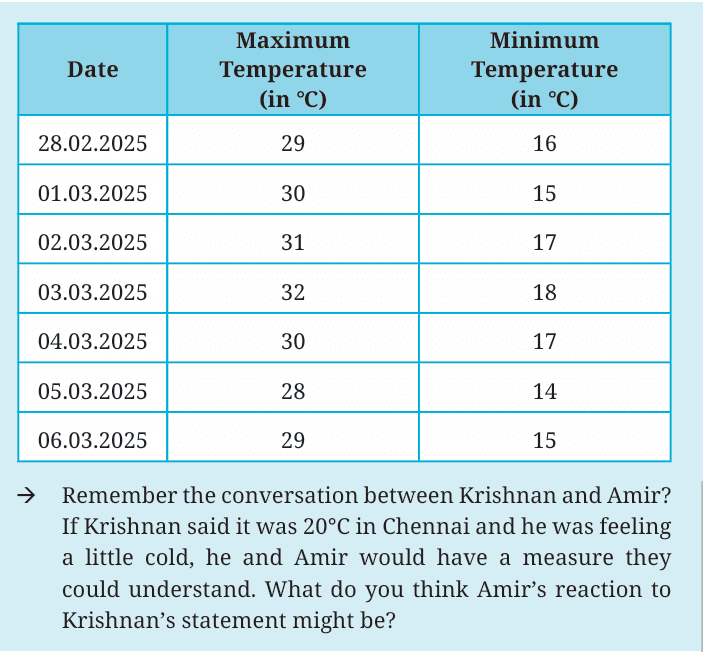
Answer (Fig. 2.5)
Step 1: Find the maximum temperature
- The highest maximum temperature in the week is 32°C
(recorded on 03.03.2025).
Step 2: Find the minimum temperature
- The lowest minimum temperature in the week is 14°C
(recorded on 05.03.2025).
Step 3: Calculate the range of temperature
- Range = Maximum temperature − Minimum temperature
- Range = 32°C − 14°C = 18°C
Final Answer:
- Maximum temperature: 32°C
- Minimum temperature: 14°C
- Range of temperature: 18°C
👉 This shows that the temperature changed a lot during the week.
THINK ABOUT IT (Pg. 35)
Why do you think it would be important to measure atmospheric pressure? Who are the people most likely to use such measurements?
Answer: Sample Answer
Why is it important to measure atmospheric pressure?
- Changes in atmospheric pressure help us predict weather changes.
- A drop in pressure can warn us about storms or cyclones.
- Measuring pressure helps in giving early warnings and keeping people safe.
Who uses these measurements?
- Meteorologists – to predict weather.
- Pilots – for safe flying.
- Sailors and fishermen – to avoid storms at sea.
- Disaster management teams – to prepare for cyclones and storms.
Conclusion: Measuring atmospheric pressure helps in weather forecasting and safety.
LET’S EXPLORE (Pg. 37)
Where do you think humidity is likely to be more, Kochi or Jaipur? You might guess that Kochi has higher humidity than Jaipur because it is located near the sea. But how will we know for sure? If we had to compare the humidity level between Kochi and Mangaluru, how would we do it? Discuss with your classmates.
Answer: Sample Answer
- Humidity is likely to be higher in Kochi than in Jaipur.
- Kochi is a coastal city, so the air contains more water vapour.
- Jaipur is far from the sea, so the air is drier.
How will we know for sure?
- We will measure humidity using an instrument called a hygrometer.
- The humidity is measured as relative humidity (%).
Comparing Kochi and Mangaluru
Both cities are near the sea. To compare them, we will:
- Measure humidity in both places using hygrometers.
- Compare their percentage values.
The place with the higher percentage has more humidity.
Conclusion: Humidity is compared using proper measurements, not guesses.
THINK ABOUT IT (Pg. 38)
If the humidity in Delhi is at 52% while in Kochi it is 84%, in which of the two places are wet clothes likely to dry faster? And where are you likely to sweat more, assuming the temperature is the same in both places?
Answer: Sample Answer
- Wet clothes will dry faster in Delhi.
- Delhi has 52% humidity, which is lower.
- Lower humidity means faster evaporation.
- You will sweat more in Kochi.
- Kochi has 84% humidity, which is very high.
- High humidity slows evaporation of sweat, so we feel more sweaty and uncomfortable.
Conclusion:
- Low humidity → clothes dry faster
- High humidity → more sweating
LET’S EXPLORE (Pg. 41)
Discuss, in pairs, different situations in which weather predictions are helpful. Make a list, and after you have completed it, share it and discuss it with the pair sitting next to you. How many different categories of situations have you been able to identify?
Answer: Sample Answer
Weather predictions are helpful in many situations. Some important ones are listed below:
- Daily Life
- Planning school, travel, and outdoor activities
- Carrying umbrellas or warm clothes
- Agriculture
- Sowing seeds at the right time
- Planning irrigation and harvesting
- Travel and Transport
- Safe flying for pilots
- Safe sailing for ships and boats
- Planning road travel during fog or rain
- Disaster Management
- Preparing for floods, cyclones, heat waves, and cold waves
- Evacuating people from danger areas
- Fishing and Coastal Activities
- Warning fishermen before storms
- Avoiding rough sea conditions
- Health and Safety
- Protecting people during heat waves or cold waves
- Planning hospital and emergency services
Number of categories identified: Six
Conclusion: Weather predictions help people plan better, stay safe, and save lives.
LET’S EXPLORE (Pg. 41)
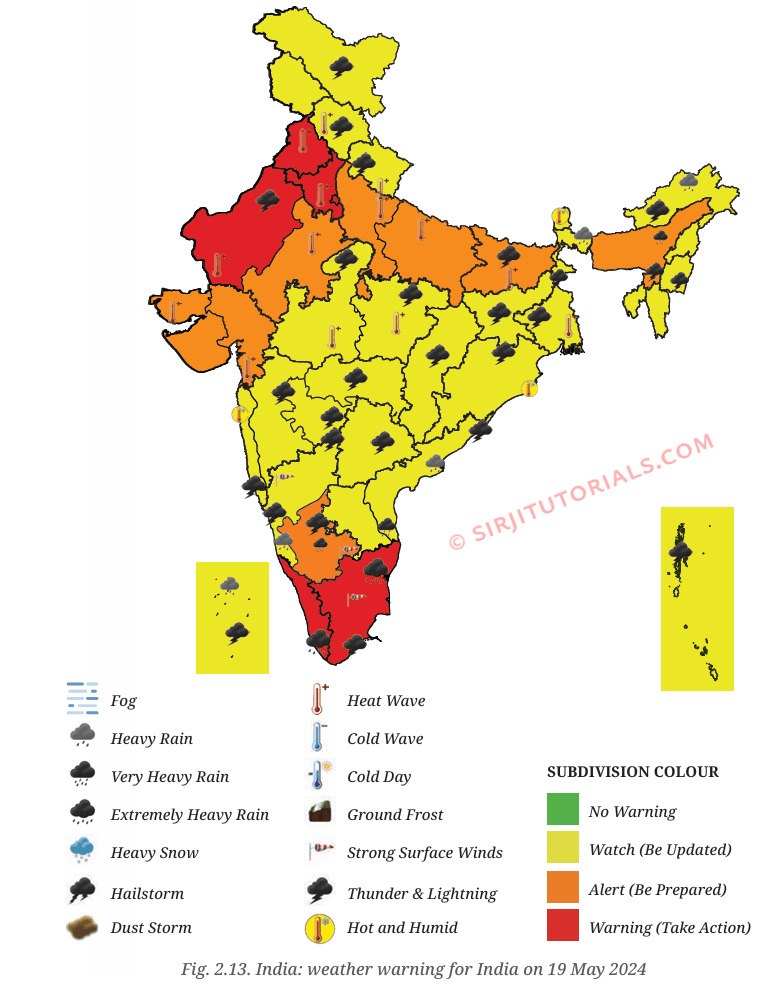
- What do you observe happening on that day? What are the various weather conditions that the IMD is alerting people to?
- Which states have warning signs?
- Which parts of India are likely to be free from severe weather?
- Which states are likely to face heat wave conditions?
- What are the causes for warning in Tripura and Lakshadweep?
Answer: Sample Answers
(Based on IMD Map, Fig. 2.13) The map was issued by the India Meteorological Department on 19 May 2024.
1. What do you observe happening on that day?
- Different parts of India are facing different weather conditions.
- IMD is alerting people about:
- Heat waves
- Heavy rain
- Thunderstorms
- Strong winds
- Cyclone-related conditions
2. Which states have warning signs?
- Tripura
- Lakshadweep
- Some coastal and eastern states
- Parts of central and southern India
These areas are marked with alert or warning symbols.
3. Which parts of India are likely to be free from severe weather?
- Some parts of north-western and central India
- Areas with no warning symbols on the map
- These regions are shown as safe or normal on that day.
4. Which states are likely to face heat wave conditions?
- Parts of:
- Rajasthan
- Madhya Pradesh
- Uttar Pradesh
- Interior Maharashtra
- These areas are marked with heat wave symbols/colours.
5. What are the causes for warning in Tripura and Lakshadweep?
- Tripura:
- Warning due to heavy rainfall and thunderstorms
- Lakshadweep:
- Warning due to stormy weather and strong winds over the sea
- Possible effect of cyclonic conditions
Conclusion:
- The IMD map helps people understand where and what type of danger is expected.
- Such warnings help in early preparation and safety.
Chapter End Exercise Questions and Activities
Chap 2: Understanding Weather – Class 7
Note: To assist students, some questions may have more than one possible answer (e.g., 1st Set, 2nd Set, etc.). Students can choose the one that works best for them.
Question 1
Match the instrument with the weather element it measures.
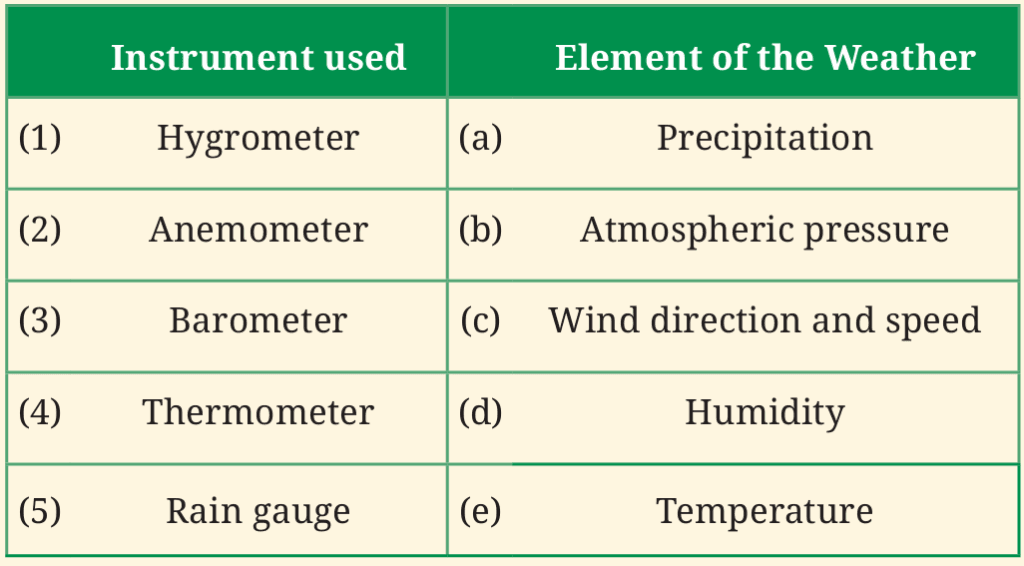
Answer:
| Instrument | Element of Weather |
| (1) Hygrometer | (d) Humidity |
| (2) Anemometer | (c) Wind direction and speed |
| (3) Barometer | (b) Atmospheric pressure |
| (4) Thermometer | (e) Temperature |
| (5) Rain gauge | (a) Precipitation |
Question 2
Jyotsna is deciding what clothes to pack for her school trip to Mumbai in June. She looks at the weather forecast, which predicts 29°C and 84% humidity. What would be your advice to her?
Answer:
Jyotsna should pack light, loose, and cotton clothes.
The temperature is moderate, but the humidity is very high, which means she will sweat more.
Cotton clothes absorb sweat and keep the body cool.
She should also carry:
- An extra set of clothes
- A cap or hat
- A water bottle
This will help her stay comfortable in humid weather.
Alternative Answer: (2nd Set)
- Mumbai will be warm and very humid.
- Jyotsna should pack:
- Light cotton clothes
- Loose and breathable clothes
- Extra clothes (because sweating will be more)
- She should avoid thick or tight clothes.
Reason:
High humidity (84%) makes us sweat more and feel uncomfortable.
Question 3
Imagine that a small group of students is setting up a rain gauge.
Here are some options for the site:
- The school vegetable garden.
- The terrace of the school building.
- Open ground with elevated platform.
- Compound wall of school.
- 5. Verandah of the school laboratory.
Discuss in your group and finalise the site. Write down the reasons for your decision.
Answer:
Choosing a suitable place to set up a rain gauge
The best place to set up a rain gauge is an open ground with an elevated platform.
Reasons:
- It is an open area, so rain is not blocked by trees or buildings.
- The elevated platform prevents water splashing from the ground.
- The rain gauge can stand straight and will not tilt.
- It gives accurate rainfall measurement.
Alternative Ans: (2nd Set)
Best option: (3) Open ground with elevated platform
Reasons:
- It is an open area.
- No buildings or trees block the rain.
- Elevated platform keeps it safe from flooding.
- Gives accurate rainfall measurement.
Why other places are not suitable:
- Garden or verandah → plants and roofs block rain
- Terrace or wall → wind and splashing affect reading
Question 4
Below is a chart taken from IMD, Jammu and Kashmir. Looking at the data available, write a short script to report 3the weather conditions in different parts of Jammu and Kashmir on the date shown. (Hint: Cover the temperature range, maximum and minimum temperatures, humidity, precipitation, etc.)
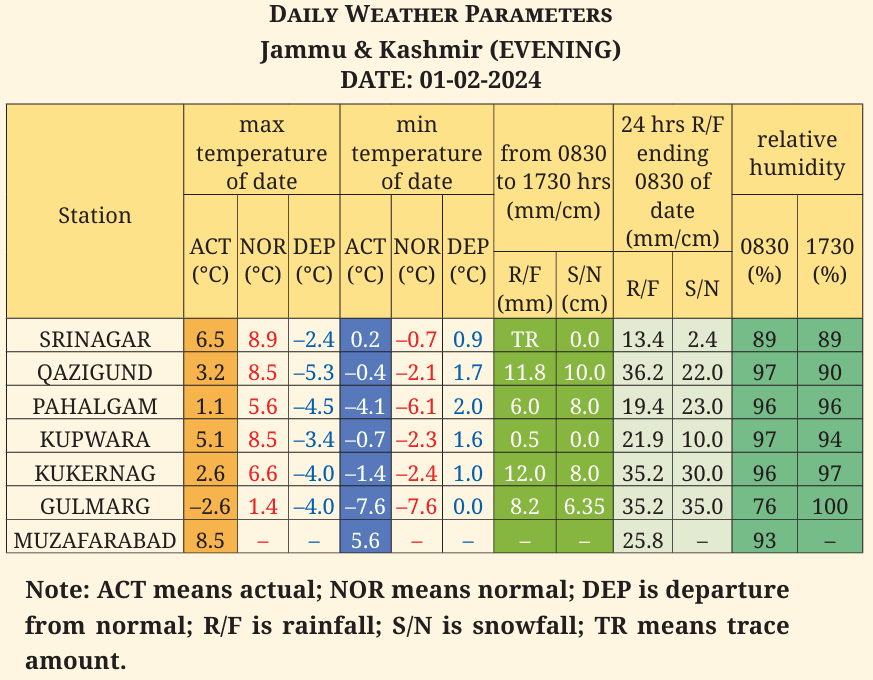
Answer: (Sample Weather Report):
We are giving here a few Sample Weather Reports to help students draft their own one.
Answer (1st Set)
On 1 February 2024, Jammu and Kashmir experienced cold weather conditions.
Most places recorded low temperatures, especially Gulmarg, where the temperature went below zero.
There was rainfall and snowfall in many areas.
Humidity levels were high, showing cold and moist weather.
Overall, the weather was cold, cloudy, and wet in most parts of the region.
Alternative Answer (2nd Set)
On 1 February 2024, the weather in Jammu and Kashmir was very cold.
Many places recorded low maximum and minimum temperatures.
Gulmarg experienced extremely cold conditions with temperatures below 0°C, indicating snowfall.
Several regions like Srinagar, Pahalgam, and Kupwara received rainfall and snowfall, while humidity levels remained very high throughout the day.
High humidity and low temperatures show that the weather was cold, wet, and cloudy.
Overall, the region experienced severe winter conditions, especially in higher areas.
👉 This weather report clearly shows cold weather with snowfall and high humidity in most parts of Jammu and Kashmir.
Alternative Answer (3rd Set)
(Date: 01-02-2024)
On 1st February 2024, Jammu and Kashmir experienced cold weather conditions.
Srinagar recorded a maximum temperature of 6.5°C and a minimum of 0.2°C, with very high humidity.
Gulmarg was the coldest place with temperatures falling below 0°C and snowfall recorded.
Many places showed high humidity levels, indicating cold and moist air.
Light rainfall and snowfall were reported in several areas.
Overall, the region experienced cold, wet, and wintry weather conditions.