

Find here the summary, meanings, character sketches, and answers for the lesson ‘Chuskit Goes to School’ from the Class 8 English book titled ‘Lavender’, including responses to both in-text and chapter-end questions.
Summary of “Chuskit Goes To School”
Chuskit is a young girl who lives in a village in Ladakh. She cannot walk because her legs do not work properly. So, she uses a wheelchair to move around.
Even though her school is not very far, the path is rough and there is a stream in between. Because of this, Chuskit cannot go to school like other children. This makes her feel sad, but she still dreams of studying, making friends, and carrying a school bag.
One day, a boy named Abdul meets Chuskit and learns about her problem. He feels that it is unfair because every child has the right to education. So, he talks to the Headmaster of the school.
The Headmaster and teachers decide to help. All the children and teachers work together. They clean and level the path and build a small bridge over the stream.
At last, the path becomes smooth and safe for Chuskit’s wheelchair. Now, she can finally go to school. Chuskit feels very happy because her dream has come true.
Message of the Lesson
This story teaches us to be kind, helpful, and sensitive to others. It also shows that every child has the right to education, and together we can solve problems.
Vocabulary
eagerly: very excitedly (उत्साह से) | Ladakh: a cold desert region in India (लद्दाख – भारत का एक पहाड़ी क्षेत्र) | apricot: a small, soft, yellow-orange fruit (खुबानी) | bloom: to produce flowers (फूल खिलना) | magpies: black and white birds (एक प्रकार की चिड़िया) | merrily: in a happy and cheerful way (खुशी से) | pebbly: (full of small stones (कंकड़-पत्थरों से भरा) | get stuck in: to become unable to move (फँस जाना) | enough-enough: stop now, that is sufficient (बस करो/बहुत हो गया) | planks: long flat pieces of wood (लकड़ी के तख्ते) | willow: a tree with long thin branches (विलो/एक प्रकार का पेड़) | wipe: to clean or remove by rubbing (पोंछना).
Ama-ley: mother (माँ) | Losar: Ladakhi New Year festival (लद्दाख का नववर्ष त्योहार) | Gonpa-festival: (festival at a monastery/temple (मठ/गोंपा का त्योहार) | Aba-ley: father (पिता) | Julley: a greeting used for hello/thank you/goodbye (नमस्ते/धन्यवाद कहने का तरीका) | Meme-ley: grandfather (दादा/नाना) | Azhang-ley: respected elder or uncle (आदरणीय बुजुर्ग/चाचा).
Answers to In-text Questions
1. Does it seem strange to you that Chuskit should be excited about going to school at the age of nine? Why do you think she had never been to school?
Ans. Yes, it seems a little strange because most children start school earlier.
Chuskit had never been to school because she could not walk and the path to school was rough and difficult for her wheelchair.
2. Can you tell what kind of emotions the grandfather was going through while saying these words?
Ans. The grandfather was feeling sad, worried, and helpless. He loved Chuskit but thought it was not possible for her to go to school.
3. Why is it important to be sensitive to the needs of others?
Ans. It is important because it helps us understand others’ problems and support them. When we care and help, we can make life better and happier for everyone.
Answers to Chaper-end Questions-Chuskit Goes to School
Time to answer
A. Choose the correct option.
- Which season is depicted in the story?
summer winter spring monsoon - What is the setting of the story?
Jammu and Kashmir Ladakh Punjab Uttar Pradesh - Which day would prove to be memorable for Chuskit?
the Losar festival
the Gonpa festival
a wedding day
the first day of school - What was hampering Chuskit from going to school?
the distance of the school
her disability to walk
her reluctance towards school
denial from her grandfather - Who played a major role in fulfilling Chuskit’s dream?
Stobdan Aba-ley Meme-ley Abdul
Answers:
- spring
- Ladakh
- the first day of school
- her disability to walk
- Abdul
B. Answer these questions
1. Describe the scene that Chuskit woke up to that spring morning.
2. Why had Chuskit been unable to go to school all those years?
3. What were some of the skills that Chuskit was better at than her younger brother and cousins?
4. What did the arrival of the wheelchair mean to the following?
a. Chuskit
b. Ama-ley
c. Stobdan
d. Billa
5. Who was Abdul and what part did he play in Chuskit’s life?
6. How did the students at the Government school help Chuskit come to school? Answer in about 100 words.
ANSWERS:
1. Describe the scene that Chuskit woke up to that spring morning.
Ans. Chuskit woke up to a beautiful spring morning in Ladakh. The apricot trees were full of flowers. Two magpies were searching for insects. Her mother was in the kitchen making tea. Everything looked fresh, bright, and lively.
2. Why had Chuskit been unable to go to school all those years?
Ans. Chuskit could not walk because of her disability. The path to school was rough and uneven, and there was a stream on the way. Her wheelchair could not move easily on such a path.
3. What were some of the skills that Chuskit was better at than her younger brother and cousins?
Ans. Chuskit was very good at stitching and drawing. She could draw beautiful pictures of what she saw from her window.
4. What did the arrival of the wheelchair mean to the following?
Ans.
a. Chuskit
It gave her freedom to move around and hope to go places on her own.
b. Ama-ley
It made her happy because she did not have to carry Chuskit everywhere.
c. Stobdan
He felt excited and wanted to ride the wheelchair for fun.
d. Billa
The cat found it comfortable and liked sitting on it.
5. Who was Abdul and what part did he play in Chuskit’s life?
Ans. Abdul was a boy from the same village who studied in the Government School. He helped Chuskit by talking to the Headmaster and suggesting ways to make the path easier. Because of him, Chuskit was able to go to school.
6. How did the students at the Government school help Chuskit come to school? (100 words)
Ans. The students and teachers of the Government School worked together to help Chuskit. They divided themselves into groups and started working on the path from her house to the school. Some children removed stones and levelled the uneven ground. Others helped build a strong wooden bridge across the stream. They worked happily, singing and helping each other. By the end of the day, the path became smooth and safe for Chuskit’s wheelchair. Because of their teamwork and kindness, Chuskit could finally go to school and fulfil her dream.
Another Set of Answers:
1. Chuskit saw a bright spring morning with blooming apricot trees, magpies, and her mother making tea.
2. She could not walk, and the rough path and stream made it difficult for her wheelchair.
3. She was better at stitching and drawing than others.
4.
a. Chuskit: freedom to move
b. Ama-ley: relief from carrying her
c. Stobdan: excitement and fun
d. Billa: a comfortable place to sit
5. Abdul was a school boy who helped Chuskit by planning a way for her to reach school.
6. The students and teachers of the Government School worked together to help Chuskit. They divided into groups and began improving the path from her home to the school. Some children cleared stones and levelled the uneven ground so that the wheelchair could move easily. Others worked with teachers to build a strong wooden bridge across the stream. Everyone worked happily, singing and helping one another. By the end of the day, the path was smooth and safe. Their teamwork and kindness made it possible for Chuskit to go to school for the first time and achieve her dream.
Reference to Context
Read these lines from the story and answer the questions that follow.
1. Once you got to the other side, a short walk up a slope took you to the school. All the children of Skitpo
Yul, Chuskit’s village, walked to school every day and with ease. But not little Chuskit.
a. Which route is being described here?
Ans. The route from Chuskit’s house to the school is being described.
b. Do you think the route to the school was easy?
Ans. No, it was not easy because it had a rough path, slope, and a stream to cross.
c. Would you have loved to take such a route to your school? Give reasons.
Ans. No, because it would be difficult and tiring. It may also be unsafe, especially during bad weather.
d. Why was Chuskit not able to go to school?
Ans. Chuskit could not walk, and the rough path and stream made it difficult for her wheelchair.
2. ‘Azhang-ley, last week we read about the fundamental rights of citizens in our civics class. All children have a right to education. That includes Chuskit as well, does it not?”
a. Who is the speaker and with whom is he speaking?
Ans. The speaker is Abdul, and he is speaking to the Headmaster.
b. Does the speaker’s logic about Chuskit’s right to education sound correct? Why or why not?
Ans. Yes, it is correct because every child has the right to education, including children with disabilities.
c. According to you, what kind of person is the speaker?
i. indifferent ii. sensitive iii. mean iv. selfish
Ans. ii. sensitive
d. Why do you think that right to education is a fundamental right?
Ans. It is a fundamental right because education helps children learn, grow, and have a better future.
Time to think and answers
1. If you were Abdul, what would you have done to help Chuskit?
2. You have learnt how to write character sketches of people in an earlier lesson. Try to bring out some personality traits of the following characters from the story:
a. Chuskit
b. Aba-ley
c. Abdul
d. The Headmaster of the village school
Remember to justify your answer with examples from the story.
For example, Chuskit can be described as enthusiastic. This is proved by the fact that despite her disability, she is eager to learn and go to school.
3. The whole school, including the Headmaster and the staff, made a combined effort to help Chuskit realise her dream of going to school. What does this action of theirs prove?
ANSWERS:
1. If you were Abdul, what would you have done to help Chuskit?
Ans. If I were Abdul, I would talk to the teachers and villagers to help Chuskit. I would try to make the path smooth and safe for her wheelchair so she could go to school easily.
2. You have learnt how to write character sketches of people in an earlier lesson. Try to bring out some personality traits of the following characters from the story:
a. Chuskit
b. Aba-ley
c. Abdul
Answer.
a. Chuskit– Chuskit is brave and determined. Even though she cannot walk, she dreams of going to school and learning like other children.
b. Aba-ley– Aba-ley is loving and encouraging. He supports Chuskit and comforts her by praising her skills like drawing and stitching.
c. Abdul– Abdul is kind and helpful. He understands Chuskit’s problem and takes the initiative to help her go to school.
d. The Headmaster– The Headmaster is supportive and practical. He listens to Abdul and helps organise the plan to make the school accessible for Chuskit.
3. The whole school, including the Headmaster and the staff, made a combined effort to help Chuskit realise her dream of going to school. What does this action of theirs prove?
Ans. It proves that teamwork and kindness can solve problems. When people work together and care for others, they can make a big difference in someone’s life.
One more set of answers
1. I would first understand her problem and then discuss it with my teachers and friends. I would suggest making the path easier and helping her reach school safely.
2. Character Sketches:
a. Chuskit
Chuskit is hopeful and hardworking. She keeps learning at home and dreams of going to school despite her difficulties.
b. Aba-ley
Aba-ley is caring and supportive. He brings colours for Chuskit and encourages her to use her talents.
c. Abdul
Abdul is thoughtful and responsible. He remembers his lesson about the right to education and takes action to help Chuskit.
d. The Headmaster
The Headmaster is open-minded and cooperative. He listens to Abdul’s idea and motivates everyone to work together.
3. It shows that when people are united and helpful, they can overcome challenges and make dreams come true.
Time to study language
Add suitable phrases or clauses to complete these sentences as instructed.
1. They spoke to him in French …………………………. (compound sentence)
2. …………………………. I went for dinner. (simple sentence)
3. Mother scolded the daughter …………………………. (complex sentence)
4. I like fruits for breakfast …………………………. (compound sentence)
5. …………………………. in the pool. (simple sentence)
6 …………………………. we were not hungry. (complex sentence)
7. …………………………. I also love Mickey Mouse. (compound sentence)
8. The baby …………………………. (simple sentence)
ANSWERS:
-
They spoke to him in French and he replied in English.
-
In the evening, I went for dinner.
-
Mother scolded the daughter because she was careless.
-
I like fruits for breakfast but my brother prefers bread.
-
The children were swimming happily in the pool.
-
Although we had food earlier, we were not hungry.
-
I love cartoons and I also love Mickey Mouse.
-
The baby was sleeping peacefully.
Time to learn new words
(See the book for the question)
ANSWER:
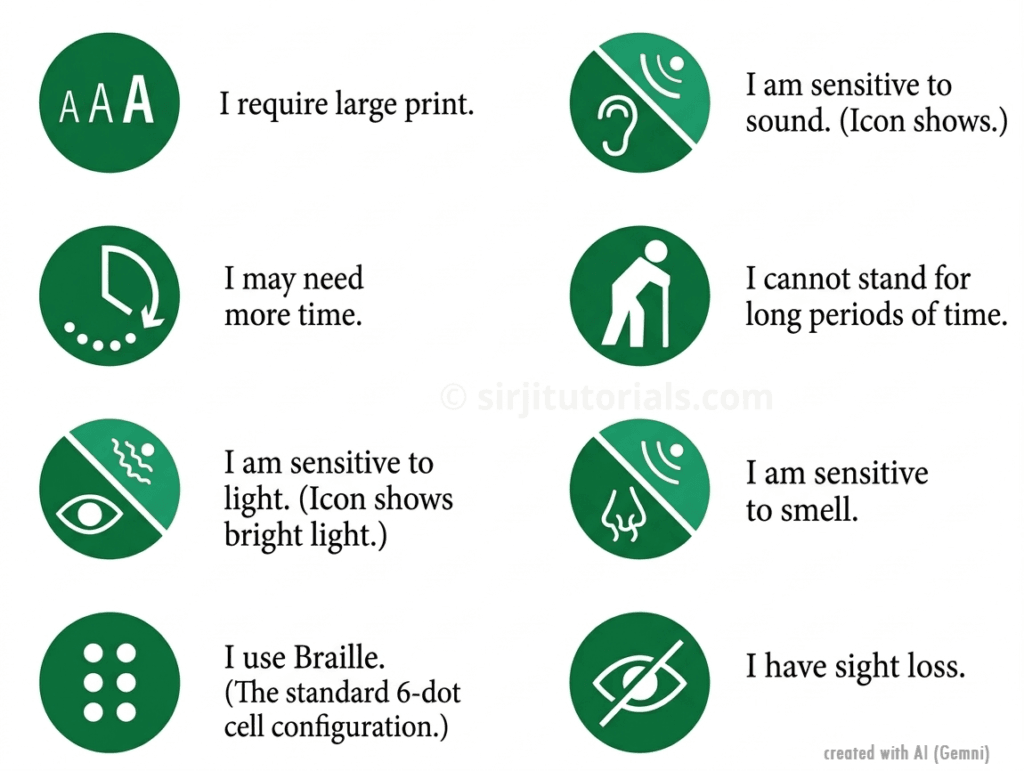
Disability Symbols are matched here.
Study skills
Write five words that come to your word when you hear these words. (see the book for the full question)
ANSWER:

Time to speak
Chuskit wants to deliver a speech in the morning assembly on her first day of school. She wants to express her gratitude to everyone who made her dream of being able to attend school, come true. Write the speech on her behalf.
ANSWER:
A Speech of Gratitude
Opening Statement“Good morning to our respected Headmaster, teachers, and my dear friends. My name is Chuskit, and today is the happiest day of my life because I am finally standing here with all of you.”
The Journey“For a long time, I used to sit by my window and watch you all walk to school, laughing and carrying your bags. Because I cannot walk and the path to school was too uneven for my wheelchair, I thought going to school was a dream that would never come true. I felt very sad and lonely at times, wondering if I would ever get the chance to learn and play like everyone else.”
Expressing Gratitude“But today, I am here because of the kindness in your hearts. I want to say a huge ‘thank you’ to:
- Abdul, who first saw my situation and decided that I deserved to be in school too. Thank you for being such a wonderful friend.
- The Headmaster and our Teachers, for believing in me and encouraging the students to help.
- All my schoolmates, who worked so hard in the sun to level the road and build the bridge across the river. You didn’t just build a path of stones; you built a path to my future.”
Closing Statement“Thank you also to my parents, Aama-le and Aaba-le, for never giving up on me. I promise to work hard, learn as much as I can, and be a good friend to all of you. Thank you for making my dream come true!”
Another Speech Example
Good morning respected Principal, teachers, and my dear friends.
Today is a very special day for me. It is my first day at school, and I feel very happy and excited to stand here before you all.
For many years, I could not come to school because I cannot walk, and the path to school was very difficult for my wheelchair. I used to feel sad when I saw other children going to school. I always dreamed of studying, making friends, and learning new things like all of you.
But today, my dream has come true. This is only because of the kindness and help of many people. I would like to thank Abdul, our Headmaster, all the teachers, and my dear friends who worked hard to make the path smooth and build a bridge for me.
Your help has changed my life. You have shown me that when we care for others and work together, we can do anything.
Thank you everyone for giving me this wonderful chance to study and be a part of this school.
Thank you and have a nice day. 🙏
Fun time
Find information about one non-governmental organisation (NGO) that is leaving an indelible mark in the lives of the blind through various interventions, such as education, rehabilitation, livelihood generation and care.
ANSWER:
Example of an NGO Helping the Blind
National Association for the Blind (NAB), India
The National Association for the Blind is a well-known non-governmental organisation in India that works to improve the lives of people who are blind or visually impaired.
What the NGO does: (nabindia.org.in)
- Education:
NAB provides education and learning support to visually impaired children so they can study and grow like other children. - Rehabilitation:
It helps people become independent by teaching daily life skills and mobility training. - Livelihood generation (jobs):
NAB offers training and skill development so that people can find jobs and earn a living. - Care and support:
The organisation provides guidance, counselling, and a supportive environment to help them live with confidence.
Impact:
This NGO helps visually impaired people become independent, confident, and active members of society. It works to give them equal opportunities in education and employment.
Conclusion (Simple Line):
NAB is making a big difference by helping blind people live better and more independent lives.