

Find detailed question-and-answer solutions for the poem “Sympathy” from the Class 7 English Lavender Book by Headword Publications.
Also Read..
Sympathy Poem Summary, Explanations & CBQs
Sympathy Poem Class 7 Lavender English Textbook Question and Answers
Time to Start
Every Indian state has a state bird. Each of these birds is an eminent part of the biodiversity of the particular state. The birds are protected and conserved in their natural habitat. Match the different state birds with their respective state.
(See the book for full questions)
Answer:
| Bird Name | State Name |
|---|---|
| 1. Northern Goshawk | b. Punjab |
| 2. Blyth’s Tragopan | d. Nagaland |
| 3. Greater Flamingo | a. Gujrat |
| 4. Asian Paradise Flycatcher | e. Madhya Pradesh |
| 5. White-throated Kingfisher | c. West Bengal |
Time to Answer
A. Choose the Correct Option
1. How does the caged bird feel?
◻helpless ◻envious ◻angry
Ans: ✅ helpless
(Explanation: The bird is trapped in a cage and cannot enjoy freedom, so it feels helpless.)
2. Which line in the poem tells us about the time of the day?
◻ When the sun is bright on the upland slopes;
◻ When the wind stirs soft through the springing grass,
◻ And the river flows like a stream of glass;
◻ When the first bird sings and the first bud opes
Ans: ✅ “When the sun is bright on the upland slopes;”
(Explanation: Bright sun suggests daytime.)
3. Which of the following quotes best describes the caged bird’s condition?
◻ Freedom gives you the power to fly.
◻ Freedom lies in being bold.
◻ Freedom always comes with a price.
◻ Freedom, in any case, is only possible by constantly struggling for it.
Ans: ✅ Freedom, in any case, is only possible by constantly struggling for it.
(Explanation: The bird keeps beating its wings despite pain, showing constant struggle for freedom.)
4. Which word can replace ‘carol’ in the poem?
◻ legend
◻ prayer
◻ song
◻ tale
Ans: ✅ song
(Explanation: A carol means a song.)
5. What are some of the elements that are outside the bird’s cage?
Ans: ✅ iv. all of them
(Explanation: The sun, wind, and river are all mentioned as part of the outside world.)
B. Answer these questions.
1. What is the state of mind of the caged bird in the first stanza? Make a list of the words, images or lines that support your answer.
2. What is the caged bird’s desire?
3. Why does the caged bird sing? What is his song about?
Answers:
1. What is the state of mind of the caged bird in the first stanza?
Ans. The caged bird feels sad, helpless, and frustrated.
Words like alas, caged, and the contrast with free nature show its unhappiness.
2. What is the caged bird’s desire?
Ans. The caged bird’s desire is freedom—to fly freely on tree branches like other birds.
3. Why does the caged bird sing? What is his song about?
Ans. The caged bird sings because it is in pain.
Its song is not joyful; it is a prayer and a plea for freedom.
Long Answers
1. What is the state of mind of the caged bird in the first stanza? Make a list of the words, images or lines that support your answer.
Ans. The caged bird feels sad, helpless, and frustrated. Though nature is beautiful outside, the bird cannot enjoy it. Words and images like “alas,” “caged bird,” bright sun, soft wind, and flowing river highlight its sadness.
2. What is the caged bird’s desire?
Ans. The caged bird desires freedom. It wants to fly freely in the open sky, sit on tree branches, and enjoy nature like other birds. Its repeated struggle against the cage shows a strong longing for liberty.
3. Why does the caged bird sing? What is his song about?
Ans. The caged bird sings because it is in pain and suffering. Its song is not joyful; it is a prayer and plea for freedom. The song expresses hope, faith, and a deep wish to escape captivity.
Reference to the context
Read the line from the poem and answer the questions that follow.
1.
“I know what the caged bird feels, alas!
When the sun is bright on the upland slopes;
When the wind stirs soft through the springing grass,
And the river flows like a stream of glass;”
a. Who is ‘I’ in these lines? Why does the speaker exclaim ‘alas’?
Ans. ‘I’ refers to the poet.
He exclaims alas because he feels sad and sympathetic towards the caged bird.
b. Do you think the bird in the cage is happy? Give reasons.
Ans. No, the bird is not happy.
It can see the beauty of nature but cannot enjoy it because it is trapped.
2.
“For he must fly back to his perch and cling
When he fain would be on the bough a-swing;
And a pain still throbs in the old, old scars
And they pulse again with a keener sting—
I know why he beats his wing!”
a. Who is ‘he’ in these lines?
i. sun
ii. wind
iii. river
iv. all of them
Ans. ✅ i. the caged bird
b. Where is ‘he’ now? And where does ‘he’ want to be?
Ans. He is inside the cage, on a perch.
He wants to be free on a tree branch, swinging happily.
c. What does the reference to ‘old, old scars’ suggest?
Ans. It suggests past suffering that still causes pain.
The bird has been hurt many times earlier.
d. Why does ‘he’ beat his wings? What happens as a result?
Ans. He beats his wings to escape and gain freedom.
As a result, he gets hurt and bleeds, and old wounds pain him again.
3.
“But a prayer that he sends from his heart’s deep core,
But a plea, that upward to Heaven he flings—
I know why the caged bird sings!”
a. What does the caged bird send out from his heart’s deep core?
Ans. The caged bird sends out a prayer.
b. What is the plea for?
i. freedom
ii. well-being
iii. good health
iv. survival
Ans. ✅ i. freedom
c. Why does the speaker end the poem with the line “I know why the caged bird sings”?
Ans. The poet ends the poem this way to emphasise his deep understanding of the bird’s pain and hope.
Time to Think and Answer
1. What does the ‘cage’ in the poem represent?
2. Why do you think the poem has the title ‘Sympathy’?
3. Can you relate to this poem? Why or why not?
Answers:
1. What does the ‘cage’ in the poem represent?
Ans. The cage represents oppression, slavery, and loss of freedom.
2. Why do you think the poem has the title ‘Sympathy’?
Ans. The poem is titled Sympathy because the poet feels deep pity and understanding for the suffering of the caged bird.
3. Can you relate to this poem? Why or why not?
Ans. Yes, we can relate to the poem because everyone feels unhappy when freedom is restricted or when treated unfairly.
Long Answers
1. What does the ‘cage’ in the poem represent?
Ans. The ‘cage’ in the poem represents oppression, injustice, and loss of freedom. It symbolises the conditions in which people are controlled and denied basic rights. Just as the bird is trapped and cannot fly freely, many people in society are restricted by unfair laws, discrimination, or slavery. The cage also represents mental and emotional imprisonment, where even hope feels limited. Through the image of the cage, the poet shows how painful life becomes when freedom is taken away.
2. Why do you think the poem has the title ‘Sympathy’?
Ans. The poem is titled ‘Sympathy’ because the poet shows deep understanding, pity, and compassion for the caged bird. He does not judge or ignore the bird’s suffering; instead, he feels its pain as his own. By repeating lines like “I know what the caged bird feels” and “I know why the caged bird sings,” the poet expresses emotional closeness. The title highlights the poet’s caring attitude towards all who suffer due to oppression and lack of freedom.
3. Can you relate to this poem? Why or why not?
Ans. Yes, the poem can be related to because everyone has experienced moments of restriction or unfair treatment. Students may feel trapped by rules, pressure, or expectations. Similarly, people who are treated unjustly or denied opportunities can relate to the caged bird. The poem teaches us that even in difficult situations, hope and faith remain important. This makes the poem meaningful and relatable to real-life experiences.
Time to Enjoy
1. How does Paul Laurence Dunbar use symbolism in the poem? Explore how the symbolism contributes to the overall meaning of the poem.
2. When a phrase or a line is repeated at intervals within a poem, especially at the end of a stanza, we call it a refrain. Since refrains are generally repeated at regular intervals, it gives a sense of rhythm to the poem. What is the effect of using refrain in ‘Sympathy?
3. What is the rhyme scheme of the poem?
Answers:
1. How does Paul Laurence Dunbar use symbolism in the poem?
Ans. The caged bird symbolises oppressed people, while the cage represents injustice.
This symbolism helps express the pain of lost freedom powerfully.
Long Answer:
Paul Laurence Dunbar uses the symbol of the cage to show the pain and struggles of African-Americans who faced prejudice and unfair laws. The bird’s fight to escape leaves it wounded, with bruised wings and a sore chest. Just as a caged bird can’t fly freely or enjoy the beauty of nature, African-Americans were denied freedom under the oppression of white society.
2. What is a refrain? What is its effect in the poem?
Ans. A refrain is a line repeated in a poem.
In Sympathy, the repeated line adds rhythm, emphasis, and emotional strength.
The poet uses refrain to help us clearly understand the feelings of the caged bird. The bird feels sad and trapped because it cannot fly freely.
At the same time, the poet also feels the same way. He is unhappy about his own difficult situation. By using the refrain, the poet wants the readers to feel sympathy for both the caged bird and for himself.
3. What is the rhyme scheme of the poem?
Ans. The rhyme scheme of each stanza is: ABAABCC
Fun time
Look at this picture and have a discussion with your partner on how birds and animals make the world a better place to live in. (See the book for the textbook picture)
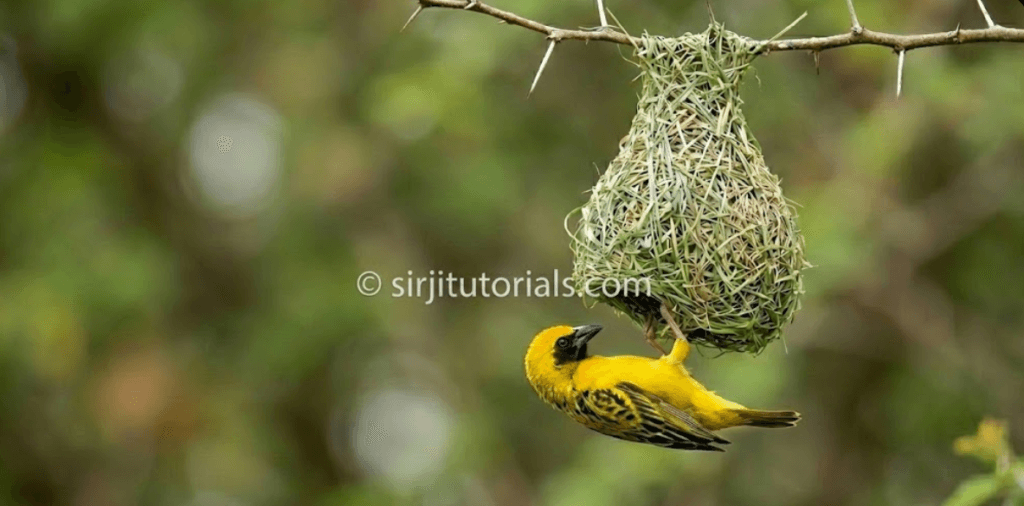
Answers: Sample answers are given here to help students draft their own answers.
Fun Ways to Answer!
Here are a few fun ways you can talk or write about this. Pick your favourite!
Option 1: Roleplay with a Friend! 🎭
(Dear Students: Grab a partner and act this out!)
Reena: Wow! Look at that bird hanging from its nest. It’s so clever!
Ajeet: Yeah, it is! The question asks how they help the world. What do you think?
Reena: I think they are like little superhero farmers! Birds eat yummy bugs and worms. This stops the bugs from eating the farmer’s veggies!
Ajeet: That’s awesome! And they help plant new trees too. When they eat fruit, they drop the seeds in new spots.
Reena: Cool! So, they save our food and grow forests.
Ajeet: You got it! The world would be way less green and a lot messier without them.
Option 2: Cool Facts ! 📝
(Dear Students: Write these down to show how smart you are!)
1. 🦸♂️ Crop Protectors! (Eating Bugs)
- Many birds love to eat insects that can hurt plants.
- This helps farmers grow yummy food without using yucky sprays.
2. 🌳 Forest Planters! (Spreading Seeds)
- Animals eat yummy fruits and berries.
- When they travel, they drop the seeds on the ground.
- These seeds grow into big, new trees! 🌲
3. ✨ Nature’s Clean-Up Crew!
- Some birds, like crows, eat things that have died.
- This helps keep our Earth clean and stops germs from spreading. Yuck!
Option 3: Short Paragraph (For Essays) 📖
(Dear Students: Use for a creative writing answer or to write a fun story.)
Two Example Paragraphs are given here.
“Our Amazing Animal Helpers
- Birds and animals are like the secret helpers of our planet! The little weaver bird in the picture shows us how to work hard and build amazing things. But birds do even more! They are like farmers because they eat pesky bugs. They are like gardeners because they plant seeds to grow new forests. They also make our world happy with their beautiful songs and colors. A world without animals would be so quiet and boring. Let’s protect our animal friends because they help keep our Earth healthy and happy! 🌍”
- “Birds and animals are the silent helpers of our planet. The weaver bird in the picture shows us the value of hard work and skill. But beyond that, birds play a big role in nature. They act as farmers by eating harmful insects, and they act as gardeners by spreading seeds to grow new forests. They also bring beauty and music to our lives. A world without animals would be silent and empty. We must protect them because they keep our environment healthy.”
More Discussion Points: How Birds & Animals Help Us
1. They are Nature’s Farmers (Ecological Balance)
- Pest Control: Many birds, like the one in the picture, eat insects and worms to feed their babies. This stops insects from destroying crops. It helps farmers grow food without using too many harmful chemical sprays.
- Pollination: Birds and insects (like bees) visit flowers to drink nectar. When they move from flower to flower, they carry pollen. This helps plants produce fruits and seeds.
- Planting Trees: Birds eat fruits and berries. When they fly away and drop their waste, the seeds fall to the ground. This plants new trees in different places, helping forests grow.
2. They Keep the Environment Clean
- Nature’s Cleaners: Some birds (like crows and vultures) and animals eat dead and decaying matter. If they didn’t do this, our surroundings would be dirty and full of diseases. They act as the natural waste management system.
3. They Teach Us Life Lessons
- Hard Work and Patience: Building a bird’s nest is a tedious task. . The bird has to fly hundreds of times to collect grass. It weaves the nest carefully. This teaches us the value of hard work and never giving up.
- Engineering Skills: Animals are great builders. Beavers build dams and birds build nests. Humans often learn building techniques by studying animals.
4. They Bring Joy and Mental Peace
- Beauty and Song: Hearing birds sing or watching a colorful butterfly makes us feel happy and calm. A world without animals would be very quiet and lonely.