

Simple and straightforward NCERT Q&A solutions for Rabindranath Tagore’s poem “Paper Boats”! This guide provides clear, step-by-step answers to all NCERT exercises, covering the “Before We Read” section, in-text questions, and end-of-text questions from pages 111-117 in the Poorvi textbook for Class 7. It’s ideal for exams and homework help.
Also See..
Paper Boats Poem Explanation
- ▶ 1 Before We-Read Activities Q&A | Class 7 NCERT English Book Poorvi Poem ‘Paper Boats’
- ▶ 2 In-text Questions – NCERT Textbook Poorvi Class 7 Poem “Paper Boats’
- 2.1 Let us discuss
- ▶ 3 End-of-the-text Questions and Answers (Pages 111-117) | NCERT Class 7 English Textbook Poem “Paper Boats”
- 3.1 Let us think and reflect
- 3.2 Let us learn
- 3.3 Let us listen
- 3.4 Let us speak
- 3.5 Let us write
- 3.6 Let us explore
- ↑ Back to top
Before We-Read Activities Q&A | Class 7 NCERT English Book Poorvi Poem ‘Paper Boats’
This section gives clear and easy answers to all NCERT exercises for the poem ‘Paper Boats’, given under the “Before We Read” section on page 109 in the NCERT English Poorvi textbook for Class 7.
Page – 109
Let us do these activities before we read.
I. Read the questions given below. Share your answers with your classmates and the teacher.
1. What comes to mind when you think about ‘paper boats’?
Ans: I think of rainy days, playing near puddles or streams, and floating small paper boats in water. It feels fun and peaceful.
2. What do you think someone might hope for when they send a paper boat down a stream?
Ans: They might hope that someone far away finds it, or they may imagine it traveling to magical places. It could also carry a message or wish.
3. Read the title of the poem ‘Paper Boats’ and predict what the poem might be about.
Ans: The poem might be about a child who floats paper boats in water and dreams about where the boats go. It may talk about imagination, dreams, and nature.
II. Read the given paragraph and match the highlighted words with their meanings given in the box below.
loading speedily flowing swelling putting bouncing
I love to play beside a 1. running stream at a short distance from my grandparent’s house. I love to see it 2. skipping along to join a river. On the river, I can see boats with 3. bulging sails moving swiftly. Some of them take the people from one shore to the other while in some of them people can be seen 4. lading things too. I can spend hours watching the busy river and dreaming about them, 5. burying my head in my pillow at night.
✅ Answer:
| Highlighted Word | Correct Meaning |
|---|---|
| 1. running | speedily flowing (बहती हुई) |
| 2. skipping | bouncing (उछलती हुई) |
| 3. bulging | swelling (फूली हुई) |
| 4. lading | loading (सामान चढ़ाना) |
| 5. burying | putting (रखना / छिपाना) |
In-text Questions – NCERT Textbook Poorvi Class 7 Poem “Paper Boats’
This section provides simple and straightforward answers to all NCERT exercises for the poem “Paper Boats,” listed under the “Let Us Discuss” section as in-text questions from pages 111-112 of the Class 7 NCERT English Poorvi textbook.
Let us discuss
(Pages 111)
I. Choose the correct words from the brackets to complete the summary of the poem given below.
The poet sends paper boats down a 1. __________ (stream/river) each day, writing his name and the name of his 2. __________ (school/ village) on them. He hopes that someone in a 3. __________ (strange/familiar) land will find them and know who he is. The poet fills his boats with 4. __________ (rose/shiuli) flowers from his garden, hoping they will be safely carried to another land at 5. __________ (night/morning). As he launches his boats, he imagines that the 6. __________ (clouds/birds) in the sky are like friends, racing with his boats. At night, he dreams that his paper boats continue to 7. __________ (swim/float) under the midnight stars, with the fairies of sleep sailing in them, their baskets full of 8. __________ (dreams/fruits).
✅ Answer:
- stream
- village
- strange
- shiuli
- night
- clouds
- float
- dreams
Completed summary:
The poet sends paper boats down a 1. stream each day, writing his name and the name of his 2. village on them. He hopes that someone in a 3. strange land will find them and know who he is. The poet fills his boats with 4. shiuli flowers from his garden, hoping they will be safely carried to another land at 5. night. As he launches his boats, he imagines that the 6. clouds in the sky are like friends, racing with his boats. At night, he dreams that his paper boats continue to 7. float under the midnight stars, with the fairies of sleep sailing in them, their baskets full of 8. dreams.
II. Choose the correct option for the following.
The theme of the poem is _________.
1. innocence 2. imagination 3. ignorance
4. playfulness 5. travel
(i) 1, 2 and 3 (ii) 3, 4 and 5 (iii) 1, 4 and 5 (iv) 1, 2 and 4
✅ Answer:
Correct Answer: (iv) 1, 2 and 4
(innocence, imagination, and playfulness)
III. Identify whether the following statement is true or false.
The setting of the poem is a natural, outdoor environment.
✅ Answer:
True
IV. Complete the following sentence by choosing the correct word given within the brackets.
The tone is ________ (sad and serious/gentle and wishful) and the mood is ________ (thoughtful/boring).
✅ Answer:
Tone: gentle and wishful
Mood: thoughtful
V. Identify the examples of alliteration from the poem.
✅ Answer:
Examples of alliteration (repletion of consonant sound in the beginning of words are:
“Day by day” – (‘d‘ sound repeated)
“Big black” – (‘b‘ sound repeated)
“Someone in some strange” – (‘s‘ sound repeated)
VI. Fill in the blanks with suitable words from the poem.
- The repetition of words ____ and ____ emphasises the passage of time.
- The poet uses imagery like ____ and ____ to create a clear picture in the minds of the readers.
✅ Answer:
- The repetition of words day and night emphasises the passage of time.
- The poet uses imagery like paper boats and shiuli flowers to create a clear picture in the minds of the readers.
(Page – 112)
VII. Match the descriptions in Column 1 with what they symbolise in Column 2.

✅ Answer:
| Column 1 | Column 2 |
|---|---|
| 1. the child’s innocence, dreams, hopes, and messages sent out into the world | (ii) paper boats |
| 2. purity, beauty, and the start of a new day | (iii) shiuli flowers |
| 3. the vast universe and the child’s dreams continuing through the night | (i) midnight stars |
End-of-the-text Questions and Answers (Pages 111-117) | NCERT Class 7 English Textbook Poem “Paper Boats”
This section provides simple, thorough, and easy-to-understand answers to all NCERT questions and exercises found at the end of the poem ‘Paper Boats’ on pages 112 to 117 in the NCERT English Poorvi textbook for Class 7.
Let us think and reflect
I. Read the extract given below and answer the questions that follow.
- When night comes I bury my face in my arms and dream that my paper boats float on and on under the midnight stars. The fairies of sleep are sailing in them, and the lading is their baskets full of dreams.
(i) Select the option that is most likely to be the speaker as per the extract.
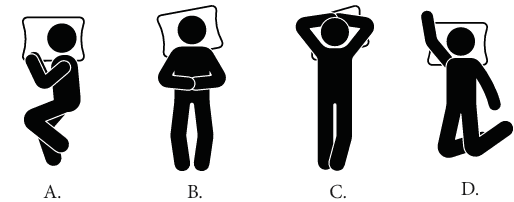
(ii) What can be inferred about the speaker’s feelings when night comes?
(iii) What kind of beings are the ‘fairies of sleep’ imagined as? Select the most appropriate option.
A. mischievous
B. gentle
C. fearsome
D. playful
(iv) Fill in the blank by selecting the correct option from those given in the brackets.
The phrase ‘lading is their baskets full of dreams’ suggests that the speaker imagines the fairies of sleep carefully _____ (carrying his dreams /collecting his wishes) in their baskets.
✅ Answers:
(i) Correct option: A
(Explanation: Why? The speaker is resting their face gently in their arms, lost in deep thought or a dream, just like in option A.)
(ii) At night, the speaker feels peaceful and dreamy. He imagines wonderful things like boats sailing under stars and fairies bringing dreams, which shows a calm, imaginative, and hopeful mood.
(iii) Correct option: B. gentle
(Explanation: Why? The fairies are softly sailing the boats and carrying baskets full of dreams — this gives a picture of kind, soft, and gentle beings.
(iv) carrying his dreams
(Complete sentence: The phrase suggests that the speaker imagines the fairies of sleep carefully carrying his dreams in their baskets.)
II. Answer the following questions.
- Why do you think the poet writes his personal details on the paper boats?
- The poet talks about the imagination of a child. Support this view with examples from the poem.
- How does the poet bring together imagination and reality to make the poem more interesting?
✅ Answers. Short and Long answers are given here.
Q1. Why do you think the poet writes his personal details on the paper boats?
Ans (short): So that someone who finds the boat can know who he is and where he lives.
Ans (Long): The poet writes his name and the name of his village on the paper boats because he hopes that someone in a faraway land will find them and know who he is.
This shows his wish to connect with the world and make new friends through his boats.
Q2. The poet talks about the imagination of a child. Support this view with examples from the poem.
Ans (short): He imagines clouds as boat sails, a sky playmate sending clouds, and fairies sailing with dreams.
Ans (Long):
The poem is full of the child’s imagination.
- The child imagines that his paper boats will reach someone in a strange land.
- He also imagines that clouds in the sky are like friends, racing with his boats.
- At night, he dreams of fairies sailing in his boats, carrying baskets full of dreams.
These ideas show a child’s creative and magical thinking.
Q3. How does the poet bring together imagination and reality to make the poem more interesting?
Ans (short): He mixes real things like paper boats and flowers with dreams of stars, fairies, and clouds racing.
Ans (Long):
The poet mixes real actions and dreams to make the poem more interesting.
- The real part is the child making paper boats, writing his name, and floating them in a stream.
- The imaginary part is when he thinks that the boats travel far, clouds race with them, and fairies sail in them at night.
This mix of real life and fantasy makes the poem feel magical and meaningful.
Let us learn
I. The poet has used phrases like ‘blooms of the dawn’ and ‘fairies of sleep’ in the poem. In the same way we can create phrases. Now, select words from Column 1 and Column 2 and combine them with ‘of’. Write as many phrases as possible in Column 3. An example has been done for you.

✅ Answer:
| Column 1 | Column 2 | Column 3 (Phrases) |
|---|---|---|
| wings | the birds | wings of the wind (given) |
| waves | the wind | waves of the wind |
| dreams | the evening | dreams of the evening |
| songs | the children | songs of the children |
| glimmers | the rain | glimmers of the rain |
| cries | the stars | cries of the stars |
| tears | the thunder | tears of the thunder |
| roars | the ocean | roars of the ocean |
| shadows | the clouds | shadows of the clouds |
II. The poet uses words like ‘dawn’, ‘night’ and ‘midnight’ to show different parts of the day. The box given below has some more words. Write the words in the appropriate columns.
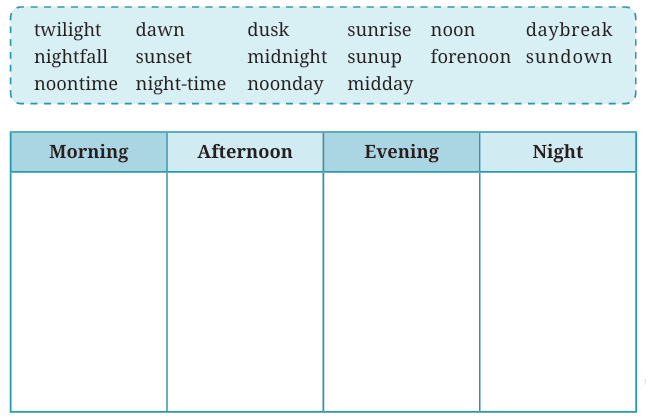
✅ Answer:
| Morning | Afternoon | Evening | Night |
|---|---|---|---|
| dawn | noon | dusk | midnight |
| sunrise | noontime | twilight | nightfall |
| sunup | noonday | sunset | night-time |
| daybreak | midday | sundown | |
| forenoon |
III. Match the words from the text given in Column 1 with their opposites in Column 2.
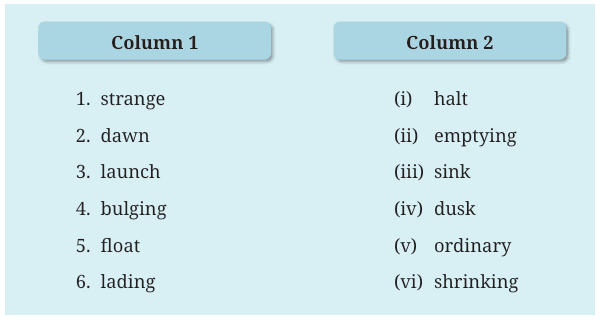
✅ Answers:
Correct Matching:
| Column 1 | Column 2 (Opposites) |
|---|---|
| 1. strange | (v) ordinary |
| 2. dawn | (iv) dusk |
| 3. launch | (i) halt |
| 4. bulging | (vi) shrinking |
| 5. float | (iii) sink |
| 6. lading | (ii) emptying |
Let us listen
You will listen to a conversation between a girl and her father about the art of paper folding called origami. As you listen, select the true statements from 1–7. (Transcript for the teacher on pg. 137)
- Sai was trying to make an origami boat.
- Sai’s father used to do origami as a child.
- Paper was very expensive so it was used only for special occasions.
- People have been making paper cranes for thousands of years.
- There is a belief that if you make a thousand paper cranes, your wish will come true.
- The art of origami is about enjoying the process.
- Sai’s father suggests making a paper bookmark next time
✅ Answer:
Here are the True Statements: 2, 3, 5, and 6
✅ 2. Sai’s father used to do origami as a child.
He says, “I remember doing that when I was your age.”
✅ 3. Paper was very expensive so it was used only for special occasions.
He explains that in ancient Japan, paper was used only for religious ceremonies.
✅ 5. There is a belief that if you make a thousand paper cranes, your wish will come true.
He shares the tradition about folding a thousand cranes to make a wish.
✅ 6. The art of origami is about enjoying the process.
He says, “Origami isn’t just about the final shape—it’s about the process, the patience and the creativity.”
Wrong Statements: 1, 4 and 7
❌ 1. Sai was trying to make an origami boat.
Incorrect—she was trying to make a crane, not a boat.
❌ 4. People have been making paper cranes for thousands of years.
Not exactly—origami started over a thousand years ago, but paper cranes became popular hundreds of years ago, not thousands.
❌ 7. Sai’s father suggests making a paper bookmark next time.
He suggests making a paper boat, not a bookmark.
Let us speak
Create any craft item using eco-friendly materials. Make a presentation in front of your classmates and teacher about the craft item you have made.

✅ Answer: Model and Sample Answers/Solutions
Here’s a sample presentation to help you talk about your eco-friendly craft in class. You can easily personalize it by adding your own item, materials, and details, giving you a clear and confident speech for your class! 😊
🌿 Sample Presentation 1:
Presentation on My Craft Item – Leaf Bird
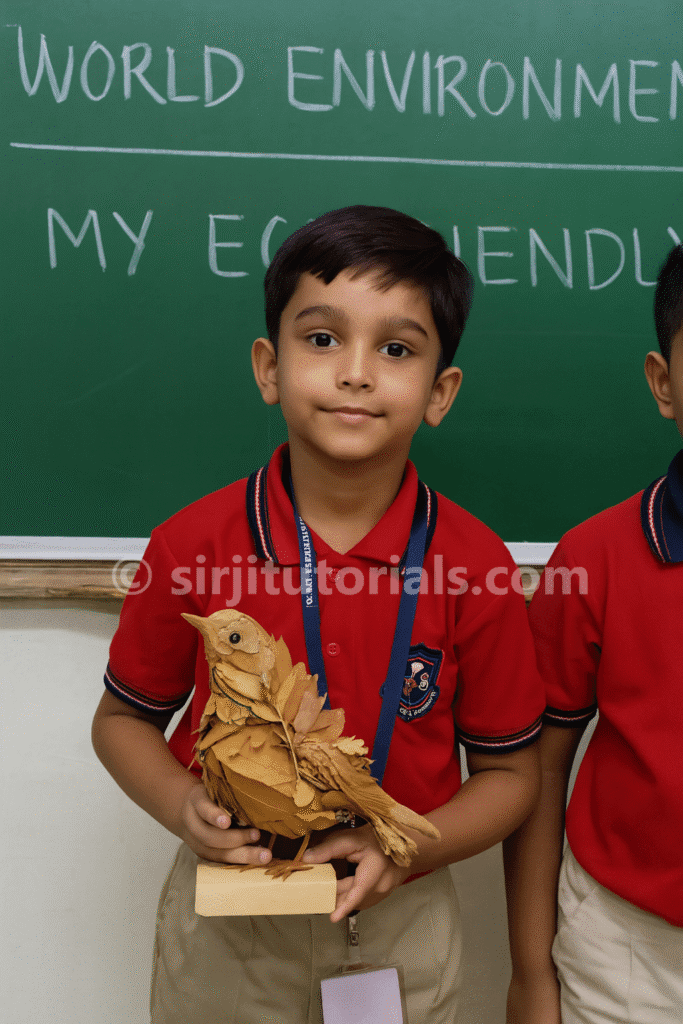
Today, I’m going to show you a bird I made.
This bird is made of dry leaves, paper, and glue.
It’s brown in colour, shaped like a real bird, and about the size of my hand.
It can be used to decorate your room or be part of a school project.
First, I started by collecting different shapes and sizes of dry leaves from my garden.
Then, I used glue and a piece of cardboard to fix the leaves in the shape of a bird.
The most difficult part was making the wings and tail with small leaves.
This is special to me because I made it myself using only eco-friendly materials.
I hope you enjoyed seeing my craft and learning about it.
Thank you for your attention. 😊
🌿 Sample Presentation 2:
Recycled-Paper Bird
1. Introduction of the item
“Today, I’m going to show you a recycled-paper bird I made.”
2. Description of how you made it
- “First, I started by collecting old newspaper and magazine pages.”
- “Then, I used scissors to cut out feather shapes and glued them together.”
- “I folded a small triangle for the beak and rolled paper for the legs.”
- “The most difficult part was to glue all the tiny feathers so they looked like real wings.”
3. Description of the item (materials, colour, shape, size, use)
- “This bird is made of recycled paper and a little bit of cardboard.”
- “It’s brown, orange, and white, about 15 cm tall.”
- “It can be used to decorate a study table or hang from a hook as a wall ornament.”
4. Reason why you like the craft
- “This is special to me because I love birds and I helped save paper from being thrown away.”
- “I enjoyed making each feather by hand—it taught me patience and creativity.”
5. Conclusion
- “I hope you enjoyed seeing my craft and learning how I made it.”
- “Thank you for your attention!”
More examples of craft item presentations.
🦌 Eco-Deer Sculpture
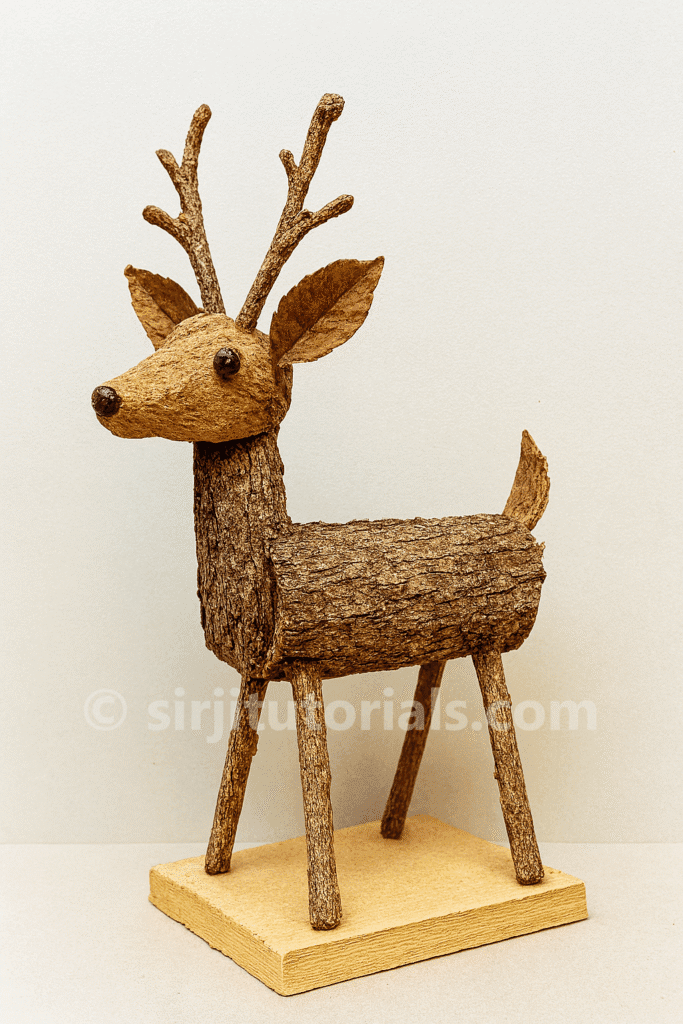
Today, I’m going to show you a deer sculpture I made.
This deer is made of tree bark, twigs, dried leaves, and seed beads.
It’s brown in colour, shaped like a standing deer with branch-like antlers, and is medium-sized, placed on a wooden base.
It can be used to decorate classrooms or nature-themed exhibitions and also to teach students about eco-friendly art.
First, I started by choosing a thick piece of bark for the body.
Then, I used twigs for the legs and antlers, and dried leaves for the ears and tail. I added a seed bead for the eye.
The most difficult part was to balance the legs and attach the antlers without breaking them.
This deer sculpture is special to me because it shows how we can use natural materials to create something beautiful and respectful to wildlife.
I hope you enjoyed seeing my craft and learning about it.
Thank you for your attention.
🐄 Eco-Cow Sculpture
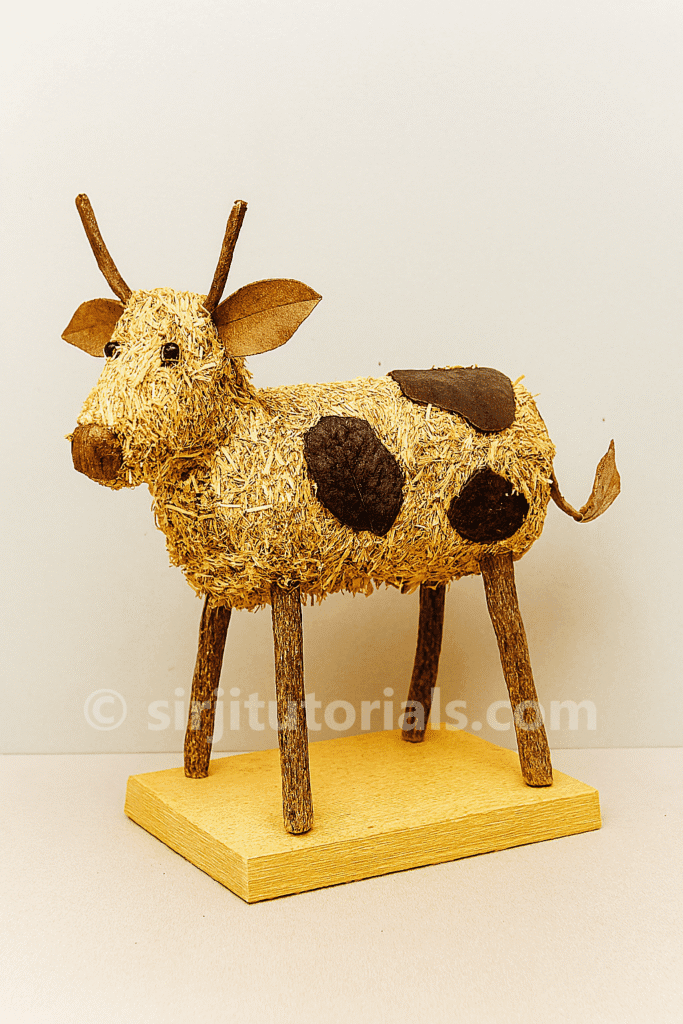
I’m going to show you a cow sculpture I made.
This cow is made of straw, bark, twigs, dried leaves, and seed beads.
It’s light brown with dark bark spots, shaped like a standing cow with horns made of twigs, and is also medium-sized, placed on a wooden base.
It can be used to celebrate rural life, decorate eco-fairs, or teach students about sustainable farming and crafts.
First, I started by bundling straw tightly to form the body and head.
Then, I used bark pieces for the spots, twigs for the legs and horns, and leaves for the ears and tail. I added seed beads for the eyes.
The most difficult part was to shape the straw neatly and attach the horns without them falling off.
This cow sculpture is special to me because it reminds me of village life and how we can reuse natural things instead of plastic.
I hope you enjoyed seeing my craft and learning about it.
Thank you for your attention.
Let us write
Write a diary entry expressing your joy experiencing a rainy day. You may begin as given below: (See the book for the full questions)
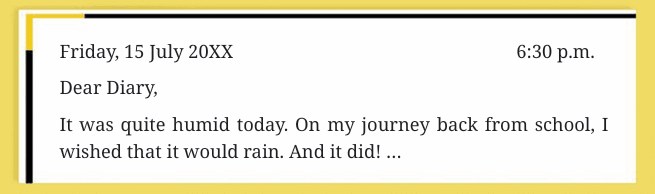
✅ Answer: Sample of complete diary entry
Here’s a sample of a complete diary entry expressing joy on a rainy day, continuing from the given starting lines. It adheres to all the guidelines in the activity: Fill in the remaining spaces as desired.
Sample Diary Entry – 1
Sunday, 05 October 20XX
6:30 p.m.
Dear Diary,
It was quite humid today. On my journey back from school, I wished that it would rain. And it did! 🌧️
Within minutes, dark clouds gathered and cool drops of water started falling. It felt like magic! I threw my bag on the chair and rushed out to play in the rain with my friends. We splashed through puddles, sang songs, and laughed so much.
The smell of wet soil was amazing. Amma made hot pakoras and tea for herself. I had mine with chutney. Everything just felt so perfect.
I wish every day could be like this! I had so much fun today. I will always remember this lovely rainy day. ☔💙
Yours,
[Your Name]
See two additional examples of diary entries.
Sample Diary Entry – 2
Friday, 06 October 2025 9:00 p.m.
Dear Diary,
Today was such a happy rainy day! On my way home from school, the sky grew dark and I felt the first cool drops of rain on my face. I jumped with joy and opened my umbrella, listening to the soft pitter-patter on the roof.
When I reached home, I changed into my raincoat and boots. I ran outside to splash in every puddle I could find. The air smelled fresh and clean, and the thirsty plants in our garden drank up all the rainwater. Even the birds looked glad and sang more sweetly than ever.
At four o’clock, I made a warm cup of hot chocolate and sat by the window. I watched streams of water racing down the street and children waving to each other from under colourful umbrellas. My little sister and I drew paper boats, then floated them in the gutter—and cheered when they sailed away!
By dusk, the rain had slowed to a gentle drizzle. I helped my mother hang the wet clothes on the line, and we laughed at how the raindrops made funny patterns on the sheets.
I feel so peaceful and excited after today’s rain, Diary. It was like the whole world got a fresh start, and I can’t wait for tomorrow—maybe I’ll go outside again and play in the puddles!
Good night,Ajeet Sir
Sample Diary Entry – 3 (Short)
Sunday, 07 October 20XX
9:30 p.m.
Dear Diary,
Today was a hot and humid day. While coming back from school, I wished it would rain—and it did! I got so happy! 🌧️
I played in the rain with my friends and jumped in puddles. When I came home, Amma gave me hot pakoras.
It was such a fun and happy day!
Yours,
[Your Name]
Let us explore

✅ Answer:
🌸 Shiuli in My Language
In my language (Hindi), Shiuli is called “हरसिंगार (Harsingar)”.
🌺 Other Fragrant Flowers in My Locality
| English Name | Local Name (Hindi) |
|---|---|
| Jasmine | चमेली (Chameli) |
| Rose | गुलाब (Gulab) |
| Marigold | गेंदा (Genda) |
| Tuberose | रजनीगंधा (Rajnigandha) |
| Champa | चंपा (Champa) |
✏️ Drawing and Colouring Suggestion
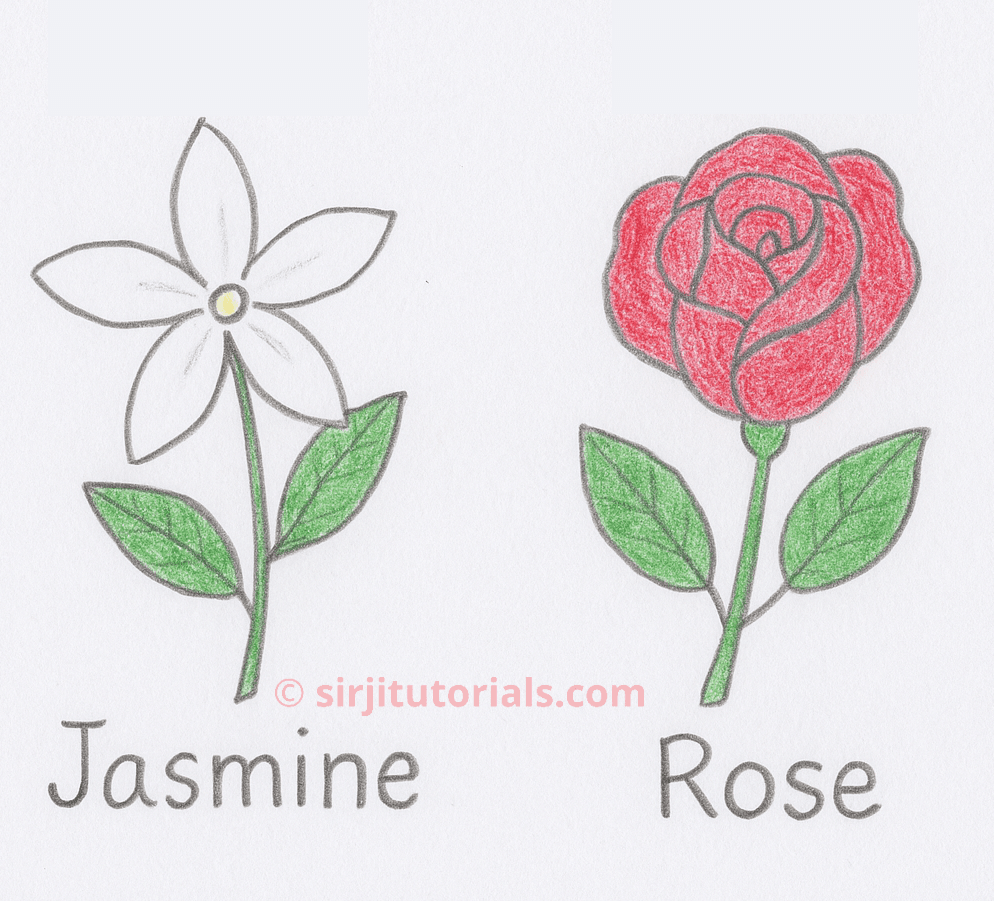
You can draw and colour these two flowers:
- Rose (गुलाब) – Colour: red or pink
- Jasmine (चमेली) – Colour: white
Here are example Drawings of Jasmine and Rose
II. Solve the riddles given below. Share your answers with your classmates and the teacher.

✅ Answer:
Here are the answers to the riddles:
- Riddle 1 Answer:Ocean / Sea
- Clues: “dolphins and the whale,” “Sun sinks,” “depths tell a tale”
- Riddle 2 Answer:Lake
- Clues: “sit in stillness,” “take a dip,” “home to ducks, frogs, fish”
- Riddle 3 Answer: Stream (Brook)
- Clues: “soft murmur,” “paper boats,” “skips along, crystal clear”
- Riddle 4 Answer:River
- Clues: “bed but do not sleep,” “bank but no money,” “journey far to meet the sea”