

This post offers study notes and solutions for the Class 7 English Gul Mohar book’s chapter ‘The Small Ghost of the Mountain’. It includes a summary, word meanings, answers to in-text questions, activities, and solutions to chapter-end questions and exercises.
- 1 Summary of ‘The small ghost of the mountain’
- 2 Word Meanings
- 3 In-text Questions – Answers
- 4 Activity Exercises with Solutions
- ▶ 5 Chapter-end question answers for ‘The Ghost of the Mountain’ from Class 7 Gul Mohar
- 5.1 Understanding the Text
- 5.2 Appreciating the Text
- 5.3 Grammar and Usuage
- 5.4 Words in Use
- 5.5 Writing
- ↑ Back to top
Summary of ‘The small ghost of the mountain’
The Small Ghost of the Mountain is an interesting article about the Pallas’s cat, one of the world’s smallest and rarest wildcats. It lives in the cold, rocky mountains of Mongolia and is very difficult to spot because its fur blends perfectly with its surroundings.
The story describes the adventure of wildlife photographer Shefiq Basheer Ahammed, who travelled from Kerala to Mongolia to photograph this mysterious cat. With the help of local guides, he spent many days trekking through snow, facing freezing weather and strong winds. After a long search, he finally saw the well-camouflaged cat and managed to take its photographs.
The lesson also shares the experiences of wildlife filmmaker Paul Williams, who called the Pallas’s cat the “small ghost of the mountain” because it is so rare and mysterious. Scientist Neeraj Maher explains that the cat can also be found in Ladakh, India. The lesson ends by reminding us that the Pallas’s cat is near threatened due to habitat loss and a decrease in its prey. It highlights the importance of protecting this unique wild animal and its natural habitat.
Summary in Hindi
‘द स्मॉल घोस्ट ऑफ द माउंटेन’ जी. साहीद द्वारा लिखा गया एक रोचक लेख है। इसमें पैलस की बिल्ली (Pallas’s cat) के बारे में बताया गया है, जो दुनिया की सबसे छोटी और दुर्लभ जंगली बिल्लियों में से एक है। यह मंगोलिया के ऊँचे, ठंडे और चट्टानी पहाड़ों में रहती है। इसका सफ़ेद-भूरा फर इसे आसपास के वातावरण में इस तरह मिला देता है कि इसे देख पाना बहुत कठिन होता है।
लेख में वन्यजीव फ़ोटोग्राफ़र शेफीक बशीर अहमद की रोमांचक यात्रा का वर्णन है। वे इस दुर्लभ बिल्ली की तस्वीरें लेने के लिए मंगोलिया गए। स्थानीय गाइडों की मदद से उन्होंने कई दिनों तक बर्फ़ीले पहाड़ों में कठिन ट्रेक किया और तेज़ हवाओं तथा कड़ाके की ठंड का सामना किया। कई दिनों की मेहनत के बाद उन्हें पैलस की बिल्ली दिखाई दी और वे उसकी तस्वीरें लेने में सफल रहे।
वन्यजीव फ़िल्म निर्माता पॉल विलियम्स ने भी अपने अनुभव साझा किए। उन्होंने इस बिल्ली को “पहाड़ों का छोटा भूत” कहा क्योंकि यह बहुत रहस्यमयी है और आसानी से दिखाई नहीं देती। वैज्ञानिक नीरज माहेर ने बताया कि यह बिल्ली भारत के लद्दाख में भी पाई जाती है।
अंत में लेख में बताया गया है कि शिकार की कमी और प्राकृतिक आवास के नष्ट होने के कारण पैलस की बिल्ली की संख्या घट रही है। इसलिए इस अनोखे और दुर्लभ वन्यजीव तथा उसके प्राकृतिक आवास का संरक्षण करना बहुत आवश्यक है।
Word Meanings
In-text Questions – Answers
1. Two words that can be used to describe the process of spotting the Pallas’s cat are—
a. …………………..
b. …………………..
Ans. Two words that can be used to describe the process of spotting the Pallas’s cat are—
a. challenging
b. patient
2. What are the qualities you need to be a guide in this situation?
Ans. A guide should be patient, observant, experienced, physically fit, and familiar with the mountains and the animal’s habits.
3. Which of these qualities do you have or would like to have? Why?
Ans. I would like to have patience and observation skills because they help in solving problems and achieving difficult goals without giving up.
4. The reason why the description of the landscape and weather is embedded in the search for the cat is because…
Ans. …….the difficult landscape and harsh weather make finding the Pallas’s cat even more challenging and show the hardships faced by the photographers.
5. The Pallas’s cat’s habitat is …………….. , rocky and …………….. .
Ans. The Pallas’s cat’s habitat is cold, rocky and snow-covered.
6. Underline the sentence that tells you that the guide is no longer sure about locating the Pallas’s cat. (Paragraph 5)
Ans. The line is given below.
“The guide said that there could be secret passageways through the snow and rocks that were only known to the cats.”
7. In what way is Williams’ experience similar to Ahammed’s and in what way is it different?
Ans.
Similarity: Both had to wait patiently for a long time and found it difficult to spot the Pallas’s cat.
Difference: Ahammed was a wildlife photographer taking photographs, while Williams was a wildlife filmmaker making a BBC documentary. Williams’ team also took many weeks to find the cat, whereas Ahammed had six sightings in fifteen days.
Activity Exercises with Solutions
Activity 1
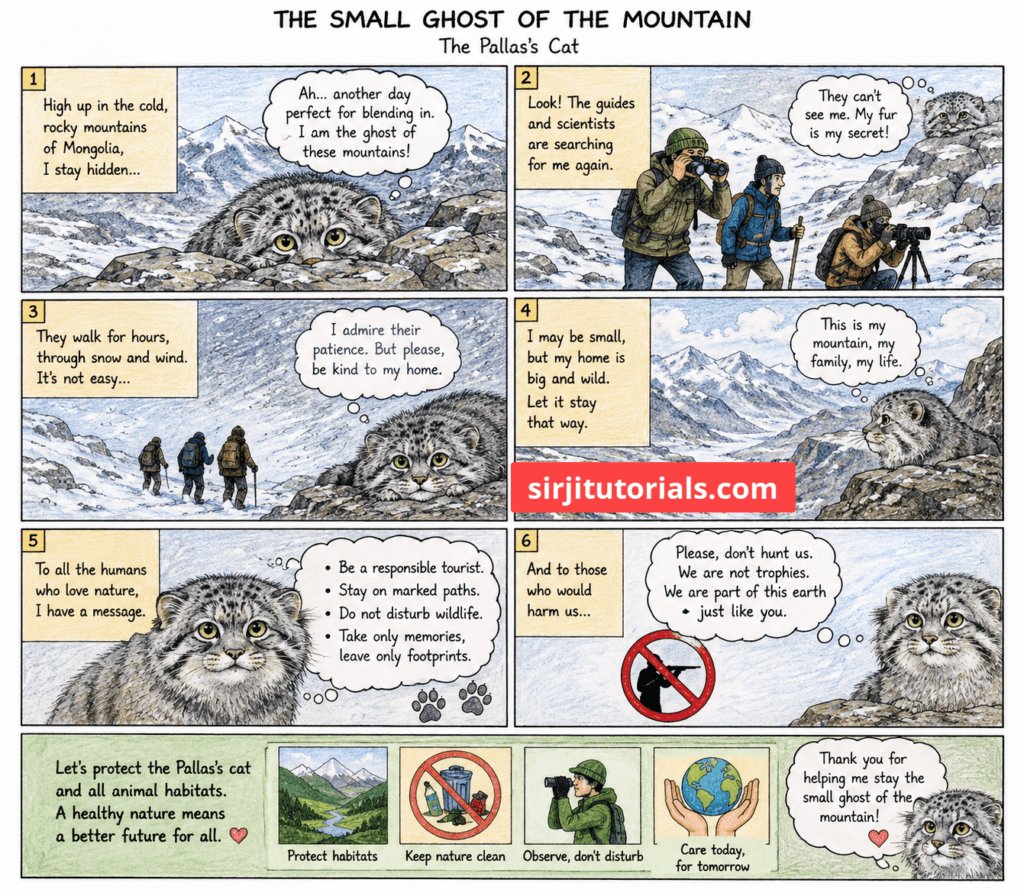
Draw the Pallas’s cat in a small comic strip. It is camouflaged and is watching the guides and scientists looking for it. Draw speech bubbles and say what it is thinking. Remember to add some lines about responsible tourism, protecting the Pallas’s cat from hunters and preserving animal habitats.
Sol. A sample comic strip is given here.
Activity 2
Have a class discussion about this question.
How does working with local people when investigating or studying something—
a. help the local people?
b. help the scientists and tourists?
Sol. – Sample Answers
a. How does working with local people help the local people?
Ans. Working with scientists and tourists gives local people jobs and income. It also helps them share their knowledge about the area and encourages them to protect wildlife and nature.
b. How does working with local people help the scientists and tourists?
Ans. Local people know the land, weather, animal habits, and safe routes very well. Their experience helps scientists and tourists find animals more easily, travel safely, and learn more about the local environment.
Activity 3
In pairs, say what it is about the Ladakh landscape that makes it suitable for the Pallas’s cat. Describe two features of the landscape.
Sol. – Sample Answer
The Ladakh landscape is suitable for the Pallas’s cat because:
It is cold and snow-covered, and the cat’s thick, light-coloured fur helps it stay warm and blend into its surroundings.
It has rocky mountains and cliffs, where the cat can hide easily and make its den.
Chapter-end question answers for ‘The Ghost of the Mountain’ from Class 7 Gul Mohar
Understanding the Text
A. Complete this table.
(See the book for the full question)
Answer:
| the Pallas’s cat | appearance | habitat | where it lives and has kittens | personality | what was used to track it | why very little is known about it |
|---|---|---|---|---|---|---|
| One of the world’s smallest wildcats | Thick white-grey coat; round face; blends with rocks and snow; looks like a “small ghost” | Cold, rocky, snow-covered mountains and dry steppes | High among rocky mountains; kittens are born in rocky caves | Shy, elusive, quiet, well-camouflaged | Radio telemetry, camera traps, footprints in the snow, binoculars, and local guides | It is extremely elusive, perfectly camouflaged, lives in remote mountains, and is rarely seen by people. |
B | Answer these questions.
- The landscape made Ahammed shudder—there was no greenery at all.
a. Why would this make Ahammed shudder? Think about where he comes from.
b. How does this line prepare us for the conditions Ahammed has to face during his stay in Mongolia? - Why is the weather described as ‘the only other point of interest’? What does this tell you about Ahammed’s state of mind? (para 3)
- How does Ahammed describe the Pallas’s cat during his first sighting? (para 4)
- What are the challenges Ahammed faces during this expedition? (para 6)
- Why do you think Paul Williams worked with not only local people but specifically with nomadic people? (para 7)
- Why do you think finding the kittens was a ‘turning point’? (para 8)
- Why has the IUCN assessed that the Pallas’s cat was near threatened? Explain in your own words.
Answers:
Two sets of answers are given here to help students.
Set – 1
1.
a. Why would this make Ahammed shudder? Think about where he comes from.
Ans. Ahammed came from Kerala, a state known for its greenery. Seeing a cold, dry land with no greenery at all was very unusual for him and made him shudder.
b. How does this line prepare us for the conditions Ahammed has to face during his stay in Mongolia?
Ans. It shows that Ahammed would have to face harsh weather, freezing temperatures, strong winds, and a difficult rocky landscape while searching for the Pallas’s cat.
2. Why is the weather described as ‘the only other point of interest’? What does this tell you about Ahammed’s state of mind? (Para 3)
Ans. The weather is called the only other point of interest because the cat was nowhere to be seen and the snowy landscape looked empty. This shows that Ahammed remained patient, alert, and hopeful, despite the difficult conditions.
3. How does Ahammed describe the Pallas’s cat during his first sighting? (Para 4)
Ans. Ahammed says that at first he thought the cat was just a piece of rock. Its head was covered with snow, and its facial hair had dewdrops that looked like icicles. He described it as a magnificent sight.
4. What are the challenges Ahammed faces during this expedition? (Para 6)
Ans. Ahammed faced changing weather, freezing cold, strong winds, and hurricanes. His tents were blown away, his fingers became numb while using the camera, and he needed special boots, sleeping bags, and blankets to survive the cold.
5. Why do you think Paul Williams worked not only with local people but specifically with nomadic people? (Para 7)
Ans. Paul Williams worked with nomadic people because they travelled through the mountains regularly and knew the land, the weather, and the movements of the Pallas’s cat better than anyone else.
6. Why do you think finding the kittens was a ‘turning point’? (Para 8)
Ans. Finding the kittens was a turning point because it gave the film team a rare chance to observe and film the young Pallas’s cats closely. This helped them learn more about the animal’s behaviour and made the documentary more special.
7. Why has the IUCN assessed that the Pallas’s cat was near threatened? Explain in your own words.
Ans. The IUCN has listed the Pallas’s cat as near threatened because its numbers are decreasing. Its natural habitat is being destroyed, and there are fewer animals available for it to hunt. Therefore, the species needs protection to survive.
Set – 2
1. a. Why would this make Ahammed shudder?
Ans. Ahammed came from green and tropical Kerala. The cold, dry, and barren landscape of Mongolia was very different and made him shudder.
b. How does this line prepare us for the conditions Ahammed has to face?
Ans. It shows that Ahammed would face harsh weather, freezing cold, and difficult mountain conditions.
2. Why is the weather described as ‘the only other point of interest’?
Ans. The cat could not be seen, so the changing weather became the only thing to notice. It shows Ahammed remained patient and hopeful.
3. How does Ahammed describe the Pallas’s cat during his first sighting?
Ans. At first, he thought it was a rock. Its snow-covered head and icy facial hair made it look beautiful and well camouflaged.
4. What are the challenges Ahammed faces during this expedition?
Ans. He faced freezing cold, strong winds, storms, numb fingers, and difficult mountain trekking.
5. Why did Paul Williams work with nomadic people?
Ans. Nomadic people knew the mountains and the Pallas’s cat’s habits, making them the best guides.
6. Why was finding the kittens a ‘turning point’?
Ans. It allowed the team to closely observe and film the young Pallas’s cats, making the documentary more successful.
7. Why has the IUCN assessed the Pallas’s cat as near threatened?
Ans. Its population is decreasing because of habitat loss and a shortage of prey, so it needs protection.
Appreciating the Text
This text is a non-fiction report (it is based on real rather than imaginary events) of how Shefiq Basheer Ahammed set out to photograph the elusive Pallas’s cat.
Which elements make this text interesting? You can choose more than one answer.
- facts and details like the place and the people involved
- description of the landscape, the weather and the Pallas’s cat
- the personal feelings and opinions of Ahammed
- a clear description of the events and relevant action
Answer: All of the above (✓ All four options).
Facts and details like the place and the people involved. ✔
Description of the landscape, the weather and the Pallas’s cat. ✔
The personal feelings and opinions of Ahammed. ✔
A clear description of the events and relevant action. ✔
Grammar and Usuage
A. | Combine these sentences using the infinitive.
- You both discuss. Agree on a topic.
Discuss so that you can agree on a topic. - I am in a hurry. I must catch the bus to Bangalore.
- She visited the library. She borrowed some books for her grandparents.
- He was very kind. He gave up his seat for me.
- I must tell you the truth. I don’t like long road trips.
Answer: Here are the sentences combined using an infinitive (to + verb):
- Discuss so that you can agree on a topic. (Given)
- I am in a hurry to catch the bus to Bangalore.
- She visited the library to borrow some books for her grandparents.
- He was very kind to give up his seat for me.
- To tell you the truth, I don’t like long road trips.
B. | Circle the present participles and underline the past participles in these sentences.
- We saw a flock of flamingos flying to the south.
- The team was exhausted after a tough match.
- The bench is freshly painted, watch out!
- The band was playing our favourite songs.
- We have not progressed much, stuck in heavy traffic.
- Being a big success, the film has been nominated for the Oscars.
- My eyes are red and swollen because of an allergy.
- I have a cast on my fractured arm and am resting it.
Answer: (Here, ( ) = circle, __ __ = underline.)
- We saw a flock of flamingos (flying) to the south.
- The team was exhausted after a tough match.
- The bench is freshly painted, watch out!
- The band was (playing) our favourite songs.
- We have not progressed much, stuck in heavy traffic.
- (Being) a big success, the film has been nominated for the Oscars.
- My eyes are red and swollen because of an allergy.
- I have a cast on my fractured arm and am (resting) it.
C. | Rearrange these words to write correct sentences.
- my / made me / talking / to / feel better / best friend
Talking to my best friend made me feel better. - different / good for / languages / personal / learning / development / is
- great fun / ice-skating / it / outdoor / is / to do
- summer camp / from / students / participating / all the / benefit / will / the / in
- bored / are / with / exercising / we / day / night / and
- young children / career / is / fulfilling / a / teaching
Answer:
- Talking to my best friend made me feel better. (Given)
- Learning different languages is good for personal development.
- It is great fun to do outdoor ice-skating.
- All the students will benefit from participating in the summer camp.
- We are bored with exercising day and night.
- Teaching young children is a fulfilling career.
Words in Use
A. | Complete these sentences with the correct words from the text.
- As a young man he had ………….. to many parts of the world. (para 1)
- The monkeys have ………….. from their enclosure in the zooon the news -I just saw it on the news. (para 1)
- She ………….. him that the model volcano would be ready the next day. (para 1)
- I’ve just ………….. Ajay-he’s over there, near the main gate. (para 3)
- Dinosaurs ………….. from the Earth 65 million years ago. (para 5)
- A team of scientist has ………….. the remains of an ancient temple. (para 8)
- The woman in the horror film would ………….. every time she heard a noise. (para 8)
- The cows were ………….. in the green fields. (para 9)
Answer:
- As a young man he had travelled to many parts of the world. (para 1)
- The monkeys have escaped from their enclosure in the zoo—I just saw it on the news. (para 1)
- She assured him that the model volcano would be ready the next day. (para 1)
- I’ve just spotted Ajay—he’s over there, near the main gate. (para 3)
- Dinosaurs vanished from the Earth 65 million years ago. (para 5)
- A team of scientists has located the remains of an ancient temple. (para 8)
- The woman in the horror film would shudder every time she heard a noise. (para 8)
- The cows were grazing in the green fields. (para 9)
B. | Choose the correct phrases from the box to complete these sentences.
[Phrases in the box]
- hard to make out (para 2)
- point of interest (para 3)
- came up empty-handed (para 3)
- an ocean of snowy wilderness (para 3)
- depended on the eyes of (para 7)
- one of the turning points (para 8)
[Sentences]
- The two thieves broke into the house expecting to find many things of value but ………… .
- The main ………… in his account was how animal activists were protecting animals from laboratory use.
- ………… of her career as a photographer was when her photographs were featured in a famous magazine.
- During many portions of their trek in the Himalayas, all they could see was ………… .
- We ………… the park ranger to spot the rare bird in the trees.
- He spoke so softly that it was ………… what he was saying.
Answer:
- The two thieves broke into the house expecting to find many things of value but came up empty-handed.
- The main point of interest in his account was how animal activists were protecting animals from laboratory use.
- One of the turning points of her career as a photographer was when her photographs were featured in a famous magazine.
- During many portions of their trek in the Himalayas, all they could see was an ocean of snowy wilderness.
- We depended on the eyes of the park ranger to spot the rare bird in the trees.
- He spoke so softly that it was hard to make out what he was saying.
Writing
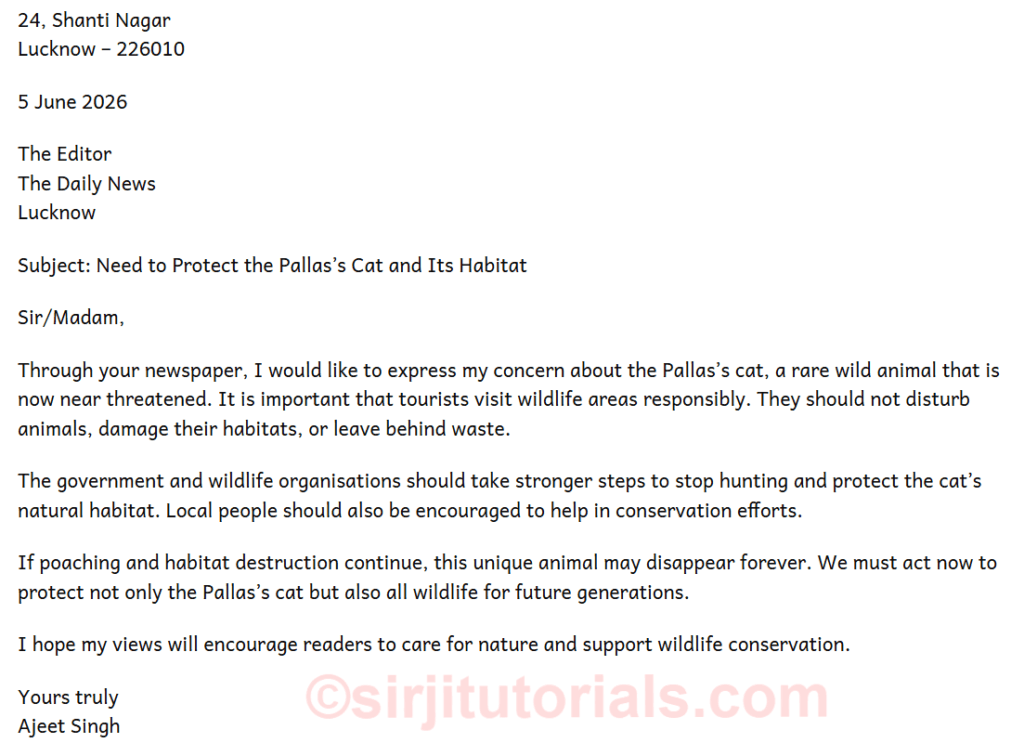
Imagine that the article ‘The Small Ghost of the Mountains’ appeared in a newspaper called ‘The Daily News’. After reading the report, you want to write a letter to the editor. Express your concern about these points.
- the importance of responsible tourism
- the measures to be taken to protect the Pallas’s cat and its habitat
- the consequences of hunting/poaching this unique animal
- the importance of ensuring that we look after and preserve our wildlife and their habitats for future generations
Answer: Two samples of letters to the editor are given below.
Sample 1 – Letter to the Editor
Sample 2 – Letter to the Editor
(You can fill in details as desired in the left-out blank spaces)
[Your Address]
[City, State, Zip Code]
July 5, 2026
The Editor
The Daily News
New Delhi
Subject: Urgent Need for the Conservation of the Pallas’s Cat and Wildlife Habitats
Respected Sir/Madam,
I am writing to express my deep concern regarding the plight of the Pallas’s cat, as highlighted in your recent article, “The Small Ghost of the Mountains.” This unique species is facing severe threats that require immediate public awareness and action.
First, we must emphasize the critical importance of responsible tourism. Unregulated travel into fragile mountain ecosystems disrupts wildlife behaviors and destroys pristine environments. Tourism must be strictly managed to ensure it does not encroach on endangered territories.
Second, urgent measures are needed to protect the Pallas’s cat and its native habitat. Establishing protected wildlife sanctuaries, enforcing strict local zoning laws, and funding scientific monitoring are essential steps to shield this elusive animal from human encroachment.
Third, the consequences of hunting and poaching this unique animal are catastrophic. Losing the Pallas’s cat disrupts the ecological balance of the mountain food chain, leading to overpopulation of rodents and subsequent degradation of grazing lands.
Finally, it is our collective responsibility to ensure that we preserve our wildlife and their habitats for future generations. If we do not act now, future generations will only know these magnificent creatures through history books. We must protect our planet’s biodiversity before it is too late.
Yours sincerely
[Your Name]