

This post covers ‘The Wolves of Cernogratz’ by Saki (Hector Hugh Munro) and includes a summary, vocabulary meanings, and solutions from the Class 7 English textbook Gul Mohar.
- ▶ 1 Summary of The Wolves of Cernogratz
- 1.1 Summary in English
- 1.2 Hindi Summary
- 2 Word Meanings
- 3 In-text Questions and Answers – The Wolves of Cernogratz
- ▶ 4 End-of-Chapter Exercises with Solutions | The Wolves of Cernogratz
- 4.1 Understanding the Text
- 4.2 Appreciating the Text
- 4.3 Grammar and Usage
- 4.4 Words in Use
- 4.5 Writing
- ↑ Back to top
Summary of The Wolves of Cernogratz
Summary in English
The Wolves of Cernogratz is a mysterious story about an old castle and an ancient family legend. Baron and Baroness Gruebel buy the Castle of Cernogratz and invite some guests for Christmas. Among them is an old governess named Amalie, who quietly serves the family.
During dinner, the guests talk about a legend that says the wolves of the nearby forest howl whenever a member of the Cernogratz family is about to die. The Baroness laughs at the story because she believes it is only a superstition. Amalie then reveals that she herself belongs to the old Cernogratz family. She explains that the wolves howl only for true members of the family, not for people who simply own the castle.
Some time later, Amalie falls seriously ill. On a cold winter night, the wolves begin to howl loudly around the castle. A tree crashes in the park, making the strange atmosphere even more frightening. Amalie happily says that the wolves have come to sing the death music of her family. Soon after, she dies peacefully.
The story ends by suggesting that the old family legend may have been true after all. It reminds us that some traditions and mysteries cannot always be explained by logic alone.
Hindi Summary
यह कहानी एक पुराने महल (या किला) और उससे जुड़ी रहस्यमयी पारिवारिक कथा पर आधारित है। बैरन और बैरोनेस ग्रूबेल सेर्नोग्रात्ज़ का महल खरीद लेते हैं। क्रिसमस के अवसर पर वे अपने मित्रों को दावत पर बुलाते हैं। उनके साथ रहने वाली एक वृद्ध गवर्नेस अमाली भी वहीं होती है।
भोजन के दौरान महल की एक पुरानी मान्यता की चर्चा होती है। कहा जाता है कि जब भी सेर्नोग्रात्ज़ परिवार का कोई सच्चा सदस्य मरने वाला होता है, तब जंगल के भेड़िए महल के चारों ओर आकर पूरी रात हुआँ-हुआँ करते हैं। बैरोनेस इस कहानी को अंधविश्वास मानकर हँसी में उड़ा देती है।
तभी अमाली बताती है कि वह स्वयं सेर्नोग्रात्ज़ परिवार की सदस्य है। वह समझाती है कि यह सम्मान केवल उस परिवार के असली लोगों को मिलता है, केवल महल खरीद लेने से कोई उस परिवार का सदस्य नहीं बन जाता।
कुछ समय बाद अमाली गंभीर रूप से बीमार पड़ जाती है। एक ठंडी रात महल के चारों ओर भेड़ियों के हुआँ-हुआँ करने की आवाज़ गूँजने लगती है। उसी समय एक पेड़ भी टूटकर गिर जाता है। अमाली प्रसन्न होकर कहती है कि भेड़िए उसके लिए परिवार का अंतिम विदाई गीत गाने आए हैं। थोड़ी ही देर बाद उसकी शांतिपूर्वक मृत्यु हो जाती है।
कहानी के अंत में ऐसा लगता है कि सेर्नोग्रात्ज़ परिवार की पुरानी कथा सच थी। यह कहानी बताती है कि कुछ रहस्य और परम्पराएँ केवल तर्क से नहीं समझी जा सकतीं और अपने परिवार तथा विरासत से जुड़ाव का महत्व बहुत गहरा होता है।
Word Meanings
In-text Questions and Answers – The Wolves of Cernogratz
1. Q: The governess’ state of mind here is… We know this because…
Ans: Her state of mind is rapidly and nervously excited. We know this because she suddenly breaks her usual habit of sitting “silent and prim and faded” to talk rapidly, looking straight ahead without addressing anyone in particular.
2. Q: The wolves howl for the Cernogratz family because… The tree falling symbolises…….
Ans: The wolves howl because it is an ancient nature legend meant to honour the soul of a true Cernogratz family member at their death hour. The tree falling symbolises the departure and passing away of that person’s soul from its earthly body.
3. Q: Why does the governess finally speak up? Compare her attitude now to what it was before.
Ans: She speaks up to defend the honor and truth of her family history after the Baroness mocks the legend. Before this, her attitude was quiet, submissive, and invisible; now, she displays a note of defiance and proud contempt.
4. Q: The life of the governess has been …….. and …….. and all she has left is her memories that she ……..
Ans: Her life has been poor and lonely, and all she has left is her memories that she guards and dusts with especial care.
5. Q: Look up the meanings of the words ’empathy’ and ‘sympathy’. Say which one applies to paragraph 16 and why.
Ans: Empathy applies to Conrad in paragraph 16. While sympathy means feeling pity for someone, empathy means truly sharing and understanding their emotions. Conrad experiences empathy because he notices the tears in her eyes and deeply connects with her emotional pain of clinging to old memories.
6. Q: The connection between the bitter cold and the governess falling ill is…
Ans: The bitter cold aggravated her weak condition, causing her frail, aged body to break down and fail after Christmas.
7. Q: What is about to happen?
Ans: The old governess is about to pass away, which is being foreshadowed by the sudden panic and howling of the animals.
8. Q: The main emotion highlighted in paragraph 24 is…
Ans: The main emotion highlighted is starved, cold misery and forlorn haunting sorrow.
9. Q: What is the significance of the old governess watching the hours of the dying year slip by?
Ans: It symbolizes that her own life is ending concurrently with the end of the calendar year.
10. Q: What do you think the wolves are saying? How would you respond if you were a von Cernogratz?
Ans: The wolves are singing a death-music tribute to welcome home the soul of the last family member. If I were a von Cernogratz, I would respond with peace and pride, feeling comforted that nature is honoring my ancestry.
11. Q: Why does the governess say “I am one of a great old family…” just after she says that she is not lonely anymore?
Ans: She says this because the arrival of the wolves proves her true identity and lineage, making her feel connected to her ancestors rather than abandoned in a strange house.
12. Q: What has happened?
Ans: The old governess has died, triggering the final supernatural token of the legend—the falling tree.
13. Q: What does the last paragraph tell us about Baron and Baroness Gruebel?
Ans: It reveals that they are hypocritical, superficial, and obsessed with social status. Despite treating her poorly and calling her a liar in life, they pretend she was a “valued friend” in the newspaper notice just to make themselves look aristocratic.
End-of-Chapter Exercises with Solutions | The Wolves of Cernogratz
Understanding the Text
A. | Complete these sentences.
- Baroness Gruebel had not believed the legend because…
- The governess explained that the legend did not apply to everyone because…
- The governess knew all about the legend because…
- According to the Baron, the governess knew about the legend because…
- The small lapdog crept shivering under the sofa because…
- The governess told the Baroness to leave the windows open because…
Answer:
- Baroness Gruebel had not believed the legend because when her old mother-in-law died last spring, they all listened closely but heard no dogs or wild beasts howling.
- The governess explained that the legend did not apply to everyone because it only worked when a member of the old Cernogratz family died, and it would not happen for a stranger.
- The governess knew all about the legend because she was actually a von Cernogratz herself, and her father used to tell her many stories about the castle when she was a child.
- According to the Baron, the governess knew about the legend because he believed she was just a commoner who had talked to local peasants to dig up the family’s old history.
- The small lapdog crept shivering under the sofa because it felt sudden terror and fear when it heard the distant yapping and unusual barking of the other dogs.
- The governess told the Baroness to leave the windows open because she wanted to hear the beautiful death-music being sung by the wolves for her family.
B. Answer these questions.
- Has the Gruebel family lived in the castle for long? How do you know? (paras 1–3)
- What details did Baroness Gruebel get wrong about the legend? (para 3)
- The answer to her taunt was even more unexpected and astonishing. (para 10)
- a. Who is being referred to here?
- b. What was the taunt? Whom was the speaker taunting and why?
- c. What was the answer to the taunt? Why was it unexpected and astonishing?
- “It was an impertinence.” (para 15)
- a. Who said these words? How did he or she speak? Why?
- b. What was the impertinence? Why was it considered an impertinence?
- Why was Baroness Gruebel both annoyed with and sorry for the governess? Do you think the speaker really felt both annoyed and sorry? Why do you think so? (para 19)
- “That music is not to be bought for any amount of money,” said Conrad. (para 34)
- a. Which music was Conrad referring to? Why did he call it ‘music’?
- b. What did he say this in response to?
- c. Why did he say that the music could not be bought?
- What is it about the situation that the Baron and Baroness and their guests find so unsettling? (paras 31–38)
- Irony means the use of words to express something other than and especially the opposite of the literal meaning. What is the irony in the last paragraph?
Answers:
Here, answers are provided in two formats—short (SA) and long (LA)—to assist students.
1. Has the Gruebel family lived in the castle for long? How do you know?
SA: No, they have not lived there long. The Baroness says they bought the place recently. Their first family death happened just “last springtime”.
LA: No, the Gruebel family has not lived in the castle for very long. We know this because the Baroness mentions that they “bought the place” and experienced their first family death there only recently, during the “last springtime”.
2. What details did Baroness Gruebel get wrong about the legend?
SA: She thought the wolves howled for anyone who died. She did not know it only happened for the Cernogratz family. She also missed the part about the falling tree.
LA: The Baroness incorrectly believed that the howling happened whenever anyone died in the castle. She also did not know that the legend only applied to the original Cernogratz family, nor did she know about the tree falling in the park.
3. “The answer to her taunt was even more unexpected and astonishing.”
- Who is being referred to here?
- SA: Amalie, the quiet old governess.
- LA: Amalie, the grey old governess (Fräulein Schmidt), is being referred to here.
- What was the taunt? Whom was the speaker taunting and why?
- SA: The Baroness mocked the governess. She said she did not know the servant was an expert on family histories. She did this because she was angry at being corrected.
- Answer: The Baroness taunted the governess by sharply saying she didn’t know family histories were one of her expert subjects. She was taunting her because she was angry that a quiet servant dared to correct her at the table.
- What was the answer to the taunt? Why was it unexpected and astonishing?
- SA: The governess said, “I am a von Cernogratz myself.” It shocked everyone because she was just a poor, silent servant.
- LA: The governess answered, “I am a von Cernogratz myself.” It was unexpected because she had always been a silent, poor servant, and no one imagined she belonged to the noble family that once owned the castle.
4. “It was an impertinence.”
- Who said these words? How did he or she speak? Why?
- SA: The Baron said them. He spoke in a snapping and mocking way. He refused to believe a servant could be a noble.
- LA: The Baron said these words. He spoke by snapping angrily and sniggering in a mocking, unkind manner because he refused to believe a poor servant could be an aristocrat.
- What was the impertinence? Why was it considered an impertinence?
- SA: The impertinence was the servant claiming she was a noble. The Baron thought she was lying to look important.
- LA: The impertinence was the governess claiming to be a von Cernogratz. It was considered disrespectful because the Baron thought she was lying and making up grand stories to elevate her social status above her position.
5. Why was Baroness Gruebel both annoyed with and sorry for the governess? Do you think the speaker really felt both annoyed and sorry? Why do you think so?
SA: She was sorry because the governess looked sick. She was annoyed because the illness ruined her holiday party. She did not really feel sorry. She only cared about her own comfort.
LA: The Baroness was sorry because the governess looked weak and shrunken, but she was annoyed because the illness happened right when the house was full of winter guests. She did not really feel sorry; her character is purely selfish, and she only cared about the inconvenience to her holiday hosting duties.
6. “That music is not to be bought for any amount of money,” said Conrad.
- Which music was Conrad referring to? Why did he call it ‘music’?
- SA: He was talking about the wolves howling. He called it music because he had a poetic imagination.
- LA: Conrad was referring to the howling of the wolves outside the castle. He called it ‘music’ because he was imaginative and poetic, viewing the howling as a beautiful, honorary death song.
- What did he say this in response to?
- SA: He said it because the Baroness complained about the scary sound.
- Answer: He said this in response to the Baroness stating that she would not want such terrible howling at her death, even for a large amount of money.
- Why did he say that the music could not be bought?
- SA: He knew this supernatural song was a gift from nature. Rich people cannot buy it with money.
- LA: He said it cannot be bought because it is a supernatural tribute from nature that only belongs to the true, ancient Cernogratz bloodline, which money cannot buy.
7. What is it about the situation that the Baron and Baroness and their guests find so unsettling?
SA: The wolves howled and the tree crashed exactly like the legend said. It proved the old governess told the truth. This terrified them.
LA: They find it unsettling because the terrifying wolf chorus and the crashing tree perfectly match the exact details of the legend the governess told them. It forces them to realize that the old woman was telling the truth, breaking their comfortable, rational worldview.
8. Irony means the use of words to express something other than and especially the opposite of the literal meaning. What is the irony in the last paragraph?
SA: The Gruebels hated the governess and wanted to fire her. Yet, they put a notice in the newspaper calling her their “valued friend” to look important.
LA: The irony is that while the Baron and Baroness mocked the governess, called her a liar, and planned to fire her, they printed a grand newspaper notice calling her their “valued friend” just to look elite and connected to the castle’s old history.
Appreciating the Text
1. Complete this Character Map with the clues given. (See the book for the full question)
Answer:
The Gruebels
- 1. Reaction to the governess’ story: They feel surprised, angry, and refuse to believe a poor servant is a noble.
- 2. Action at the deathbed: The Baroness goes to her room on an impulse and tries to shut out the wolf songs.
- 3. Action after her death: They put a fake notice in the newspaper calling her a “valued friend” to look elite.
- Character Sketch: The Gruebels are shallow, cruel, and arrogant people who care only about money and social status.
The Governess
- 1. Introduction and behavior: She is a quiet, faded servant who usually sits completely silent at the table.
- 2. Unexpected action: She proudly speaks up to correct the family and reveals her true noble identity.
- 3. Deathbed behavior: She commands the Baroness to leave the window open and dies with a look of long-delayed happiness.
- 4. Final transformation: She changes from a forgotten servant back into a proud noblewoman recognized by nature.
- Character Sketch: Amalie is a proud, dignified, and patient woman who secretly holds onto her glorious family memories.
Conrad
- 1. Feeling about the legend: He loves the story and thinks it sounds beautifully weird and romantic.
- 2. Belief in the governess: He believes her because he quietly notices the genuine tears in her eyes.
- 3. Feeling about the occurrence: He respects the wolves’ cries and states that true honor cannot be bought with money.
- Character Sketch: Conrad is an imaginative, sensitive, and kind-hearted man who shows deep empathy toward others.
2. How do these elements of the story create an eerie atmosphere?
a. the old castle
b. the weather
c. the wolves
d. the mysterious character of the governess
Answers:
a. The old castle
- It is an ancient, isolated place full of old history.
- Dark legends and secrets hang around its old walls.
- It creates a spooky and gothic setting for the ghost story.
b. The weather
- The weather is bitterly cold, freezing, and biting.
- The winter night feels harsh, dark, and dead.
- This extreme frozen environment makes the mood feel bleak and scary.
c. The wolves
- Hundreds of wild wolves gather out of nowhere in the dark.
- Their long, wailing cries sound like haunting, miserable melodies.
- Their supernatural timing directly signals that death is coming.
d. The mysterious character of the governess
- She is a quiet, faded woman who suddenly speaks with an eerie command.
- She accurately predicts her own death and welcomes the wild animals.
- Her strange connection to forces of nature adds a spooky, magical mystery to the story.
Grammar and Usage
A. | Choose the correct form of the verb in the brackets to complete each of these sentences.
- Gymnastics is (is / are) a part of the school’s extra-curricular activities.
- Ten thousand rupees ……………………. (are / is) an enormous sum of money for such a small radio.
- Mariam and her brother ……………………. (writes / write) for the school magazine.
- Streams from nearby areas ……………………. (supply / supplies) water to their fields.
- The committee ……………………. (has / have) not agreed on a final decision.
- Neither candy nor chocolate ……………………. (is / are) good for your teeth.
- My favourite music band ……………………. (play / plays) fusion music.
- Either my brother or my cousins ……………………. (has / have) played this prank on me.
Answers:
- Gymnastics is a part of the school’s extra-curricular activities.
(Rule: “Gymnastics” looks plural but takes a singular verb.) - Ten thousand rupees is an enormous sum of money for such a small radio.
(Rule: A specific sum of money is treated as a single collective unit.) - Mariam and her brother write for the school magazine.
(Rule: Two subjects joined by “and” take a plural verb.) - Streams from nearby areas supply water to their fields.
(Rule: The main subject “Streams” is plural, so it takes a plural verb.) - The committee has not agreed on a final decision.
(Rule: Collective nouns acting together as a single whole take a singular verb.) - Neither candy nor chocolate is good for your teeth.
(Rule: For subjects joined by “neither… nor”, the verb agrees with the closer singular subject “chocolate”.) - My favourite music band plays fusion music.
(Rule: “Band” is a collective noun acting together as a single group unit.) - Either my brother or my cousins have played this prank on me.
(Rule: For subjects joined by “either… or”, the verb agrees with the closer plural subject “cousins”.)
B. | Complete each of these sentences with was or were.
- A great many of them were absent.
- All of them ……………………. touched by the hospitality.
- A lot of speeches ……………………. made.
- Not one of them ……………………. boring.
- A few of the speakers ……………………. given more time to share their thoughts.
- A series of slides ……………………. shown about the institution.
- Either of the two plans ……………………. fine with me.
- A small number of them ……………………. invited to share their experiences.
Answer:
- A great many of them were absent.
(Rule: “A great many of” refers to a plural head noun at the end.) - All of them were touched by the hospitality.
(Rule: “All of them” refers to a plural group of people.) - A lot of speeches were made.
(Rule: “A lot of” takes a plural verb when used with a plural countable noun like “speeches”.) - Not one of them was boring.
(Rule: The head word is the singular “one”, so it takes a singular verb.) - A few of the speakers were given more time to share their thoughts.
(Rule: “A few of” points to a plural head noun at the end.) - A series of slides was shown about the institution.
(Rule: The head noun is the singular phrase “A series”, so it takes a singular verb.) - Either of the two plans was fine with me.
(Rule: “Either of” means one or the other, which is always singular.) - A small number of them were invited to share their experiences.
(Rule: The phrase “a number of” acts as a plural determiner, making the verb plural.)
Words in Use
A. | Complete these phrases with the correct words from the text.
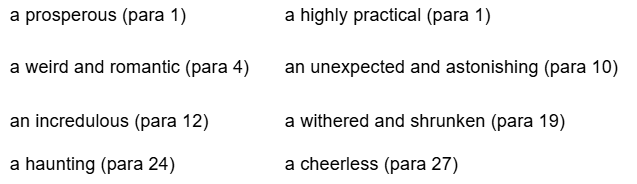
- a highly practical plan
- …………………………………………………… old chimpanzee
- …………………………………………………… businessman
- …………………………………………………… room
- …………………………………………………… plot twist
- …………………………………………………… legend
- …………………………………………………… melody
- …………………………………………………… look
Answers:
- a highly practical plan
- a withered and shrunken old chimpanzee
- a prosperous businessman
- a cheerless room
- an unexpected and astonishing plot twist
- a weird and romantic legend
- a haunting melody
- an incredulous look
C. | Match the adverbs from the text in A with the words in B.
| A | B |
|---|---|
| 1. poetically | a. studied the map |
| 2. nervously | b. described the scene |
| 3. sharply | c. listened to the problem |
| 4. sympathetically | d. came up on the stage |
| 5. intently | e. criticised the plan |
Answer:
- 1. poetically → b. described the scene
(1 – b) - 2. nervously → d. came up on the stage
(2 – d) - 3. sharply → e. criticised the plan
(3 – e) - 4. sympathetically → c. listened to the problem
(4 – c) - 5. intently → a. studied the map
(5 – a)
Writing
Imagine that Conrad and Baroness Gruebel are telling their mother about what happened at Cernogratz. Conrad believes the legend, while the Baroness prefers the rational explanation. Their mother is trying to decide what may have really happened.
Complete this dialogue.
Conrad: So you see, what the governess said must have been true.
Mother: Oh dear! What a strange and wonderful tale!
Baroness: But it was just a coincidence, don’t you think? I mean…
Answer: A Sample solution is given here to complete the dialogue.
Dialogue Completion
Conrad: So you see, what the governess said must have been true.
Mother: Oh dear! What a strange and wonderful tale!
Baroness: But it was just a coincidence, don’t you think? I mean, the weather has been unusually freezing after Christmas. It is the intense cold that splits the trees in the park, not any family curse.
Conrad: But sister, how do you explain the animals? No dog behaves like that on normal cold nights. They barked in absolute terror. The small lapdog even ran away to hide under the sofa before we even heard the wolves.
Mother: That is true. It sounds like the animals knew something supernatural was happening. Has anyone ever heard of a similar thing happening in a different season?
Baroness: No one can say for sure, Mother. No member of the von Cernogratz family had lived there for a very long time. Because of that, there was no one left alive in the village who could verify the old stories.
Conrad: Well, we can certainly see the truth now. The last von Cernogratz is now dead, so there is no way for anyone to check it in the future. Nature gave her a royal farewell, and no amount of money can buy that beautiful death-music.
Mother: It seems the castle holds deeper secrets than we thought. We must respect her memory.