

This page provides simple and clear solutions to the chapter To Truly Understand a Rainbow from the Class 7 Gul Mohar English book. Here you will find the summary, Hindi summary, word meanings, character sketch of Isaac Newton, and answers to all in-text and chapter-end exercises and activities in easy language for better understanding, Homework Help and quick revision.
#GulMoharC7
- ▶ 1 Summary of To Truly Understand a Rainbow by Kathleen Krull
- 2 Character Sketch of Isaac Newton
- 3 Vocabulary: Word Meanings
- 4 In-text Questions and Activity Answers
- ▶ 5 Textbook Question Answers for ‘To Truly Understand a Rainbow-Class 6 Gul Mohar
- ▶ 6 Worksheet – To Truly Understand a Rainbow | Class 6 Gul Mohar
- 6.1 Extract – 1
- 6.2 Extract – 2
- 6.3 Extract – 3
- 6.4 Extract – 4
- 6.5 Answer Key
- ↑ Back to top
Summary of To Truly Understand a Rainbow by Kathleen Krull
Summary in English
To Truly Understand a Rainbow by Kathleen Krull tells the story of how young Isaac Newton discovered the true nature of light and colours.
In the early 1660s, Newton was a quiet and brilliant college student. During a market visit, he bought two prisms because he was fascinated by them. Soon after, the Great Plague spread across London, and Newton had to leave college and return to his home, Woolsthorpe Manor.
While staying there, Newton spent his time thinking deeply about nature and science. At that time, many scholars believed that white light was simple and that colours were formed by mixing light and darkness. Newton did not agree with this idea.
Using a prism, Newton carried out experiments in his room. He allowed a narrow beam of sunlight to pass through the prism and noticed that the white light spread out into many colours. He called this band of colours a spectrum. He understood that white light already contained all these colours and that the prism only separated them.
To prove his idea, Newton performed another experiment. He passed only green light through a second prism. The green light remained green, showing that the prism itself did not create colours.
Through these experiments, Newton became the first person to truly understand how a rainbow is formed. His discoveries changed people’s understanding of light and colour forever.
Summary in Hindi
यह पाठ बताता है कि युवा Isaac Newton ने प्रकाश और रंगों के बारे में एक महान खोज कैसे की।
सन् 1660 के आसपास न्यूटन एक शांत, अकेले रहने वाले लेकिन बहुत बुद्धिमान छात्र थे। एक दिन उन्होंने मेले से दो प्रिज़्म खरीदे। कुछ समय बाद लंदन में भयंकर प्लेग फैल गया, इसलिए उन्हें अपना कॉलेज छोड़कर अपने गाँव स्थित घर वूल्सथोर्प मैनर लौटना पड़ा।
घर पर रहते हुए न्यूटन ने प्रकृति के रहस्यों के बारे में सोचना शुरू किया। उस समय लोग मानते थे कि सफेद प्रकाश साधारण होता है और रंग प्रकाश तथा अँधेरे के मिश्रण से बनते हैं। लेकिन न्यूटन इस बात से सहमत नहीं थे।
उन्होंने प्रिज़्म की सहायता से प्रयोग किए। जब सूर्य की सफेद किरण प्रिज़्म से होकर गुज़री, तो वह कई रंगों में बँट गई। न्यूटन ने इस रंगों की पट्टी को स्पेक्ट्रम कहा। उन्होंने समझा कि सफेद प्रकाश में पहले से ही सभी रंग मौजूद होते हैं और प्रिज़्म केवल उन्हें अलग-अलग कर देता है।
अपनी बात सिद्ध करने के लिए न्यूटन ने एक और प्रयोग किया। उन्होंने केवल हरी रोशनी को दूसरे प्रिज़्म से गुजारा। हरी रोशनी हरी ही रही। इससे साबित हुआ कि प्रिज़्म रंग पैदा नहीं करता।
इन प्रयोगों के कारण न्यूटन दुनिया के पहले व्यक्ति बने जिन्होंने सही रूप से समझा कि इंद्रधनुष कैसे बनता है। उनकी खोज ने विज्ञान की दुनिया को बदल दिया।
Character Sketch of Isaac Newton
Isaac Newton was a brilliant, curious, and hardworking young student. He liked to spend time alone and think deeply about nature and science. He was very intelligent and never accepted ideas without proof. Instead, he performed experiments to discover the truth.
Newton used his free time wisely, even during the Great Plague. He carefully observed things around him and used prisms to study light and colours. His scientific thinking and determination helped him discover that white light contains many colours.
Newton was also confident and fearless because he challenged the old beliefs of famous scholars. His discoveries made him one of the greatest scientists in the world.
Vocabulary: Word Meanings
| Word / Phrase | Meaning in English | हिन्दी अर्थ |
|---|---|---|
| solitary | living or spending time alone | अकेला रहने वाला |
| promptly | quickly; without delay | तुरंत, शीघ्र |
| Great Plague | a deadly disease that spread widely in London | लंदन में फैली भयानक महामारी |
| estimated | roughly calculated or guessed | अनुमानित |
| a quarter of | one out of four equal parts | चौथाई भाग |
| flee | to run away from danger | भाग जाना |
| countryside | rural area outside cities | गाँव का इलाका, देहात |
| waited out | stayed safely until something dangerous ended | खतरा खत्म होने तक रुके रहना |
| bleating | the crying sound made by sheep or goats | भेड़ों की मिमियाने की आवाज़ |
| fluffy | soft and light like wool | मुलायम और रूई जैसा |
| Aristotle | an ancient Greek philosopher | प्राचीन यूनानी दार्शनिक अरस्तू |
| Robert Hooke | an English scientist of Newton’s time | न्यूटन के समय के अंग्रेज वैज्ञानिक रॉबर्ट हुक |
| assumed | believed something without proof | मान लिया |
| blended | mixed together smoothly | मिल जाना |
| bands | long strips or lines | पट्टियाँ, धारियाँ |
| refract | to bend light when it passes through something | प्रकाश का मुड़ना |
| spectrum | a band of colours formed when light splits | रंगों की पट्टी, स्पेक्ट्रम |
| wavelength | the length of a light wave | तरंगदैर्घ्य |
| experimentum crucis | a very important experiment to prove something | निर्णायक प्रयोग |
| governed by scientific principles | controlled or explained by rules of science | वैज्ञानिक सिद्धांतों द्वारा नियंत्रित |
In-text Questions and Activity Answers
1. The two things we learn about Newton in paragraph 2 are-
a………..
b………..
Ans.
The two things we learn about Newton in paragraph 2 are-
- Newton bought a prism at the annual market near his college.
- Even though he had very little money, he bought another prism because he liked it very much.
2. Why do you think that people travelled to the countryside to escape the plague?
Ans. People travelled to the countryside because the plague was spreading rapidly in crowded cities like London. The countryside was safer and less crowded.
3. Unlike Newton, scientists of the time continued to……….
Ans.
Unlike Newton, scientists of the time continued to believe that colour was a mixture of light and darkness.
4. The last sentence of paragraph 7 tells us that……….
Ans.
The last sentence tells us that Newton liked to challenge and prove famous experts wrong.
5. C. V. Raman was an Indian physicist. He made a discovery that won him the 1930 Nobel Prize in Physics. Find out what his connection is to this text.
Ans.
C. V. Raman studied light and colours, just like Isaac Newton. He discovered the Raman Effect, which explains how light changes when it passes through a substance. His work, like Newton’s experiments with prisms and colours, helped scientists understand light better.
6. Underline the key sentence that tells us what Newton discovered about colours and white light. (paragraph 10 and 11)
Ans. Key sentences are given below
“Therefore, all the colours already existed in white light and the prism was simply fanning them out according to their ability to be bent.”
OR
“But the most important thing he had discovered was that white light contained all the other colours.”
7. Use one word to describe how Newton set up his experiment and tested his theories. (paragraph 12 and 13)
Ans.
Carefully / Systematically/Scientifically
Activity 1
How does being alone help Newton? How do you think you will benefit by spending some time on your own in a quiet place?
Answer:
Being alone helped Isaac Newton because he got time to think deeply and do experiments without disturbance. The quiet environment helped him concentrate on solving scientific problems and making important discoveries.
Spending some time alone in a quiet place can also help us. It allows us to think clearly, improve concentration, complete our work peacefully, and understand our ideas and feelings better.
Activity 2
How would you explain the information in paragraphs 10 and 11 with graphics? Choose the information you will use and say how you will explain it simply and how you will present it.
Answer:
I would explain paragraphs 10 and 11 with a simple labelled diagram of a prism and a rainbow spectrum.
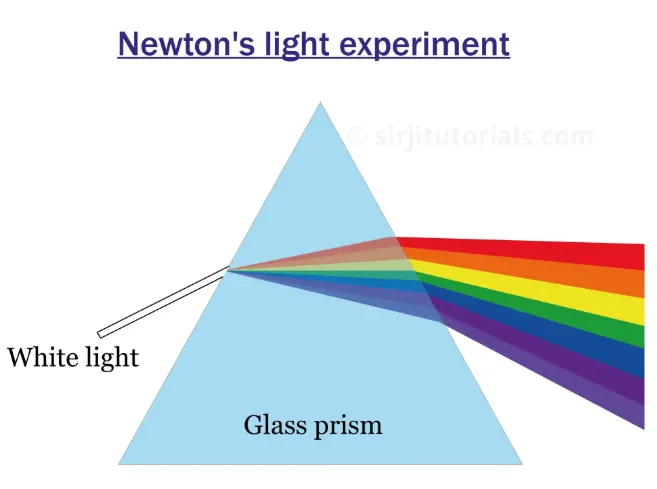
First, I would draw a beam of white sunlight entering a prism. Then I would show the light splitting into seven colours—red, orange, yellow, green, blue, indigo, and violet. I would use arrows and different colours to make the diagram easy to understand.
I would also write short labels such as:
- “White light enters”
- “Prism bends light”
- “Colours spread out”
- “This band of colours is called a spectrum”
To explain it simply, I would tell that white light already contains many colours and the prism only separates them. I would present the information using colourful charts or a PowerPoint slide so that it becomes interesting and easy to remember.
Activity 3
Write what Newton discovered in the experiment. Mention the aim, apparatus used, procedure, analysis of findings and conclusion.
Answer:
Newton’s Experiment on Light and Colours
| Heading | Details |
|---|---|
| Aim | To find out whether white light contains different colours and whether a prism creates colours. |
| Apparatus Used | Two prisms, sunlight, a screen with a slit, and a dark room. |
| Procedure | Newton allowed a narrow beam of sunlight to pass through a prism. The white light spread into many colours called a spectrum. Then he allowed only green light to pass through a second prism. |
| Analysis of Findings | The green light remained green even after passing through the second prism. This showed that the prism did not create colours. It only separated the colours already present in white light. |
| Conclusion | White light contains many colours. A prism separates these colours according to their wavelengths. This discovery also explained how rainbows are formed. |
Textbook Question Answers for ‘To Truly Understand a Rainbow-Class 6 Gul Mohar
Understanding the Text
A.| Complete this flow chart. (Refer to the book for the complete question.)
Answer:
- The sparkling prisms caught Newton’s eye—he wanted to discover
→ something more accurate about the nature of colour. - Newton didn’t see how
→ Aristotle or Hooke could be right. - A white page with black writing did not
→ appear in colour from a distance; it appeared grey. - The prism was the perfect
→ tool for his experiment. - Newton suspected that more accurate results could be had by
→ moving the prism farther away. - He wondered how the prism split the white light
→ into different colours. - A refracting object could bend each wavelength of light
→ by a different angle or amount. - Therefore, all the colours already existed in white light
→ and the prism only separated them.
B. | Answer these questions.
- Why did a prism interest a college student who liked science?
- How did Newton feel about leaving London and living in the countryside? (para 3)
- What did Newton do before he began an experiment? What does this tell us about the process of scientific discovery? (paras 4 and 5)
- What did Aristotle and Robert Hooke believe about white light? (para 6)
- What did Newton observe during his experiment? What conclusion did he come to? (paras 9 and 10)
- This was a significant discovery!
- How is the discovery significant for scientists and scientific principles?
- How is it significant for Newton himself?
- Why did Newton conduct an ‘experimentum crucis’? How did he do it? (paras 12 and 13)
Answers:
To help students, each question is provided with three answers: a short one, and two versions of a longer one (v1 and v2).
Q1. Why did a prism interest a college student who liked science?
Short Ans.
A prism interested Newton because it produced beautiful colours and made him curious about light.
Long Ans. v1
A prism interested Isaac Newton because it produced beautiful colours when sunlight passed through it. Newton was curious about science and wanted to discover whether the prism created colours or only separated the colours already present in white light.
Long Ans. v2
A prism interested Isaac Newton because it produced many beautiful colours when sunlight passed through it. Newton was curious about science and wanted to understand the true nature of light and colours. He wished to discover whether the prism created colours or only separated them.
Q2. How did Newton feel about leaving London and living in the countryside? (para 3)
Short Ans.
Newton used the quiet countryside to think and work on scientific ideas
Long Ans. v1
Newton did not waste time worrying about leaving London. Instead, he used the peaceful countryside to think deeply and work on scientific ideas. The quiet environment helped him concentrate on experiments and observations about light and colour.
Long Ans. v2
Newton used his time in the countryside wisely instead of feeling unhappy about leaving London. The peaceful surroundings helped him think deeply about scientific problems. He spent his time observing nature, studying prisms, and carrying out experiments on light and colours.
Q3. What did Newton do before he began an experiment? What does this tell us about the process of scientific discovery? (paras 4 and 5)
Short Ans.
Newton thought carefully and questioned old beliefs before experimenting.
Long Ans. v1
Before beginning experiments, Newton carefully thought about the problem and questioned old ideas. This shows that scientific discovery requires curiosity, observation, deep thinking, and careful planning before testing ideas through experiments.
Long Ans. v2
Before beginning experiments, Newton carefully thought about nature and questioned the old ideas taught by scholars. He observed things around him and planned his work properly. This shows that scientific discovery requires curiosity, careful thinking, observation, and testing ideas through experiments.
Q4. What did Aristotle and Robert Hooke believe about white light? (para 6)
Short Ans.
They believed colours were formed by mixing light with darkness.
Long Ans. v1
Aristotle and Robert Hooke believed that white light was simple and that colours were formed by mixing light with darkness. Hooke even created a colour scale based on different amounts of darkness mixed with light.
Long Ans. v2
Aristotle and Robert Hooke believed that white light was simple and that colours were formed by mixing light with darkness. Hooke also believed that different colours were created by different amounts of darkness blocking light.
Q5. What did Newton observe during his experiment? What conclusion did he come to? (paras 9 and 10)
Short Ans.
Newton observed white light splitting into many colours. He concluded that white light contains all colours.
Long Ans. v2
Newton observed that sunlight passing through a prism spread into coloured bands called a spectrum. He concluded that white light already contained many colours and that the prism only separated them according to their wavelengths.
Long Ans. v2
Isaac Newton observed that when sunlight passed through a prism, it spread into different coloured bands called a spectrum. He concluded that white light already contained all the colours. The prism did not create colours; it only separated them because each colour bends differently while passing through the prism.
Q6. This was a significant discovery!
- How is the discovery significant for scientists and scientific principles?
- How is it significant for Newton himself?
Short Ans.
- It helped scientists understand light, colours, and rainbows scientifically.
- It made Newton famous as a great scientist.
Long Ans.
- Newton’s discovery helped scientists understand the true nature of light and colours. It proved that colours follow scientific principles and are not formed by mixing light and darkness. His work became important for the study of optics and rainbows.
- This discovery made Newton famous as a brilliant scientist. It proved his ideas were correct and showed his ability to challenge old beliefs through experiments and observation. It was one of the important discoveries of his scientific career.
Q7. Why did Newton conduct an ‘experimentum crucis’? How did he do it? (paras 12 and 13)
Short Ans.
He wanted to prove that prisms do not create colours. He passed green light through a second prism, and it stayed green.
Long Ans. v1
Newton conducted an experimentum crucis to prove that the prism did not create colours. He passed only green light through a second prism. The light remained green, proving that colours already existed in white light.
Long Ans. v2
Newton conducted an experimentum crucis to prove that the prism itself did not create colours. He allowed only green light to pass through a slit and then through a second prism. The light remained green. This proved that colours already existed in white light and the prism only separated them.
Appreciating the Text
- The writer gives us many clues about Newton’s personality and who he is. But she does not describe his physical appearance. Why do you think she chose to do this? (Think about the type of text it is.)
- The writer asks some questions as the text progresses. What effect does this have on the reader? Does it help us follow along? Does it mimic Newton’s thought process? How does this help in understanding the text?
Answers:
1. The writer gives us many clues about Newton’s personality and who he is. But she does not describe his physical appearance. Why do you think she chose to do this?
Ans.
The writer focuses on Newton’s thoughts, curiosity, and scientific discoveries rather than his looks because this is an informative biographical text. The main aim is to help readers understand his personality, ideas, and achievements, not his physical appearance.
2. The writer asks some questions as the text progresses. What effect does this have on the reader?
Ans.
The questions make the text more interesting and help readers think along with Isaac Newton. They guide us through his thought process and make it easier to understand how he formed his ideas and discoveries.
Grammar and Usage
A. | Complete these sentences with the correct prepositions. Then write what the preposition indicates.
- Jessie waited for half an hour. Then he called me. time and duration
- ………… we finish dinner and clear the dishes, we can go out ………… an ice cream.
- The stranger stood ………… the tall trees so nobody would notice him.
- The counter will open ………… ten minutes. We can buy the tickets then.
- We heard the fire alarm ………… four this afternoon and ran ………… the exit.
- My sister worked ………… Singapore ………… last year.
- Both the boys jumped ………… the wall and escaped with the mangoes.
- The participants ………… the other schools came ………… their teachers.
Answer:
- Jessie waited for half an hour. Then he called me. — time and duration
- After we finish dinner and clear the dishes, we can go out for an ice cream. — time / purpose
- The stranger stood behind the tall trees so nobody would notice him. — place
- The counter will open in ten minutes. We can buy the tickets then. — time
- We heard the fire alarm at four this afternoon and ran towards the exit. — time / direction
- My sister worked in Singapore during last year. — place / time
- Both the boys jumped over the wall and escaped with the mangoes. — movement
- The participants from the other schools came with their teachers. — source / accompaniment
B. | Grammar Fun
In groups, design your dream home. Use the correct prepositions in complete sentences to say—
- where the house will be.
- how long it will take to build.
- what you are building it for.
- what materials you will use and from where you will source them.
- how you will transport the materials.
- where in the house you will place your prized possessions.
Answer:
My dream home will be near the mountains and beside a river. It will have a small garden in front of the house. We will build it for my family so that we can live peacefully.
The house will take about one year to build. We will use wood from forests and stones from nearby hills. The materials will be transported by trucks.
I will place my books and trophies in my study room and family photographs on the walls of the living room.
C. | Write sentences as instructed.
- Use except for to say that, in class 7B, only Jatin did not go on the excursion.
All students of class 7B except for Jatin went on the excursion. - Use by means of to say taxi drivers locate places easily with GPS.
- Use in addition to to say that she paid ₹100 extra at the restaurant as service charges.
- Use instead of to suggest we can go to Ooty if Kodaikanal is too far.
- Use on account of to announce that the school will remain closed for a week because the summer heat is severe.
Answers:
- All students of class 7B except for Jatin went on the excursion.
- Taxi drivers locate places easily by means of GPS.
- She paid ₹100 extra in addition to the bill as service charges.
- We can go to Ooty instead of Kodaikanal if Kodaikanal is too far.
- The school will remain closed for a week on account of the severe summer heat.
D. | Write what kinds of sentences these are—declarative, interrogative, imperative or exclamatory.
- Viaan is not going to be late. declarative
- Where is your school?
- This is the most beautiful forest I have ever seen!
- French fries are not good for your health.
- It took a great deal of hard work to dig this well.
- Could you please pass the salt?
- Finish your homework immediately.
- Look out! A bike is coming!
Answers:
- Viaan is not going to be late. — Declarative
- Where is your school? — Interrogative
- This is the most beautiful forest I have ever seen! — Exclamatory
- French fries are not good for your health. — Declarative
- It took a great deal of hard work to dig this well. — Declarative
- Could you please pass the salt? — Interrogative
- Finish your homework immediately. — Imperative
- Look out! A bike is coming! — Exclamatory
Words in Use (synonyms)
A. | Write a synonym for each of these words from the text. You may refer to a dictionary.
| word | synonym | word | synonym |
|---|---|---|---|
| 1. gifted (para 1) | 4. precise (para 9) | ||
| 2. uncommon (para 2) | 5. essential (para 12) | ||
| 3. unvarying (para 6) | 6. immaculate (para 12) |
Answers:
| Word | Synonym |
|---|---|
| 1. gifted (para 1) | brilliant/talented |
| 2. uncommon (para 2) | rare/unusual |
| 3. unvarying (para 6) | uniform/constant/unchanging |
| 4. precise (para 9) | accurate/exact |
| 5. essential (para 12) | crucial/vital/necessary |
| 6. immaculate (para 12) | pure/perfect/flawless |
B. | Find one word each in paragraphs 9 and 14 that means to show a particular result after a period of time.
Answer:
- Paragraph 9 — projected
- Paragraph 14 — established
Here is the text extracted from the image:
C. | Vocabulary Activity
Work in groups and find these words from the text.
- three words that describe Newton
- one word to describe how the other scholars of the time thought about white light
- one word to describe how Newton studied his experiment
The first group to find all five words and get them right, wins.
Answers:
- Three words that describe Newton:
- solitary
- brilliant
- unpopular
- One word to describe how the other scholars thought about white light:
- uniform
- One word to describe how Newton studied his experiment:
- accurately
Writing
After performing the experiment, Newton decides to write a letter to his acquaintance a fellow scientist, explaining what he had discovered.
Complete the letter. You can include these points.
- wondered if he could discover something about the nature of colour
- set up the experiment and observed the prism and the light
- performed an ‘experimentum crucis’ and established his findings
- asked for help to present his findings to other scientists
Dear Lewis,
I write to enquire how you are and…
I have some very interesting news for you. I have made a discovery that…
This is how I went about it…
I wonder if you could help me share these findings with the Royal Society?
Yours sincerely,
Isaac
Answer:
A sample letter is provided below.
Worksheet – To Truly Understand a Rainbow | Class 6 Gul Mohar
Name: ____________________ Class: _________ Date: __________
Read the extracts and answer the questions that follow.
Extract – 1
“That day, Newton had spent a rare few hours outside at the annual market near his college. He bought a toy—a prism. Though he had very little money, he liked the prism so much that he promptly bought another.
Shortly afterward, the Great Plague spread through London. It killed an estimated 100,000 people. Newton, too, was forced to leave college and retreat to his childhood home, Woolsthorpe Manor.”
A. Choose the correct answer. Why did Newton buy a second prism?
(a) He wanted to gift it to a friend
(b) He found the prism interesting
(c) The shopkeeper forced him
(d) The prism was very cheap
B. Fill in the blank. The Great Plague forced Newton to leave __________ and return home.
C. True or False. Newton was very rich and bought many expensive things. _________
D. Combination MCQ Which two statements are correct?
- Newton was curious about science.
- Newton bought a telescope at the market.
- The Great Plague spread through London.
- Newton stayed in college during the plague.
(a) 1 and 3
(b) 2 and 4
(c) 1 and 2
(d) 3 and 4
Extract – 2
“While other students might have taken this time to forget about their studies for a while, Newton sat still…and thought. Which of the many puzzles in nature could he solve while he waited out the plague in the countryside?
The sparkling prisms caught his eye. What if he could discover something about the nature of colour—something more accurate than what he was being taught in college?”
A. Choose the correct answer. What did Newton do during his stay in the countryside?
(a) He wasted his time
(b) He travelled around the country
(c) He thought deeply about scientific problems
(d) He stopped studying completely
B. Fill in the blank. Newton wanted to discover something more accurate about the nature of __________.
C. True or False. Newton accepted every idea taught in college without questioning it. _________
D. Combination MCQ Choose the correct pair.
- Newton was curious and thoughtful.
- Newton ignored the prisms completely.
- Newton liked solving puzzles in nature.
- Newton believed everything without proof.
(a) 1 and 3
(b) 2 and 4
(c) 1 and 2
(d) 3 and 4
Extract – 3
“In his study upstairs, he positioned the prism at the far wall so that it was twenty-two feet from the window. He let a narrow beam of sunlight pass through the prism. He observed that the beam of sunlight spread out into coloured bands of light which he called a spectrum.
The white light had split into different colours.”
A. Choose the correct answer. What happened when sunlight passed through the prism?
(a) The light disappeared
(b) The light became black
(c) The light spread into many colours
(d) The prism broke into pieces
B. Fill in the blank. Newton called the coloured band of light a __________.
C. True or False. Newton observed his experiment carefully. _________
D. Combination MCQ Which statements are correct?
- Newton used sunlight in his experiment.
- The prism produced only green colour.
- White light split into different colours.
- Newton carried out the experiment carelessly.
(a) 1 and 3
(b) 2 and 4
(c) 1 and 2
(d) 3 and 4
Extract – 4
“Then he took his second prism and placed it in the green light. If the prism was colouring the light, the green would come out as a different colour. But the green light remained green. The prism had no effect on it.
Newton rarely smiled, but he might have just then. He had just established that colours were governed by scientific principles.”
A. Choose the correct answer. Why did Newton use a second prism?
(a) To decorate his room
(b) To prove that the prism did not create colours
(c) To make the light brighter
(d) To produce darkness
B. Fill in the blank. The green light remained __________ after passing through the second prism.
C. True or False. Newton proved that colours are governed by scientific principles. _________
D. Combination MCQ Choose the correct answer.
- The second prism changed green light into red light.
- Newton’s experiment proved an important scientific idea.
- The green light remained green.
- Newton’s experiment failed.
(a) 1 and 4
(b) 2 and 3
(c) 1 and 2
(d) 3 and 4
Bonus Thinking Question:
Why do you think curiosity is important for scientists like Isaac Newton?
Answer Key
Extract – 1
A. (b) He found the prism interesting
B. college
C. False
D. (a) 1 and 3
Extract – 2
A. (c) He thought deeply about scientific problems
B. colour
C. False
D. (a) 1 and 3
Extract – 3
A. (c) The light spread into many colours
B. spectrum
C. True
D. (a) 1 and 3
Extract – 4
A. (b) To prove that the prism did not create colours
B. green
C. True
D. (b) 2 and 3
Bonus Thinking Question (Sample Answer)
Curiosity is important for scientists because it helps them ask questions, think deeply, and discover new things. Without curiosity, important discoveries and inventions would not happen.