

This post offers complete notes and solutions for the Class 6 Gulmohar English lesson “Wild Duck” by Romesh Gunesekera. It features a clear summary, key vocabulary, character sketches, themes, genre, and moral values. You’ll also find detailed answers to in-text questions and chapter-end exercises, making it easy to understand and perfect for effective revision.
Video: Wild Duck – Hindi Explanation
Chapter Notes on Wild Duck by Romesh Gunesekera
Summary, Meanings, Themes, Character Sketch, Moral Values
Summary of Wild Duck
A father and his son go to a lake to hunt wild ducks. The father teaches the boy how to aim and shoot. Soon, a huge flock of birds flies over them. The father fires many shots but misses. The boy carefully aims and shoots one duck.
When they find the duck, it is badly hurt but still alive. The boy feels sad and guilty when he touches it. He realizes that hurting the duck was wrong. He decides to take care of it instead of letting it die.
At home, the boy nurses the duck and looks after it. The duck cannot fly again, but it lives safely with him. The boy’s feelings change completely. He throws away his gun because he no longer wants to hurt animals. In the end, even the father feels peaceful and relieved.
Hindi Summary
एक पिता अपने बेटे के साथ झील पर जंगली बतख का शिकार करने जाता है। पिता बेटे को बंदूक चलाना सिखाता है। कुछ ही देर में बहुत सारे पक्षी आकाश में उड़ते हुए दिखाई देते हैं। पिता कई गोलियाँ चलाता है, लेकिन वह किसी को नहीं मार पाता। बेटा ध्यान से निशाना लगाकर एक बतख को मार देता है।
जब वे बतख को ढूँढते हैं, तो वह घायल होती है लेकिन अभी ज़िंदा होती है। बेटे को बहुत दुख और पछतावा होता है। उसे लगता है कि उसने गलत काम किया है। वह उसे मारने के बजाय उसकी देखभाल करने का फैसला करता है।
घर पर वह बतख के पंख पर पट्टी बाँधता है और उसकी देखभाल करता है। बतख फिर कभी उड़ नहीं पाती, लेकिन सुरक्षित रहती है। बेटे के विचार पूरी तरह बदल जाते हैं। वह अपनी बंदूक फेंक देता है क्योंकि वह अब किसी जानवर को चोट नहीं पहुँचाना चाहता। अंत में पिता भी शांति और राहत महसूस करता है।
Vocabulary (Meanings)
Character Sketches
1. The Boy (Son)
The boy is a sensitive, gentle, and thoughtful child who loves watching birds. At the beginning, he obeys his father and shoots at the ducks, showing that he is still learning from elders. However, his true nature is revealed when he sees the injured duck. He feels guilt, fear, and deep regret. Instead of feeling proud, he becomes uncomfortable with what he has done. His kind-hearted nature makes him care for the wounded duck, and he decides to protect it. By throwing away the gun, he shows strong moral courage and a clear decision to never harm animals again. His character shows a powerful inner change from a hunter to a compassionate human being.
2. The Father (Man)
The father is an experienced and practical man who is skilled in hunting. At the start, he appears strict and focused only on teaching his son how to shoot properly. He believes in skill, control, and success in hunting, and does not show much concern for the feelings of animals. However, when his son reacts differently, the father is first shocked but later becomes quiet and thoughtful. In the end, he feels a sense of peace and relief, which suggests that he understands and accepts his son’s decision. His character shows a subtle change from being only a hunter to becoming a more understanding and supportive father.
3. About The Wild Duck
The wild duck is presented as an innocent, helpless, and silent victim in the story. It does not speak, yet its suffering has a strong impact. When the boy sees the duck alive and injured, its condition creates a moment of realisation for him. The duck becomes a powerful symbol of pain, life, and kindness. Its presence changes the boy’s thinking and actions completely. Thus, the duck plays an important role in teaching the lesson of compassion, responsibility, and respect for living beings.
Themes, Genre and Values
Theme:
The story shows compassion, realisation of mistakes, and respect for life. It highlights how a person can change from hurting to caring.
Genre:
It is a realistic short story with a touch of moral lesson and emotional growth.
Values:
The story teaches kindness, responsibility, and love for animals, along with the courage to do what is right.
Wild Duck Question Answers | Class 6 English Gulmohar Book
Intext Question Answers
S Ans. = Short Answer | L Ans. = Long Answer
1. Till para 10, the boy hardly speaks. Why do you think he is so quiet?
S Ans. The boy is quiet because he is focused, serious, and listening carefully to his father.
L Ans. The boy is quiet because he is serious, focused, and a little nervous. He is carefully listening to his father’s instructions and preparing himself to shoot. This is a new and important moment for him, so he prefers to stay silent and concentrate.
2. Why do you think the writer provides such detailed and beautiful images of nature? (paras 11–13)
S Ans. The writer describes nature beautifully to show its beauty and to contrast it with the violence of hunting.
L Ans. The writer uses beautiful and detailed images to show the beauty of nature and the large number of birds. It helps the reader feel the scene clearly. This also creates a contrast between the peaceful beauty of nature and the violence of hunting, making the story more meaningful.
3. Do you notice any change in the boy from para 11 onwards? What is it?
S Ans. Yes, the boy changes. He becomes amazed, then later guilty and caring.
L Ans. Yes, there is a clear change. The boy becomes excited and amazed when he sees the birds and feels spellbound by their beauty. Later, after shooting the duck, he becomes sad, guilty, and caring. His feelings change from excitement to compassion.
4. Why do you think the boy wants to find the bird? What does he plan to do?
S Ans. He wants to find the bird because he feels concerned and plans to help and care for it.
L Ans. The boy wants to find the bird because he is concerned about it. After shooting it, he does not feel proud but worried. He plans to check if it is alive and later decides to take care of it instead of letting it die.
5. Point out the comparison in para 26 and explain it.
S Ans. The wing is compared to a “ragged sail of a toy boat,” showing the duck is injured and helpless.
L Ans. The comparison is: “the broken wing… like the ragged sail of a toy boat.”
Here, the duck’s broken wing is compared to a torn sail. This shows how damaged and helpless the duck is. The image makes the reader feel sympathy for the bird.
6. Why does the writer use the word ‘sick’ to describe how the boy feels? Would the word ‘angry’ or ‘sad’ have the same effect?
S Ans. “Sick” shows deep guilt and discomfort. “Angry” or “sad” would not show such strong feelings.
L Ans. The word “sick” shows that the boy feels deep discomfort and guilt, almost like he is physically unwell. It is stronger than just feeling angry or sad. The words “angry” or “sad” would not show the same level of inner pain and regret that “sick” expresses.
Chapter -text-end Question Answers – “Wild Duck”
Understanding the Text
A. | Give reasons for these statements.
- The boy watched the birds in fascination.
- The man could tell the boy how and which way the birds would move.
- The colours of the lake changed from para 6 to para 13.
- The boy took the duck home.
- The boy threw his gun away.
- In para 43, the man felt two different emotions one after the other.
Answers:
- The boy watched the birds in fascination because he loved birds and was amazed by their large number and beauty.
- The man could tell this because he was experienced in hunting and understood the birds’ flight patterns.
- The colours of the lake changed because the light of the setting sun changed and later the huge flock of birds darkened the sky and water.
- The boy took the duck home because he felt guilty and compassionate and wanted to take care of it.
- The boy threw his gun away because it made him feel ashamed and uncomfortable, and he decided not to harm animals again.
- The man first felt angry and shocked, but then he felt peaceful and relieved after understanding his son’s feelings.
B. | Answer these questions.
- How does the story open—what can you see and where? (paras 1 to 10) What kind of mood does it set?
- His arms trembled as he pulled the paddle through the black water. (para 24)
a. What had happened just before this? Why was the boy paddling?
b. Why do you think his arms trembled? Which para shows a change in this feeling? - … the boy looked frightened at what he had done. What had the boy done and why was he frightened by it? (paras 20, 21 and 29)
- “You’ll have to look after it.” (para 34)
a. Do you think the man wanted the boy to look after the duck? What makes you think so?
b. Has the man been mentioned in para 36? Why do you think the writer did this? Does it support your answer to question 4.a.? - “I threw it away,” he said defiantly. (para 38)
a. What was the boy’s state of mind when he said this? Why do you think he spoke this way?
b. Do you agree with what the boy did? Why or why not? - Read the last line of the text. What can we guess about the man from this line that has not been directly said anywhere? (para 43)
- How does this text encourage ahimsa or non-violence? Explain based on these points.
a. What is the act of violence in the story and what is its direct outcome?
b. How do the characters feel when they decide to stop doing something violent?
Answers:
1. How does the story open—what can you see and where? What kind of mood does it set?
Ans. The story opens on a quiet lake in a wilderness, where a father and his son sit in a still boat with guns. The light of the evening is changing. This sets a calm and silent mood, but also creates a feeling of tension and expectation.
Another Ans:
The story begins on a lonely lake, where a father and son sit quietly in a small boat with their guns. The sky is changing colours as evening falls. This creates a peaceful yet serious mood, with a sense of waiting and suspense.
2. (a) What had happened just before this? Why was the boy paddling?
Ans. Just before this, the boy had shot a duck. He was paddling to find and pick up the injured bird.
Another Ans:
The boy had just shot a duck from the sky. He was paddling to reach the place where the bird had fallen.
(b) Why do you think his arms trembled? Which para shows a change in this feeling?
Ans. His arms trembled because he felt nervous, excited, and later guilty about what he had done. The change in this feeling is seen in para 32–33, where he feels relief when he realizes the duck is still alive and decides to care for it.
Another Ans:
His arms trembled because he felt uneasy and disturbed after shooting the duck. This feeling changes in para 32, when he feels relieved to see that the duck is still alive.
3. What had the boy done and why was he frightened by it?
Ans. The boy had shot the duck and injured it. He was frightened because he realised he had hurt a living creature and felt guilty and shocked.
Another Ans:
The boy had shot and injured the duck. He was frightened because he saw the duck’s pain and helplessness, which made him realise his mistake.
4. (a) Do you think the man wanted the boy to look after the duck? Why?
Ans. Yes, the man wanted him to look after it. His words show that he wanted the boy to take responsibility for what he had done.
Another Ans:
Yes, the man wanted him to look after it. By saying this, he made the boy face the result of his action and learn a lesson.
(b) Has the man been mentioned in para 36? Why do you think the writer did this? Does it support your answer?
Ans. No, the man is not mentioned. This shows the boy is independently caring for the duck. Yes, it supports that the boy has accepted responsibility.
Another Ans:
No, the man is not mentioned. This shows the boy is taking care of the duck on his own, which supports the idea that he has accepted responsibility.
5. (a) What was the boy’s state of mind? Why did he speak this way?
Ans. The boy felt strong and determined. He spoke defiantly because he had made a firm decision not to hurt animals again.
Another Ans:
The boy was firm and emotionally strong. He spoke this way because he truly believed that hurting animals was wrong.
(b) Do you agree with what the boy did? Why or why not?
Ans. Yes, because he chose kindness over violence and learned an important lesson about respecting life.
Another Ans:
Yes, because he showed compassion and chose to protect life instead of harming it.
6. What can we guess about the man from the last line?
Ans. We can guess that the man understood his son’s feelings and felt happy and peaceful about the change.
Another Ans:
We can guess that the man had changed his thinking and quietly accepted his son’s decision.
7. (a) What is the act of violence and its direct outcome?
Ans. The act of violence is shooting the duck, and the outcome is that the duck is injured and cannot fly.
Another Ans:
The act of violence is shooting the duck, and the result is that the duck is injured and unable to fly.
(b) How do the characters feel when they stop doing something violent?
Ans. They feel peaceful, relieved, and satisfied, as they choose kindness and care instead of harm.
Another Ans:
They feel calm, satisfied, and at peace, because they choose care and kindness.
Appreciating the Text
1. Read the story carefully. Find an example each to show a conflict that occurs—
a. within the minds of the boy and the man.
b. between the boy and the man.
Answers:
a. Conflict within the minds of the boy and the man
The boy faces an inner conflict after shooting the duck. At first, he follows his father and shoots, but later he feels guilt and compassion. He is torn between being a hunter and being kind.
The man also has an inner conflict at the end. He first feels anger and shock when the boy throws the gun away, but later he feels peace and relief, showing a change in his thinking.
Short Ans.
Boy: The boy feels guilt vs duty after shooting the duck.
Man: The man feels anger vs peace when the boy throws the gun.
b. Conflict between the boy and the man
There is a conflict between the boy and the man in their ideas about hunting. The father believes in hunting and skill, while the boy begins to believe in kindness and protecting life. This difference becomes clear when the boy throws away the gun and refuses to harm animals.
Short Ans.
The father supports hunting, but the boy chooses kindness and non-violence.
2. Pick Another metaphor used to describe the ducks and explain what it means.
Answer:
Another metaphor used in the story is when the ducks are described as “a ribbon of black dots.”
This means that the ducks are flying in a long, thin line across the sky, looking like a dark ribbon. It helps us imagine their shape and movement clearly and shows how large and organised the flock is.
3. Look at the table on the next page. Complete it by writing how these descriptions from the text make you feel. You can add another description that you love, from the text.
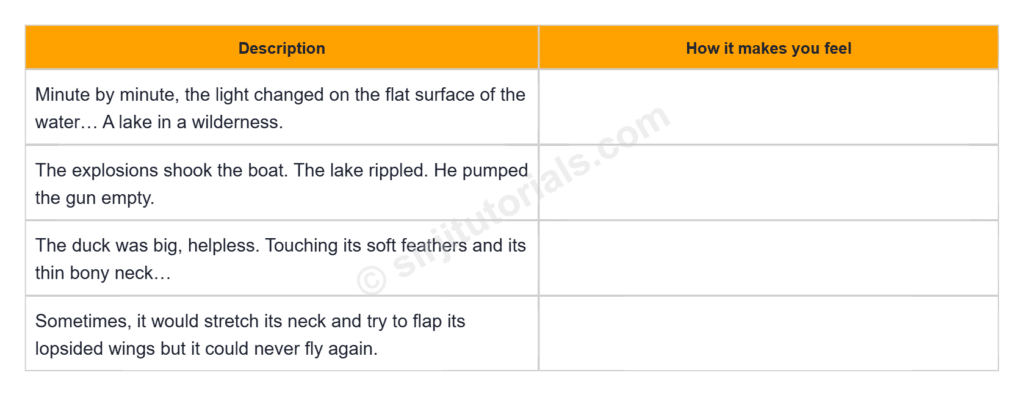
Answer:
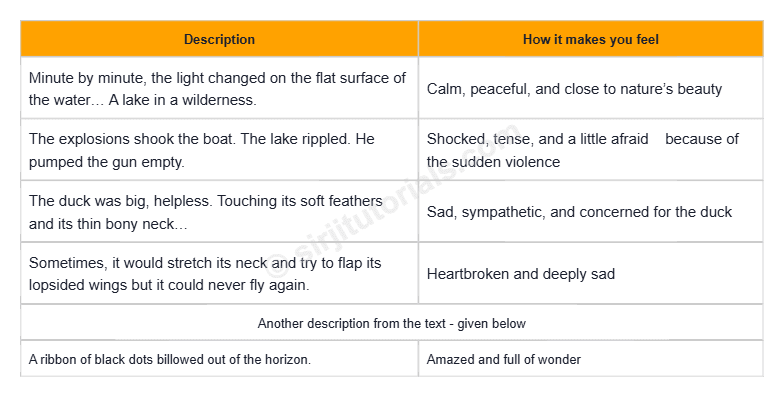
Grammar and Usage
A. | Look at the highlighted words. Mark (F) for the finite and (NF) for non-finite.
She decided that she would take up knitting as a hobby. → NF
They have been waiting for the doctor patiently. …………
To explore this place, you need a map. …………
I called her, but she was talking to someone else. …………
Thank you, we have enjoyed our stay with you immensely. …………
The audience cheered him while he was speaking. …………
Answer:
- She decided that she would take up knitting as a hobby. → NF
- They have been waiting for the doctor patiently. → NF
- To explore this place, you need a map. → NF
- I called her, but she was talking to someone else. → NF
- Thank you, we have enjoyed our stay with you immensely. → F
- The audience cheered him while he was speaking. → NF
B. | Rewrite these sentences as suggested.
- We overate last night. It wasn’t a good idea. (Use a gerund.)
Overeating last night was not a good idea. - Joanna paints and sculpts. Those are her hobbies. (Use gerunds.)
Joanna’s ……………………………………………………….. . - I finally met my favourite author. I waited for a whole year. (Use a ‘to’ infinitive.)
I waited ………………………………………………………… . - We travelled for sixteen hours. It has quite exhausted us. (Use a gerund.)
………………………………………………… exhausted us. - He let the children travel alone. It was a bold decision. (Use a ‘to’ infinitive.)
…………………………………………………. a bold decision. - Akash is training hard. He will run a marathon. (Use a ‘to’ infinitive.)
Akash is ………………………………………………………..
Answer:
- Overeating last night was not a good idea.
- Joanna’s painting and sculpting are her hobbies.
- I waited for a whole year to meet my favourite author.
- Travelling for sixteen hours has quite exhausted us.
- To let the children travel alone was a bold decision.
- Akash is training hard to run a marathon.
Words in Use
A. | Which words in the text have these meanings?
Look at paragraphs 11 and 36.
| verb | noun | adjective |
|---|---|---|
| 1. swelled | 2. where the sky seems to meet the earth | 3. held by magic |
| 4. made a sound by forcing air through the lips | 5. a deep and strong interest | 6. seriously injured |
| 7. reach as far as possible | 8. space behind a house | 9. unbalanced |
Answer:
- swelled → billowed
- where the sky seems to meet the earth → horizon
- held by magic → spellbound
- made a sound by forcing air through the lips → whistled
- a deep and strong interest → passion
- seriously injured → maimed
- reach as far as possible → stretch
- space behind a house → backyard
- unbalanced → lopsided
B. | Match the words with similar meanings. Then, look at the pairs of words and mark each word as strong (S) or weak (W). (see the boo for the full question)
Answer:
- broken (W) → shattered (S)
- dead-on (S) → accurate (W)
- frightened (W) → terrified (S)
- sick (W) → disgusted (S)
- spellbound (S) → fascinated (W)
- thin (W) → skinny (S)
Punctuation
Rewrite these using contractions.
- he will ……………………………………………..
- where is ………………………………………….
- cannot ……………………………………………
- ought not ……………………………………….
- let us ………………………………………………
- there would …………………………………….
- I am ……………………………………………….
- will not …………………………………………..
- Mina has arrived. ……………………………
- That is amazing. ……………………………..
Answer:
- he will → he’ll
- where is → where’s
- cannot → can’t
- ought not → oughtn’t
- let us → let’s
- there would → there’d
- I am → I’m
- will not → won’t
- Mina has arrived → Mina’s arrived
- That is amazing → That’s amazing
Worksheet Competency Focused Questions (CFQs) for Wild Duck Story in Class 6 Gulmohar
Here are three extracts from the story ‘Wild Duck’ along with competency-based questions aimed at assessing students’ understanding and learning from the text. The source of the story text is the Class English textbook ‘Gulmohar’.
Worksheet – Wild Duck | Class 6 Gulmohar Book
(For Class 6 – Reading Skills & Understanding)
Extract 1
“They will come from over there,” the man pointed at a red volcanic hill.
He and the boy both had guns resting across their knees. They sat facing each other in a small motionless boat, with the oars tucked in.
“Are you ready?” he asked his son.
“Yes.”
“They come in clouds, huge clouds moving very fast… You have to be quick. Shoot fast.”
Questions:
- Where are the father and the boy sitting?
- What is the father teaching the boy?
a) Fishing
b) Swimming
c) Shooting
d) Rowing - Find one word that shows the boat is not moving.
- The boat is __________ because the oars are tucked in.
- Which of the following describe the father?
(i) Experienced
(ii) Careless
(iii) Serious
(iv) Playful
a) (i) and (iii)
b) (ii) and (iv)
c) (i) and (iv)
d) (ii) and (iii) - The father is teaching the boy patiently.
Extract 2
“Suddenly, the boy looked up. ‘Is that them?’ A ribbon of black dots billowed out of the horizon. The boy was spellbound…
Half the sky was covered by teal. Huge clouds of them banked one way, then another, changing the shape of the sky and blotting the light. The sky deepened, the water turned black.”
Questions:
- What is being described as a “ribbon of black dots”?
- What does the word “spellbound” mean?
a) Angry
b) Bored
c) Amazed
d) Afraid - How does the sky look in this scene?
- Half the sky was covered by __________.
- Which statements are correct?
(i) The birds are few in number
(ii) The boy is fascinated
(iii) The sky looks crowded
(iv) The birds are sitting quietly
a) (ii) and (iii)
b) (i) and (iv)
c) (i) and (ii)
d) (iii) and (iv) - The boy feels uninterested in the birds.
Extract 3
“There was a lump floating on the water… On it was a broken wing, pointing at the sky like the ragged sail of a toy boat…
The duck was big, helpless. Touching its soft feathers and its thin bony neck, the boy looked frightened at what he had done.
Then, the duck lifted up its head…
The boy stroked its head. ‘I want to go home.’”
Questions:
- What condition is the duck in?
- How does the boy feel when he sees the duck?
a) Happy
b) Proud
c) Sad
d) Angry - What does the word “stroked” show about the boy’s behaviour?
- The duck was __________ and could not fly properly.
- Which words describe the boy now?
(i) Caring
(ii) Cruel
(iii) Gentle
(iv) Careless
a) (i) and (iii)
b) (ii) and (iv)
c) (i) and (iv)
d) (ii) and (iii) - The boy wants to continue hunting.
Answer Keys
Extract 1 – Answers
- They are sitting in a small boat on a lake.
- c) Shooting
- motionless
- The boat is still / not moving because the oars are tucked in.
- a) (i) and (iii)
- True
Extract 2 – Answers
- It refers to a large flock of birds (ducks).
- c) Amazed
- The sky looks full of birds and dark.
- Half the sky was covered by teal.
- a) (ii) and (iii)
- False
Extract 3 – Answers
- The duck is injured and helpless.
- c) Sad
- It shows the boy is gentle and caring.
- The duck was injured / helpless and could not fly properly.
- a) (i) and (iii)
- False
Ends ……