

This post contains NCERT book question answers and solutions for the poem “Somebody’s Mother” from the Class 8 English textbook ‘Poorvi’. It includes answers to both in-text and end-of-the-text exercises, questions, and activities.
In-text Question Answers – “Soebodys’s Mother” Poem
In text Questions: These include the questions and exercises found before the poem “Somebody’s Mother” in the section ‘Let us do these activities before we read,’ as well as those after the poem under ‘Let us discuss.’ They are different from the chapter-end questions and exercises that appear later, starting from the section ‘Let us think and reflect.’
Let us do these activities before we read.
I. Recall a time you helped someone. Write two words describing:
1. What were your feelings after you did so?
Answer:
- Happy
- Proud
2. What might have been the feelings of the person whom you helped?
Answer:
- Thankful
- Relieved
Note: Since this is a personal response, students may use other suitable words such as joyful, satisfied, grateful, cared for, or safe.
II. Work in pairs. Read the words given below. Circle the words you would associate with an elderly person and underline the words you would associate with a school student. Share the reasons for your choices with your classmates and teacher.

Answers:
Elderly Person (Circle)
- worried
- trembling
- bent
- grey
- slow
School Student (Underline)
- strong
- hastening
- merry
- helpful
- guide
Note:
Some words such as helpful and guide can be associated with both elderly people and school students. However, in the context of the poem, helpful describes the kind schoolboy who helps the old woman, and guide refers to the boy guiding her across the road.
III. Read the lines.
The woman was old and ragged and grey
And bent with the chill of the Winter’s day.
Select the suitable meaning of ‘ragged’ as used in these lines. There are other four meanings given below. Discuss with your classmates and teacher.
- (of clothes) old and torn; synonym: shabby
- a ragged jacket
- Having an outline, an edge, or a surface that is not straight or even
- a ragged coastline
- Not smooth or regular; not showing control or careful preparation
- I could hear the sound of his ragged breathing.
- Their performance was still very ragged.
- (Informal) very tired, especially after physical effort
- The elderly man was ragged after climbing the stairs.
Answer: ✅ 1. (of clothes) old and torn; shabby
Reason:
In the poem, the phrase “old and ragged and grey” describes the old woman’s worn-out clothes. Therefore, ‘ragged’ means wearing old, torn, and shabby clothes.
NCERT Book Question Answers for the poem ‘Somebody’s Mother’
End-of-the-text Questions: These are the questions, exercises, and activities from the Class 8 NCERT English book ‘Poorvi’, found at the end of the poem “Somebody’s Mother”. Starting with the section “Let us Think and Reflect” and moving through other sections, they aim to assess understanding of the entire chapter.
Let us discuss
I. Arrange the events of the poem in the correct order of occurrence. Share your answers with your classmates and teacher.
- The boy returned to his friends, feeling proud of what he had done.
- The old woman stood alone at the crossing, hesitant to move.
- A group of schoolboys passed by, playing, and laughing.
- The boy offered to help the old woman cross the street.
- The woman prayed for the boy who helped her.
- The children hurried past the old woman without offering help.
- The woman placed her hand on the boy’s arm, and he guided her
safely across the street. - The boy thought about his own mother and hoped someone would
help her one day.
Answer:
(Correct Order):
2 → 3 → 6 → 4 → 7 → 1 → 8 → 5
- The old woman stood alone at the crossing, hesitant to move. (2)
- A group of schoolboys passed by, playing, and laughing. (3)
- The children hurried past the old woman without offering help. (6)
- The boy offered to help the old woman cross the street. (4)
- The woman placed her hand on the boy’s arm, and he guided her safely across the street. (7)
- The boy returned to his friends, feeling proud of what he had done. (1)
- The boy thought about his own mother and hoped someone would help her one day. (8)
- The woman prayed for the boy who helped her. (5)
II. Fill in the blanks by choosing the correct answer from the options given in the brackets.
- The central theme of the poem is ______. (kindness and empathy/ adventure and courage)
- The tone of the poem is ______. (humorous and playful/ sympathetic and hopeful)
- The poem is written in couplets with ______ lines in each stanza. (four/two)
- The structure of the poem gives a rhythmic flow that reflects both the ______. (narrative and emotions/story’s pace and message)
- The poem follows a rhyme scheme of ______. (AABB/ABAB)
Answers:
- The central theme of the poem is kindness and empathy.
- The tone of the poem is sympathetic and hopeful.
- The poem is written in couplets with two lines in each stanza.
- The structure of the poem gives a rhythmic flow that reflects both the story’s pace and message.
- The poem follows a rhyme scheme of AABB.
III. Pick examples from the poem for the following poetic devices.
- Simile
- Alliteration
- Repetition
Answer:
- Simile: “Like a flock of sheep” (use of ‘like’)
- Alliteration: (4 examples are given here)
- “helping hand” (repetition of the /h/ sound)
- “slippery street” (repetition of the /s/ sound)
- “heart happy” (repetition of the /h/ sound)
- “my mother” (repetition of the /m/ sound)
- Repetition:
- “Mother” (repeated three times in the poem)
- “Somebody’s mother” (repeated two times in the poem)
- “So meek, so timid” (repetition of “so”)
IV. Complete the following sentences appropriately explaining the imagery.
- The poem uses imagery to describe scenes of a bustling street. We know this by the phrase _______.
- The line ‘The street was wet with a recent snow’ suggests a cold and _______ weather, emphasising the woman’s helplessness.
Answer:
- The poem uses imagery to describe scenes of a bustling street. We know this by the phrase the throng of eager people.
- The line “The street was wet with a recent snow” suggests a cold and slippery weather, emphasising the woman’s helplessness.
V. Complete the following sentence with a suitable reason.
The poet repeats the phrase Somebody’s mother because it ___________.
Answer:
The poet repeats the phrase Somebody’s mother because it reminds us that every elderly woman is someone’s beloved mother and deserves kindness, respect, and care.
VI. Complete the analogy:
The old woman: vulnerable and neglected :: The young boy: ___________.
Answer:
The old woman : vulnerable and neglected :: The young boy : kind and compassionate.
Let us think and reflect
I. Read the given extracts and answer the questions that follow.
- The woman was old and ragged and grey
And bent with the chill of the Winter’s day.
The street was wet with a recent snow
And the woman’s feet were aged and slow.
(i) What does the phrase ‘ragged and grey’ refer to ?
A. the woman’s emotional state that day
B. the woman’s old and worn-out appearance
C. the weather conditions of the particular day
D. the colour of the street and the surroundings
Ans: B. the woman’s old and worn-out appearance
(ii) Complete the following sentence with a suitable reason:
The woman was ‘bent’ with the chill of the Winter’s day because she was ___________.
Ans: The woman was ‘bent’ with the chill of the Winter’s day because she was old, weak, and shivering in the cold weather.
(iii) Identify the fact and opinion from the following sentences:
A. The street was wet with recent snow. ___________
B. The woman was too weak to cross the street on her own.
Ans:
A. The street was wet with recent snow. — Fact
B. The woman was too weak to cross the street on her own. — Opinion
(iv) Why do you think the woman’s feet were described as ‘aged and slow’?
Ans:
The woman’s feet were described as ‘aged and slow’ because she was old and weak. She found it difficult to walk quickly, especially on the wet and slippery road. Her slow movement shows her helplessness and the need for someone’s help.
- He guided the trembling feet along,
Proud that his own were firm and strong.
Then back again to his friends he went,
His young heart happy and well content.
(i) What does the contrast between the ‘trembling feet’ of the old woman and the ‘firm and strong’ feet of the boy emphasise?
Ans: The contrast emphasises the difference between the old woman’s weakness and the boy’s youth and strength, showing that he was able to help her in her time of need.
(ii) Fill in the blank given below by selecting the correct option from the brackets.
The poem tells us that the boy was ‘proud’ that his feet were strong. This tells us that the boy was ______. (arrogant about being strong/grateful for his ability to help)
Ans: The poem tells us that the boy was ‘proud’ that his feet were strong. This tells us that the boy was grateful for his ability to help
(iii) What is the boy most likely to tell his friends on getting back?
A. I’m so glad I could help her.
B. I’m worried about her safety.
C. I’m surprised she forgot to thank me.
D. I’m thankful for all your support.
Ans: A. I’m so glad I could help her.
(iv) Rectify the false sentence given below.
The young boy’s actions were driven by a logical decision
Ans: Rectified Statement:
The young boy’s actions were driven by kindness, empathy, and compassion.
II. Answer the following questions.
- What might be the old woman’s fears as she waited for a long time at the crossing?
- How does the poet show the helplessness of the old woman? Support your answer with evidence from the poem.
- Why does the boy decide to help the old woman? What does this tell us about him?
- How was the boy’s approach towards the old woman different from that of the other boys in the group?
- Justify the appropriateness of the title of the poem.
- What does the poem suggest about the role of empathy and humanity in society?
Answers:
1. What might be the old woman’s fears as she waited for a long time at the crossing?
Short Answer:
The old woman might have been afraid of slipping on the wet, snowy road or being hit by passing traffic. She was old, weak, and unable to cross the street alone. She also feared that no one would stop to help her.
Long Answer:
The old woman was old, weak, and standing alone on a cold winter day. The road was wet with recent snow, making it slippery and dangerous. She might have feared falling while crossing the street or getting hurt. Since many people passed by without helping her, she may have also felt lonely, ignored, and worried that she would have to face the difficult situation alone. Her fears show her helplessness and her need for kindness and support.
2. How does the poet show the helplessness of the old woman? Support your answer with evidence from the poem.
Short Answer:
The poet shows the old woman’s helplessness by describing her as “old and ragged and grey” and “bent with the chill of the Winter’s day.” She stood waiting at the crossing, unable to move because the road was wet and slippery. Her “aged and slow” feet further highlight her weakness.
Long Answer:
The poet presents the old woman as weak, lonely, and helpless through vivid descriptions. She is described as “old and ragged and grey” and “bent with the chill of the Winter’s day,” showing her poor health and old age. The road is wet with recent snow, making it unsafe to cross. Her “aged and slow” feet and her hesitation at the crossing show that she cannot cross the street without help. These details create sympathy for the old woman and make the reader understand her difficult situation.
3. Why does the boy decide to help the old woman? What does this tell us about him?
Short Answer:
The boy helps the old woman because he feels sympathy for her and understands that she needs help. He also thinks that if his own mother were in a similar situation, he would want someone to help her. This shows that he is kind, caring, and thoughtful.
Long Answer:
The boy notices that the old woman is unable to cross the slippery street safely. Unlike the others, he feels sympathy for her and immediately offers his help. Later, he explains that she is “somebody’s mother” and hopes that if his own mother ever needs help, someone will help her too. This shows that he is kind, compassionate, respectful towards the elderly, and willing to help others without expecting anything in return.
4. How was the boy’s approach towards the old woman different from that of the other boys in the group?
Short Answer:
Most of the boys hurried past the old woman without helping her. However, one boy stopped, spoke to her politely, and safely guided her across the road. His actions showed kindness and empathy.
Long Answer:
The other boys were busy laughing, playing, and rushing ahead. They ignored the old woman and did not realise that she needed help. In contrast, one boy noticed her helplessness and immediately offered to help. He gently held her arm and safely guided her across the slippery street. He did not expect any reward or praise for his good deed. His caring attitude and thoughtful actions made him different from the rest of the group.
5. Justify the appropriateness of the title of the poem.
Short Answer:
The title “Somebody’s Mother” is appropriate because it reminds us that every elderly woman is someone’s beloved mother. It encourages us to treat all elderly people with kindness, respect, and compassion.
Long Answer:
The title “Somebody’s Mother” is meaningful because it highlights the main message of the poem. The boy helps the old woman because he realises that she is someone’s mother, just as his own mother is precious to him. The title reminds readers that every elderly person deserves love, care, and respect. It encourages us to show empathy towards others and teaches that even a small act of kindness can make a big difference in someone’s life.
6. What does the poem suggest about the role of empathy and humanity in society?
Short Answer:
The poem suggests that empathy and humanity make society kinder and more caring. By understanding the feelings of others and helping those in need, we can make a positive difference in their lives.
Long Answer:
The poem teaches that empathy and humanity are essential for a caring society. The young boy understands the old woman’s helplessness and helps her without expecting any reward. His kindness inspires hope and brings happiness to the old woman. The poem reminds us that every person deserves respect and compassion, especially the elderly and those in need. It encourages us to help others whenever possible and shows that even small acts of kindness can make society more caring and humane.
Let us learn
I. The grid given below has the antonyms of the words from the text. Locate these words in the grid horizontally, vertically, and diagonally. One example has been done for you. You may refer to a dictionary.
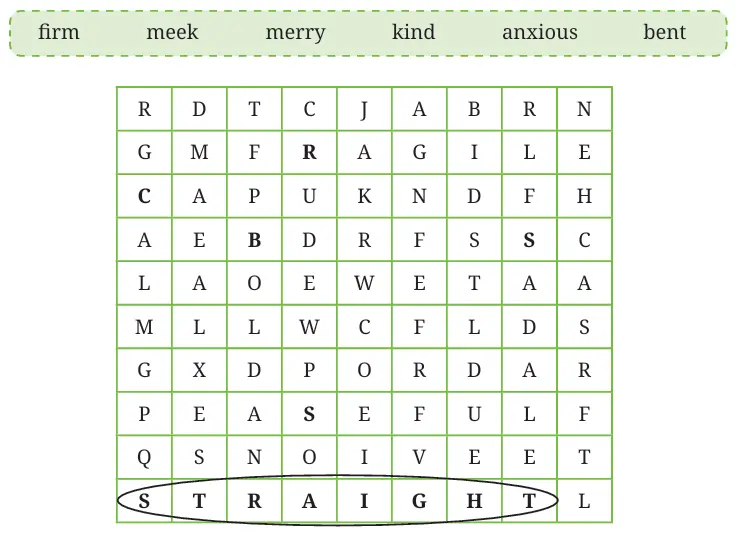
Answer: The antonyms hidden in the grid are:
| Word from the text | Antonym in the grid |
|---|---|
| firm | fragile |
| meek | bold |
| merry | sad |
| kind | cruel |
| anxious | calm |
| bent | straight (given as the example) |
II. Match the words from the text given in Column 1 with the underlined phrases in Column 2.
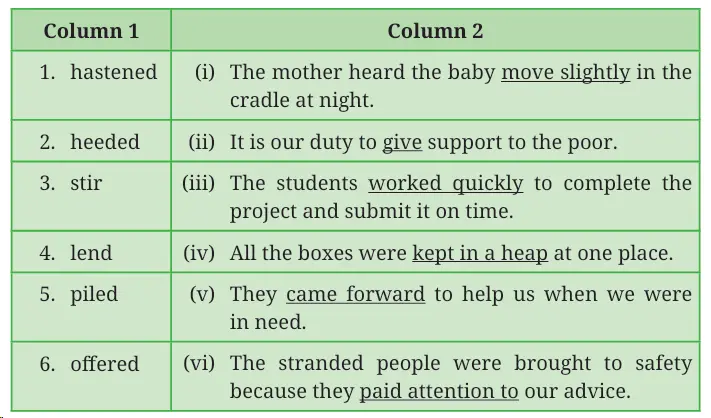
Answer:
| Column 1 | Column 2 |
|---|---|
| 1. hastened | (iii) worked quickly |
| 2. heeded | (vi) paid attention to |
| 3. stir | (i) move slightly |
| 4. lend | (ii) give support to |
| 5. piled | (iv) kept in a heap |
| 6. offered | (v) came forward |
III. In the poem, the poet uses the idiom ‘lend a hand’ which means ‘help somebody’. Some more idioms using ‘hand’ are given in Column 1. Match these idioms with their meanings in Column 2. You may refer to a dictionary.
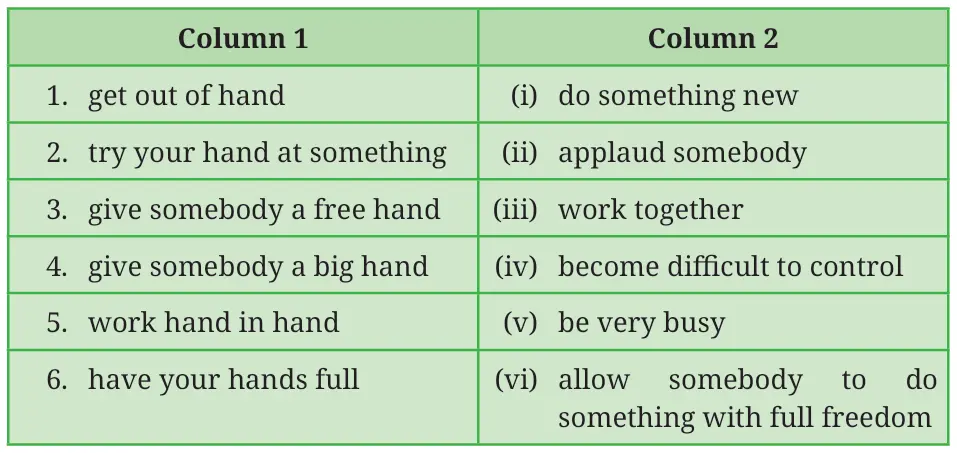
Answer:
| Column 1 | Column 2 |
|---|---|
| 1. get out of hand | (iv) become difficult to control |
| 2. try your hand at something | (i) do something new |
| 3. give somebody a free hand | (vi) allow somebody to do something with full freedom |
| 4. give somebody a big hand | (ii) applaud somebody |
| 5. work hand in hand | (iii) work together |
| 6. have your hands full | (v) be very busy |
IV. Complete the following analogy by filling in the blanks with the correct words from the poem.
- _____ : winter :: heat : summer
- hurt : _____ :: old: aged
- whispered : shouted :: humble : _____
- eyes : _____ :: legs : walk
- having a lot of money: wealthy :: densely packed people: _____
Answer:
- cold : winter :: heat : summer
- harm : hurt :: old : aged
- whispered : shouted :: humble : proud
- eyes : see :: legs : walk
- having a lot of money : wealthy :: densely packed people : throng
Let us listen
I. You will listen to a woman read the special broadcast of the news. As you listen, arrange the pictures in the correct sequence of the events that took place. (Transcript for teacher on page 99)
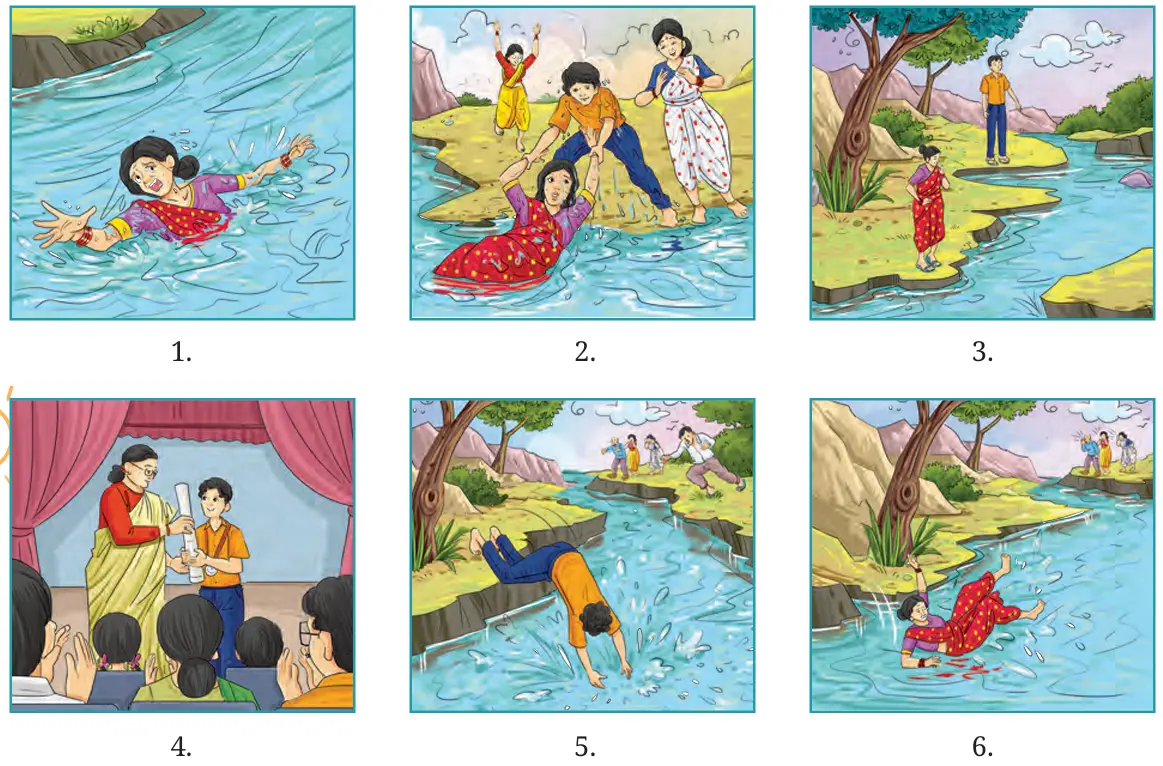
Answer:
The correct order is: 3 → 6 → 1 → 5 → 2 → 4
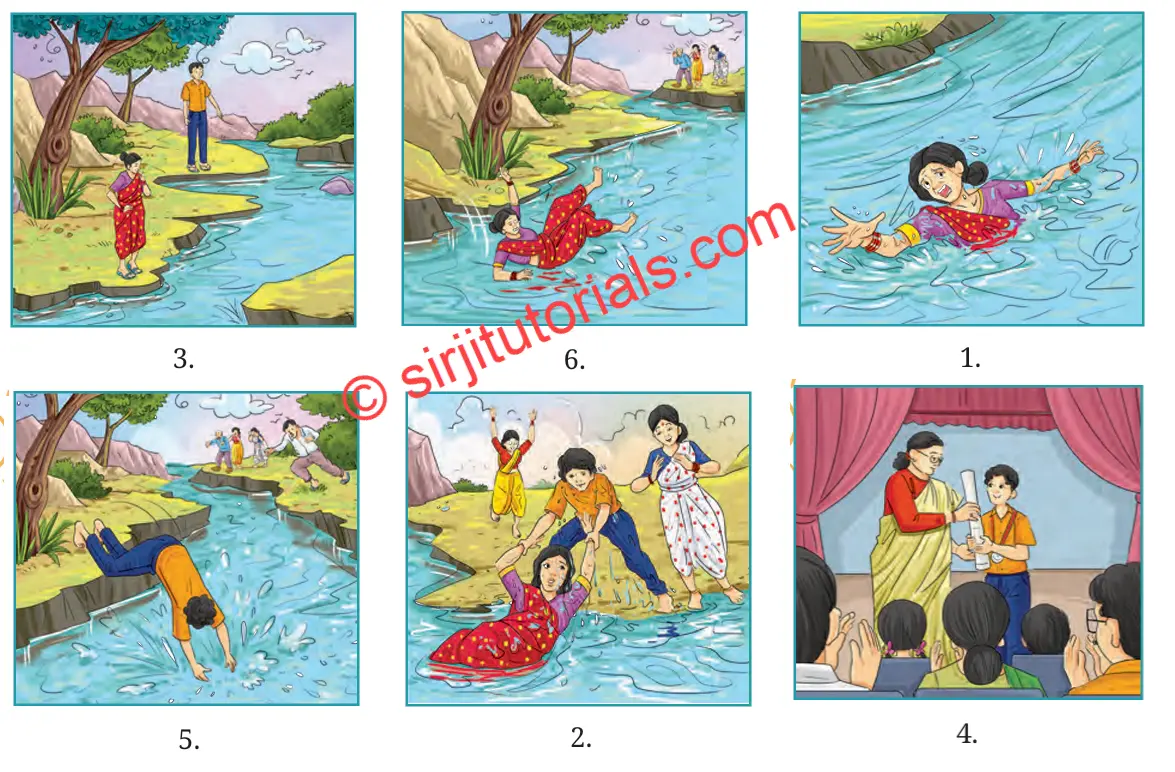
- Picture 3 – The woman is washing clothes near the river.
- Picture 6 – She slips and falls into the river.
- Picture 1 – She struggles to stay afloat in the strong current.
- Picture 5 – Rohan jumps into the river to rescue her.
- Picture 2 – He reaches her and pulls her safely to the riverbank.
- Picture 4 – Rohan is honoured with the Pradhan Mantri Rashtriya Bal Puraskar for his bravery.
II. You will once again listen to the special broadcast of the news. As you listen, complete the following sentences with one to three exact words.
- The woman was having a difficult time staying afloat due to the _____.
- Rohan leapt into the river to save the woman without any _____.
- Rohan’s act of bravery was witnessed by _____.
- Rohan was honoured at the Vigyan Bhawan for his incredible courage and _____.
- Rohan proved that when it comes to saving lives, age is _____.
Answer:
Based on the given transcript, the exact words are:
- The woman was having a difficult time staying afloat due to the strong currents.
- Rohan leapt into the river to save the woman without any moment’s hesitation.
- Rohan’s act of bravery was witnessed by onlookers.
- Rohan was honoured at the Vigyan Bhawan for his incredible courage and selfless act.
- Rohan proved that when it comes to saving lives, age is no barrier.
Let us speak
I. Read aloud the list of words from the poem that end in ‘-ed’. As you read, focus on the final sound of each word and place them in the appropriate columns. One example has been done for you.
Ans: Do it yourself
II. Work in pairs. Narrate an incident where you helped someone in the past. Take turns to speak and use the cue cards given below.
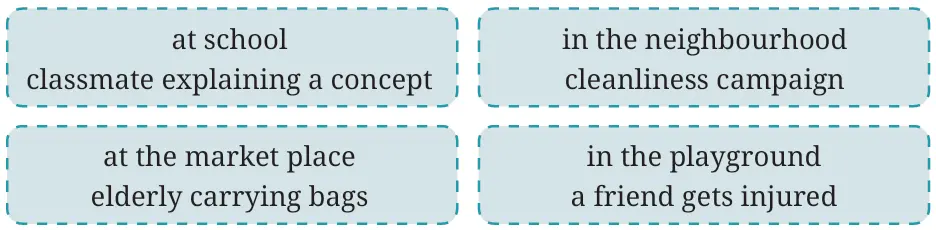
Answers: Sample Solutions are given here. Students may choose any one of the situations given.
Sample Answer 1: Helping a Classmate at School
It all started when my classmate was finding it difficult to understand a Maths lesson. He looked worried before the test. At that moment, I realised that I could help him. I explained the concept step by step and solved a few examples with him. Soon, he understood the topic and thanked me.
I felt happy and satisfied after helping him. This experience taught me the value of kindness and helping others whenever possible.
Sample Answer 2: Helping an Elderly Person at the Market
One day, I saw an elderly woman carrying two heavy bags at the market. She looked tired and was walking slowly. I offered to carry her bags to her house. She smiled and thanked me for my help.
I felt proud and happy. This memory reminds me to always respect and help elderly people.
Sample Answer 3: Cleanliness Campaign
Last month, my friends and I joined a cleanliness campaign in our neighbourhood. We collected plastic waste, swept the streets, and put garbage in dustbins. We also requested people to keep the area clean.
At the end of the day, we felt proud of our work. This experience taught me that everyone should help keep the environment clean.
Sample Answer 4: Helping an Injured Friend
One day, my friend fell while playing football in the playground. He hurt his knee and could not walk properly. I helped him get up and took him to the school medical room. The teacher gave him first aid and informed his parents.
I was relieved that my friend was safe. From that day on, I realised that helping others in difficult situations is our responsibility.
Let us write
I. Write a diary entry of a day you helped someone in need. (Refer to the book for the complete text of the question)
Answer: A Sample Diary Entry is given here.
Diary Entry
26 April 20XX, Saturday 8:00 p.m.
Dear Diary,
Today was a special day that I will always remember. In the afternoon, while I was returning from the market, I saw an elderly woman carrying two heavy bags. She looked tired and was finding it difficult to walk.
I immediately went to her and offered to help. I carried her bags and walked with her to her house. She smiled warmly and thanked me for my kindness. Her words made me feel very happy.
During the whole time, I felt that I was doing the right thing. After helping her, I felt proud and satisfied. I realised that even a small act of kindness can make a big difference in someone’s life.
I will always try to help people in need because helping others brings happiness to both the helper and the person being helped.
Good night, Dear Diary!
Let us explore
I. Did you know that even Earth has been referred to as mother in the ancient scriptures of India? In section 12.1.12 of Pṛthvi-Sūkta (hymn-to the-earth) of Atharva Veda, Earth is referred to as mother and us as her children by stating:
माता भूमिः पुत्रोऽहं पृथिव्याः।
It can be translated as ‘Earth is my mother and I am her child’.
Explanation:
This verse teaches us to love, respect, protect, and care for the Earth, just as we love and respect our own mother.
II. Work in groups of four. Find out the names of countries that refer to their country as ‘motherland’ and a few others as ‘fatherland’. Share your findings with your classmates and teacher.
Answer:
Countries that use the term “Motherland”
- India
- Russia
- Bangladesh
- Nepal
Countries that use the term “Fatherland”
- Germany
- Italy
Note: The terms “Motherland” and “Fatherland” are traditional cultural expressions. Different countries use them based on their history, language, and culture. In modern times, many countries also simply use terms like “homeland” or “native land.”
III. Read the poem and enjoy.
A Nation’s Strength (Poem)
Not gold, but only men can make
– Ralph Waldo Emerson
A people great and strong…
Men who for truth and honour’s sake
Stand fast and suffer long.
Brave men who work while others sleep,
Who dare while others fly…
They build a nation’s pillars deep
And lift them to the sky.
Exploring the Poem “A Nation’s Strength”
This short poem beautifully reinforces the same value highlighted in “Somebody’s Mother”—that a nation’s greatness is built by people who show good character and selfless actions.
Vocabulary
- Stand fast – remain firm and determined (दृढ़ ओर डटे रहना)
- Suffer long – patiently face difficulties (लंबे समय तक कठिनाइयाँ सहना)
- Dare – have the courage to do something (साहस करना)
- Fly – run away from danger (भाग जाना)
- Pillars – strong supports or foundations (स्तंभ, आधार)
- Lift them to the sky – make the nation great and successful (देश को महान ऊँचाइयों तक पहुँचाना)
Summary
The poem teaches that the real strength of a nation does not come from its gold, wealth, or riches. A nation becomes truly great because of its honest, brave, hardworking, and truthful people.
The poet says that people who stand for truth and honour, remain strong during difficult times, and work hard while others rest are the real builders of a nation. They are courageous enough to face challenges instead of running away from them. Such people lay the strong foundation of a nation and help it grow to great heights.
The poem reminds us that the character of its citizens is a country’s greatest strength.
Central Idea
The poem conveys that a nation’s true strength lies in the character, honesty, courage, and hard work of its people, not in its wealth or material possessions.
Message
- Good citizens make a strong nation.
- Truth, honesty, courage, and hard work are more valuable than wealth.
- Every individual has a role in building a better country.
Important Values
- Truthfulness
- Honesty
- Courage
- Hard work
- Perseverance
- Patriotism
- Responsibility towards the nation
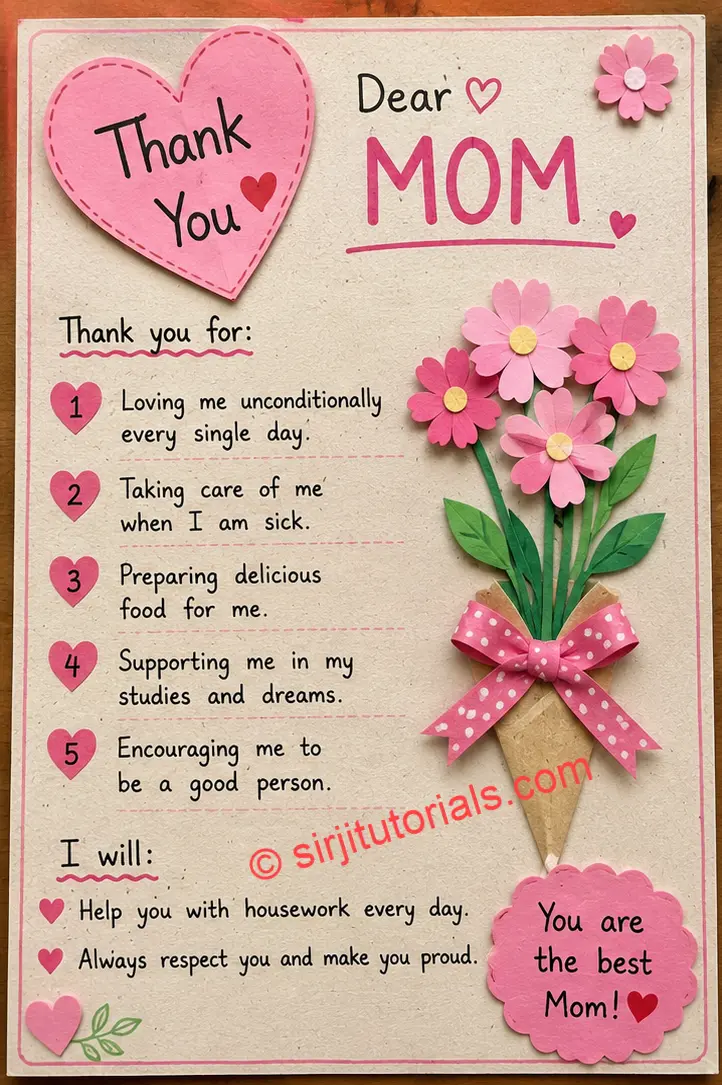
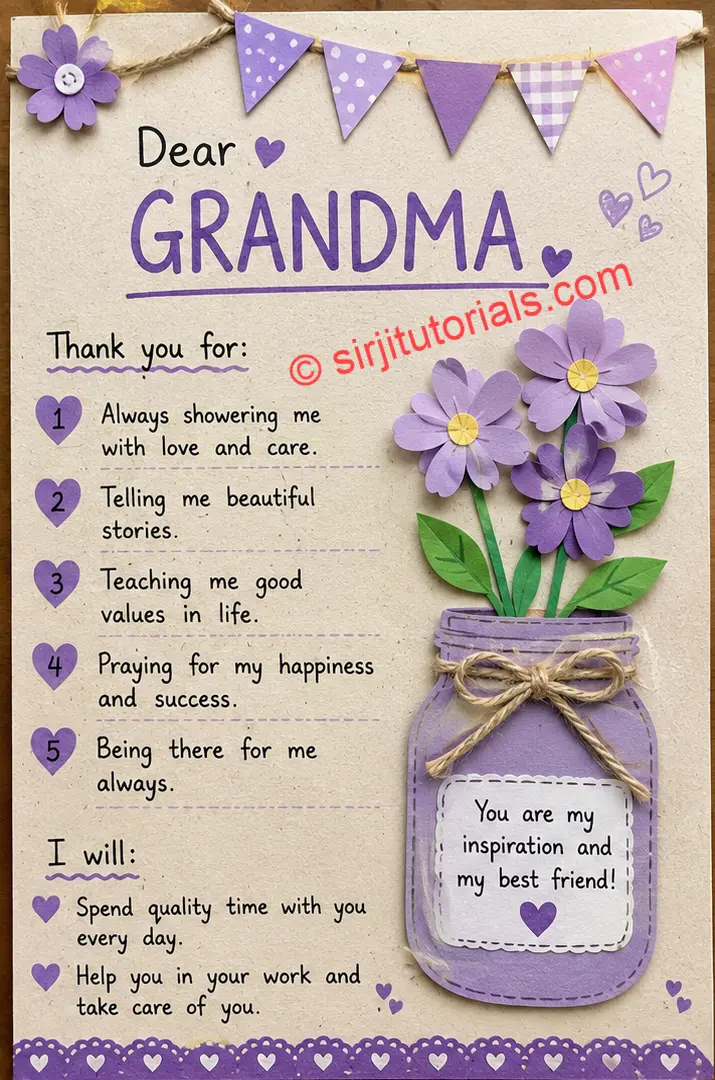
IV. Make a gratitude card for your mother/grandmother to thank her for at least five things that she does for you. Also write two things that you would do regularly to help them. Use recycled material to make and decorate the card.
Solution: Two gratitude Cards are given below:
Gratitude Card for Mother
Gratitude Crad for Grandmother
© sirjitutorials.com