


The Wit That Won Hearts Question Answers for NCERT Class 8 English Poorvi Unit 1 are provided here in a clear and student-friendly format. This post covers all textbook questions and answers, including Intext questions, “Let Us Discuss,” “Let Us Think and Reflect,” grammar activities, writing and speaking tasks. Each answer is written in simple language to help students understand the chapter easily and prepare confidently for exams. Whether you need short answers, detailed explanations, or revision support, this guide will help you complete your NCERT homework and strengthen your understanding of the story. #SrjiSolutionsC8
.
Intext Questions and Answers of ‘The Wit That Won Hearts’
Intext questions are questions and activities given either before the beginning or along with the text of the of the lesson ‘The Wit that Won hearts’.
Let us do these activities before we read. (Page 1)
I. Select qualities of a person who uses wit from the box given below.

Now discuss reasons for your choice of qualities.
Answer:
Correct qualities:
- wise
- clever
- humorous
- observant
- charming
- creative
- confident
Reasons for choice (simple):
- A witty person thinks quickly and wisely.
- Such a person is clever and observant.
- Humour and creativity help in solving problems politely.
- Confidence and charm help the person win hearts without arguments.
II. Work in pairs and answer the riddles that are given below. Share the answers with your classmates and teacher.
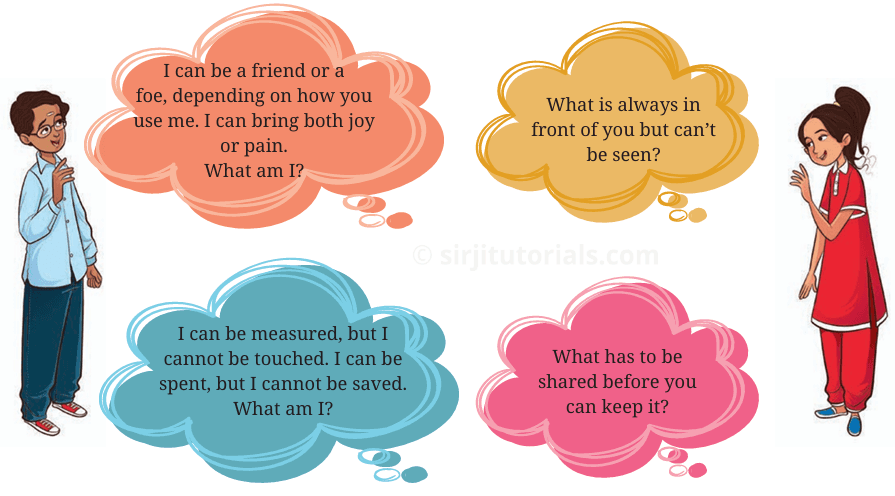
Answers:
I can be a friend or a foe… I can bring both joy or pain.
Ans: Words
What is always in front of you but can’t be seen?
Ans: The future
I can be measured, but I cannot be touched. I can be spent, but I cannot be saved.
Ans: Time
What has to be shared before you can keep it?
Answer: A secret
Discuss in Pairs. (Page 2)
Answer Set -1
1. Why are qualities like humour and wit important in a person?
Ans. Humour and wit help a person handle difficult situations calmly. They reduce tension and prevent fights. Such qualities help people solve problems in a friendly way.
2. Why do you think kings and queens preferred to have witty people among their courtiers?
Ans. Witty courtiers gave wise and clever advice. They helped solve problems without offending anyone. They also kept the court atmosphere pleasant and peaceful.
3. If you were asked to solve a disagreement between two people, what approach would you take?
Ans. I would listen to both sides patiently. I would try to understand their feelings. Then I would suggest a calm and fair solution.
4. Have you ever been in a situation where a small misunderstanding led to a big problem? How was it resolved?
Ans. Yes, a small misunderstanding once caused an argument. When we talked calmly and explained our views, the problem was solved. Clear communication helped restore peace.
Answer Set – 2
1. Why are qualities like humour and wit important in a person?
Ans. Humour and wit help a person handle difficult situations calmly. They reduce tension and make communication pleasant. Such qualities help in solving problems without anger.
2. Why do you think kings and queens preferred to have witty people among their courtiers?
Ans. Witty courtiers gave wise advice in a polite way. They helped rulers solve problems peacefully. Their humour also kept the court lively and positive.
3. If you were asked to solve a disagreement between two people, what approach would you take?
Ans. I would listen to both sides patiently. I would try to understand their feelings. Then I would suggest a calm and fair solution.
4. Have you ever been in a situation where a small misunderstanding led to a big problem? How was it resolved?
Ans. Yes, sometimes small misunderstandings grow into big problems. They are usually resolved by talking openly and clearing doubts. Apologising and understanding each other helps solve the issue.
These answers encourage thinking, discussion, and real-life connection, as expected by NCERT.
Let Us Discuss (Page 7)
I. Rectify the following false statements from the text.
- The queen insulted the king by speaking against the quality of his poem.
- Tenali Rama immediately went to the king and convinced him to talk to the queen.
- The courtiers admired the king’s poem and praised his literary talent.
- The ministers in the court were eager to hear Tenali Rama’s idea about paddy cultivation.
- The king never realised his mistake and continued to stay angry with the queen.
Answers:
- The queen did not insult the king. She only yawned because she was tired, and the king misunderstood her action.
- Tenali Rama did not immediately go to the king. He made a clever plan and used humour in the court to make the king realise his mistake.
- The courtiers did not admire the king’s poem. They avoided listening to it and made excuses.
- The ministers were not eager to hear Tenali Rama’s idea. Some of them mocked and doubted his suggestion about the paddy seeds.
- The king later realised his mistake. He apologised to the queen and made peace with her.
Another Set of Answers
1. False Statement:
The queen insulted the king by speaking against the quality of his poem.
Rectified Statement:
The queen did not insult the king. She only yawned because she was tired, and the king misunderstood her action.
2. False Statement:
Tenali Rama immediately went to the king and convinced him to talk to the queen.
Rectified Statement:
Tenali Rama did not speak to the king directly. He used a clever plan in the court to make the king realise his mistake.
3. False Statement:
The courtiers admired the king’s poem and praised his literary talent.
Rectified Statement:
The courtiers avoided the king and made excuses when he tried to recite his poem.
4. False Statement:
The ministers in the court were eager to hear Tenali Rama’s idea about paddy cultivation.
Rectified Statement:
The ministers and courtiers were doubtful and even laughed at Tenali Rama’s idea.
5. False Statement:
The king never realised his mistake and continued to stay angry with the queen.
Rectified Statement:
The king realised his mistake, apologised to the queen, and restored peace in the palace.
End-of-the-Text Questions and Answers-The Wit That Win Hearts’
These questions and activities are given after the text of the lesson ‘The Wit that Won Hearts’ in the NCERT English book ‘Poorvi’ for Grade 8.
Let us think and reflect (Page 7)
I. Read the extracts and answer the questions that follow.
- “… The king thought I was disrespecting his poem and stormed off. Since then, he has not spoken to me. If I had known this would happen I would have chosen another day. Help me, please, Rama. Only you can help the king understand.” Rama nodded thoughtfully. “If you like, I will try my best to resolve this matter, Your Highness. But this needs a well-planned approach and I may need time to find the right strategy.”
(i) Why does the queen believe that only Tenali Rama can help the king understand?
Ans. The queen believes that Tenali Rama is wise and intelligent. He knows how to speak cleverly and make the king realise his mistake without hurting his pride.
(ii) What does the queen’s statement, “If I had known this would happen, I would have chosen another day”, suggest about her feelings?
- She is angry at the king for overreacting.
- She regrets the unintended misunderstanding.
- She believes the poem was not worth listening to.
- She is worried that the king might punish her.
Ans. (ii) B. She regrets the unintended misunderstanding.
(iii) How does Tenali Rama’s response reflect his wisdom and problem-solving skills?
Ans. Tenali Rama does not act in haste. He says that the matter needs a well-planned approach. This shows that he thinks carefully before taking action and solves problems wisely.
(iv) Fill in the blank by choosing the correct option from those given in the brackets.
The king’s reaction shows that he is sensitive and ______ (has a lot of faith/takes great pride)in his poetry.
Ans. The king’s reaction shows that he is sensitive and takes great pride in his poetry.
- That evening, the king approached the queen with a softened expression. “Thirumalambal”, he began, his voice gentle, “I have been foolish. I see now that I overreacted. I let my pride blind me. I’m so sorry.”
The queen, who had longed for this moment, smiled and replied, “If you like, we can leave this quarrel behind us. I would very much like to listen to your poem.”
(i) Complete the following with a suitable explanation. When the king said, “I let my pride blind me”, he means that _______ .
Ans. He allowed his pride to control his thinking and did not judge the situation fairly.
(ii) Why does the queen say, “If you like, we can leave this quarrel behind us”?
Ans. She wants to forgive the king and restore peace. She shows that she values their relationship more than the argument.
(iii) Fill in the blank by choosing the correct option from those given in the brackets.
The king acknowledges that his pride clouded his judgement, which shows (intelligence and courage/maturity and self-awareness)
Ans. The king acknowledges that his pride clouded his judgement, which shows maturity and self-awareness.
(iv) State any one characteristic that the queen’s response to the king’s apology shows about her.Ans.
Ans. The queen is forgiving. (She also shows patience and understanding.)
II. Answer the following questions.
- Why was the Vijayanagara Empire considered to be in its ‘Golden Era’ during Krishnadeva Raya’s reign?
- How did Tenali Ramakrishna gain a special place in the king’s court?
- How did the quarrel between the king and the queen affect the palace?
- What strategy did Tenali Rama use to make the king realise his mistake?
- What was the reaction of the courtiers when Tenali Rama introduced his ‘special’ paddy seeds?
- How does the story conclude, and what lesson can be learnt from it?
Answers:
1. Why was the Vijayanagara Empire considered to be in its ‘Golden Era’ during Krishnadeva Raya’s reign?
Ans. The empire was called the ‘Golden Era’ because art, literature, and architecture flourished during his rule. The king supported scholars and poets. Peace and prosperity increased in the kingdom.
2. How did Tenali Ramakrishna gain a special place in the king’s court?
Ans. Tenali Ramakrishna gained a special place because of his quick wit and intelligence. He solved difficult problems cleverly and entertained the court with his humour.
3. How did the quarrel between the king and the queen affect the palace?
Ans. The quarrel created sadness in the palace. The king stopped visiting the queen. The cheerful atmosphere became quiet and gloomy.
4. What strategy did Tenali Rama use to make the king realise his mistake?
Ans. Tenali Rama spoke about special paddy seeds in the court. He cleverly compared yawning to scattering seeds unevenly. Through humour, he made the king understand that yawning is natural and not disrespectful.
5. What was the reaction of the courtiers when Tenali Rama introduced his ‘special’ paddy seeds?
Ans. The courtiers first mocked and doubted him. They made sarcastic remarks and laughed quietly. They did not take his idea seriously.
6. How does the story conclude, and what lesson can be learnt from it?Ans. The king realised his mistake and apologised to the queen. Peace and happiness returned to the palace.
Ans. The lesson is that wit and wisdom can solve problems better than anger, and accepting one’s mistake shows true greatness.
Another Set of Answers:
1. Why was the Vijayanagara Empire considered to be in its ‘Golden Era’ during Krishnadeva Raya’s reign?
Ans. It was called the ‘Golden Era’ because art, literature, and architecture flourished during his rule. The king supported poets and scholars. The empire became famous for its cultural achievements and prosperity.
2. How did Tenali Ramakrishna gain a special place in the king’s court?
Ans. Tenali Ramakrishna gained a special place because of his quick wit and intelligence. He solved difficult problems cleverly and entertained the court with his humour.
3. How did the quarrel between the king and the queen affect the palace?
Ans. The king stopped speaking to the queen and avoided her. Sadness spread in the palace. The once cheerful corridors became quiet and gloomy.
4. What strategy did Tenali Rama use to make the king realise his mistake?
Ans. Tenali Rama used a clever example of ‘special’ paddy seeds. Through humour, he compared yawning to a natural act. This made the king understand that the queen had not disrespected him.
5. What was the reaction of the courtiers when Tenali Rama introduced his ‘special’ paddy seeds?
Ans. The courtiers mocked him and made sarcastic remarks. They laughed and did not take his idea seriously at first.
6. How does the story conclude, and what lesson can be learnt from it?
Ans. The king realised his mistake and apologised to the queen. Peace and happiness returned to the palace. The story teaches that wit and wisdom can solve problems and that accepting one’s mistake shows true greatness.
Let us learn (Page 9)
I. Fill in the blanks and complete the paragraph by choosing suitable expressions from the box given below.

My mother is quite witty, and her sense of humour always lightens stressful moments. Once, at a family dinner, an argument began over a minor issue, and 1 ______, making everyone feel uncomfortable. Just as things were getting serious, she made a clever remark and laughter 2 ______. the gathering, making everyone relaxed. The person who started the argument 3 ______. Everyone disapproved of the action and a 4 ______. My 5 ______. to how my mother had saved other situations like this. Without her, such moments would have 6 ______. over the gatherings. I hope that I grow up to be as witty as my mother.
Answer:
I. Fill in the blanks (Expressions)
- a murmur swept through the room
- rippled through
- stormed off
- hush fell over
- mind raced back
- cast a shadow
Completed Paragraph
My mother is quite witty, and her sense of humour always lightens stressful moments. Once, at a family dinner, an argument began over a minor issue, and 1 a murmur swept through the room, making everyone feel uncomfortable. Just as things were getting serious, she made a clever remark and laughter 2 rippled through the gathering, making everyone relaxed. The person who started the argument 3 stormed off. Everyone disapproved of the action and 4 a hush fell over. My 5 mind raced back to how my mother had saved other situations like this. Without her, such moments would have 6 cast a shadow over the gatherings. I hope that I grow up to be as witty as my mother.
II. The writer uses words like ‘roared’ , ‘murmur’ in the text to indicate the sound produced. Fill in the blanks with suitable sound words from the box given below. You may refer to a dictionary.
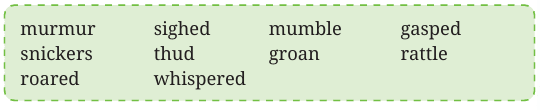
- As the teacher began the riddle challenge, a _____ of excitement spread through the classroom.
- Anaya _____ in relief—she loved riddles more than solving Mathematics problems.
- ‘Think carefully,’ the teacher began to _____, as she wrote a riddle on the board.
- When the question was revealed, a few students _____, realising it wasn’t as easy as they had expected.
- Some exchanged _____, wondering if anyone at all would be able to solve it.
- Just then, Anaya tapped her book on the desk with a small_____, deep in thought.
- ‘Ah, I see it now!’ she said stretching with a _____, as if it had taken her great effort.
- A small breeze made the windows _____ , adding to the suspense of the moment.
- ‘So, what’s the answer?’ the students _____, their voices filled with playful enthusiasm.
- Leaning forward with a smile, Anaya _____, ‘Sometimes, the trickiest questions have the simplest answers.’
Answers:
- As the teacher began the riddle challenge, a murmur of excitement spread through the classroom.
- Anaya sighed in relief—she loved riddles more than solving Mathematics problems.
- ‘Think carefully,’ the teacher began to mumble, as she wrote a riddle on the board.
- When the question was revealed, a few students gasped, realising it wasn’t as easy as they had expected.
- Some exchanged snickers, wondering if anyone at all would be able to solve it.
- Just then, Anaya tapped her book on the desk with a small thud, deep in thought.
- ‘Ah, I see it now!’ she said stretching with a groan, as if it had taken her great effort.
- A small breeze made the windows rattle, adding to the suspense of the moment.
- ‘So, what’s the answer?’ the students roared, their voices filled with playful enthusiasm.
- Leaning forward with a smile, Anaya whispered, ‘Sometimes, the trickiest questions have the simplest answers.’
III. As you have learnt, a compound word is formed when two or more words are combined to create a new word with a distinct meaning. These are of three types: closed compounds (sunlight, courtroom), hyphenated compounds (well-planned), and open compounds (paddy seeds).
- Create new compound words by matching words in Column 1 with
those in Column 2.
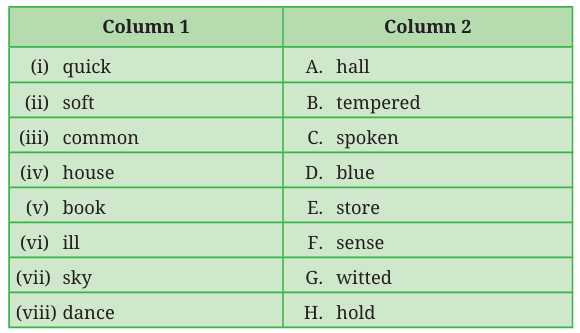
Answer:
(i) quick – witted → quick-witted
(ii) soft – spoken → soft-spoken
(iii) common – sense → common-sense
(iv) house – hold → household
(v) book – store → bookstore
(vi) ill – tempered → ill-tempered
(vii) sky – blue → sky-blue
(viii) dance – hall → dance hall
| Column 1 | Column 2 | Compound Word |
|---|---|---|
| (i) quick | G. witted | quick-witted |
| (ii) soft | C. spoken | soft-spoken |
| (iii) common | F. sense | common-sense |
| (iv) house | H. hold | household |
| (v) book | E. store | bookstore |
| (vi) ill | B. tempered | ill-tempered |
| (vii) sky | D. blue | sky-blue |
| (viii) dance | A. hall | dance hall |
2. Fill in the blanks with the words created in the previous question.
Ravi was (i) __________, always speaking calmly even in arguments. He grew up in a lively (ii) __________, where he learned to handle different personalities. His friend Arun, however, was(iii)__________and often lost his patience. Despite this, Arun admired Ravi’s (iv) __________ thinking. One evening, as they passed a (v) __________, they saw some performers rushing out. Ravi noticed that one of them dropped a (vi) __________ book on the ground. “Is this yours?” he asked. “Oh thank you, young man!” the performer smiled. “It’s a recent purchase from the (vii) ________ round the corner.” True to his nature Arun promptly said to Ravi, “It’s (viii) ________ that it’s not from a bakery but book shop!” Ravi smiled and they walked on.
Answer:
Ravi was (i) soft-spoken, always speaking calmly even in arguments. He grew up in a lively (ii) household, where he learned to handle different personalities. His friend Arun, however, was (iii) ill-tempered and often lost his patience. Despite this, Arun admired Ravi’s (iv) common-sense thinking. One evening, as they passed a (v) dance hall, they saw some performers rushing out. Ravi noticed that one of them dropped a (vi) sky-blue book on the ground. “Is this yours?” he asked. “Oh thank you, young man!” the performer smiled. “It’s a recent purchase from the (vii) bookstore round the corner.” True to his nature Arun promptly said to Ravi, “It’s (viii) quick-witted that it’s not from a bakery but bookshop!” Ravi smiled and they walked on.
IV. Read the sentences from the text and their explanation given in the table below.
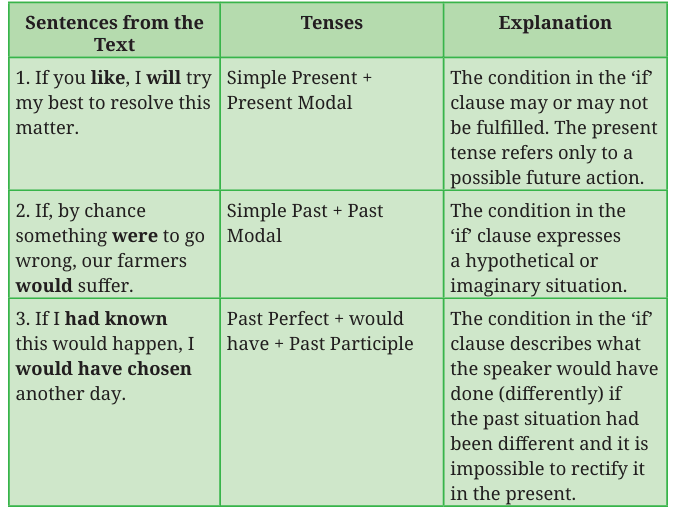
In sentence 1 ‘if you like’ is the subordinate clause (if clause) and ‘I will try my best to resolve this matter’ is the main clause.
Identify the subordinate and main clauses in sentences 2 and 3
Answer:
Sentence 2
If, by chance something were to go wrong, our farmers would suffer.
- Subordinate clause (if clause):
If, by chance something were to go wrong - Main clause:
our farmers would suffer
Sentence 3
If I had known this would happen, I would have chosen another day.
- Subordinate clause (if clause):
If I had known this would happen - Main clause:
I would have chosen another day
Now, match the subordinate clauses (if clauses) in Column 1 with the appropriate main clauses in Column 2 to make complete sentences.
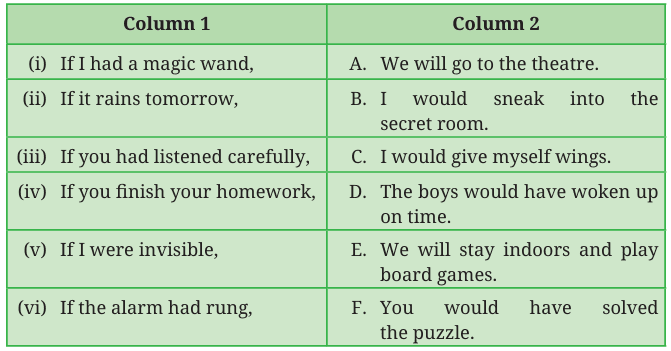
Answer:
| Column 1 | Column 2 |
|---|---|
| (i) If I had a magic wand, | C. I would give myself wings. |
| (ii) If it rains tomorrow, | E. We will stay indoors and play board games. |
| (iii) If you had listened carefully, | F. You would have solved the puzzle. |
| (iv) If you finish your homework, | A. We will go to the theatre. |
| (v) If I were invisible, | B. I would sneak into the secret room. |
| (vi) If the alarm had rung, | D. The boys would have woken up on time. |
V. Complete the following sentences appropriately with either the main clause or the subordinate clause (if clause).
- Your teacher will be unhappy if ______.
- They would have caught the train if ______.
- ______ if you continue to stay up late every night.
- If she knew the answer, ______.
- ______ if she had studied harder.
- If I had a million rupees, ______.
Answers:
- Your teacher will be unhappy if you do not complete your homework on time.
- They would have caught the train if they had left the house earlier.
- You will feel tired if you continue to stay up late every night.
- If she knew the answer, she would tell us immediately.
- She would have scored better marks if she had studied harder.
- If I had a million rupees, I would help the poor and build a school.
VI. Complete the following sentences. One example has been done for you.
- If I were a tree, I would play with the wind and talk to the birds.
- If I were the Head Teacher of my school, _____.
- If I were a bird, _____.
- If I were a magician, _____.
- If I had studied harder, _____.
Answers:
- If I were the Head Teacher of my school, I would make learning more enjoyable and encourage every student.
- If I were a bird, I would fly high in the sky and explore new places.
- If I were a magician, I would remove problems from the world and spread happiness.
- If I had studied harder, I would have scored better marks in the exam.
Let us listen (Page 12)
I. You will listen to a woman narrating a story. As you listen, fill in the blanks in the following sentences by selecting the correct options. (Transcript for teacher on page 46 of the book)
Answers:
1. The rope tying the bundle of sticks was _____ .
(i) loose
(ii) thick
(iii) short
Ans. (ii) thick
2. The scholar is finally referred to as _____ .
(i) irritable
(ii) mischievous
(iii) arrogant
Ans. (iii) arrogant.
II. You will once again listen to the story. As you listen, number the events of the story in the correct order of occurrence.
- The great scholar was ashamed because he did not know what to say.
- Rama accepted the challenge thrown by the visitor.
- Rama had a bundle tied in silk when he came to the palace.
- The king laughed at the explanation given by Rama.
- The visitor wanted to show his superiority over others in the palace.
- Rama showedtheworktobeabundleofstickstiedtogetherbyarope.
- The king wanted to know more about the work mentioned by Rama.
- The court scholars were afraid of the king’s anger.
Answer:
Correct sequence:
5 → 8 → 2 → 3 → 1 → 7 → 6 → 4
- The great scholar was ashamed because he did not know what to say. → 5
- Rama accepted the challenge thrown by the visitor. → 3
- Rama had a bundle tied in silk when he came to the palace. → 4
- The king laughed at the explanation given by Rama. → 8
- The visitor wanted to show his superiority over others in the palace. → 1
- Rama showed the work to be a bundle of sticks tied together by a rope. → 7
- The king wanted to know more about the work mentioned by Rama. → 6
- The court scholars were afraid of the king’s anger. → 2
Let us speak (Page 13)
Now, work in pairs and take turns to ask and answer the questions about witty characters in folktales or stories you have read. Use the correct intonation while asking questions.
For example: Your favourite character in the folktale (Who…?)
Who is your favourite character in the folktale?
- The name of the witty character (Who…?)
- The reason for her/his wit being important in the story (Why…?)
- The most famous trick or clever idea she/he used (What…?)
- The time period or setting of the folktale/story (When…?)
- The way she/he used her/his intelligence to solve a problem (How…?)
- The location where the story takes place (Where…?)
Answers:
Here is a model dialogue based on a witty character.
Example: Tenali Rama
1. Who is the witty character in the story?
Tenali Rama is the witty character in the story.
2. Why is his wit important in the story?
His wit is important because it helps solve difficult problems peacefully.
3. What is the most famous trick he used?
He used a clever trick with a bundle of sticks and a difficult name to defeat an arrogant scholar.
4. When does the story take place?
The story takes place during the reign of King Krishnadeva Raya in the Vijayanagara Empire.
5. How did he use his intelligence to solve a problem?
He used humour and quick thinking to confuse the scholar and teach him a lesson.
6. Where does the story take place?
The story takes place in the royal court of Vijayanagara.
Dear Students, you may also choose other witty characters like Birbal, Akbar–Birbal stories, or Mulla Nasruddin, and practise asking and answering questions with correct intonation.
Example of ‘Akbar-Birbal stories
1. Who is the witty character in the story?
Birbal is the witty character in the story.
2. Why is his wit important in the story?
His wit is important because he solves difficult problems in the royal court with intelligence and humour.
3. What is the most famous trick he used?
He once answered Emperor Akbar’s tricky question by drawing a shorter line without touching it—he drew a longer line beside it.
4. When does the story take place?
The story takes place during the reign of Emperor Akbar in the Mughal period.
5. How did he use his intelligence to solve a problem?
He used clever thinking and simple ideas to give wise solutions that surprised everyone.
6. Where does the story take place?
The story takes place in the royal court of Emperor Akbar.
Let us write (Page 15)
Write a narrative essay based on any one of the situations given below.
• The Day I Learnt the Value of Teamwork
• A Small Act of Kindness that Made a Difference
Answers:
Both the essay topics are given here:
The Day I Learnt the Value of Teamwork
Last year, our school announced an inter-house Science Exhibition. Each class had to prepare one working model. Our class decided to make a model of a rainwater harvesting system. At first, everyone was excited. But soon, problems began.
Some students wanted to lead. Others did not want to do any work. A few classmates argued about whose idea was better. Because of this, we wasted two days. The model was still incomplete, and the exhibition date was near. I felt worried and disappointed.
Our class teacher noticed the tension. She calmly said, “A team succeeds only when everyone works together.” Her words made us think. We realised that we were behaving selfishly. After that, we divided the work equally. One group collected materials. Another group prepared the chart. Some students painted the model. I helped in arranging the pipes and explaining the working process.
As we started cooperating, the work became easier and faster. We even enjoyed working together. On the day of the exhibition, our model worked perfectly. The judges appreciated our effort and teamwork. We won the second prize.
That day, I understood that success is not about one person’s talent. It is about working together with trust and respect. Teamwork teaches us patience, understanding, and unity. It was a lesson I will never forget.
A Small Act of Kindness that Made a Difference
One rainy afternoon, I was returning home from school. As I waited at the bus stop, I noticed an old man standing nearby. He looked worried and confused. People were passing by, but no one stopped to help him.
I gathered courage and went up to him. He told me that he had lost his way and could not read the bus numbers clearly. His hands were trembling, and he seemed tired. I gently asked him where he wanted to go. Luckily, his destination was near my home.
When the bus arrived, I helped him get in safely and offered him my seat. During the journey, he thanked me many times. When we reached the stop, I helped him cross the road. Before leaving, he blessed me and said, “Your kindness has made my day easier.”
That evening, I felt very happy. I realised that even a small act of kindness can bring comfort and hope to someone. It does not take much effort to help others, but it can make a big difference in their lives. Since that day, I try to be more helpful and kind whenever I can.
Let Us Explore (Page 16)
Note: Sample solutions/answers are given here from our side. students should try to draft their own answers.
I. Limericks are poems in five lines that have a twist in the last line. Read and enjoy the following limericks and create one on your own.
Raju flew his kite in the sky so wide,
It soared with grace, full of pride.
But a crow came along,
Singing its song,
And now it’s the crow on a joyride!
Answer:
There once was a boy named Kabir,
Who laughed loud for all to hear.
He slipped on a peel,
While showing his skill,
And said, “I meant to fall here!”
II. Go to the library and read a story of your choice. Share its theme and the interesting parts of the story with your classmates and teacher.
Answer:
Story from the Library
Story Name: The Clever Rabbit and the Lion
Theme: Intelligence is stronger than physical strength.
Interesting Parts:
- The lion frightens all the animals in the forest.
- The clever rabbit makes a plan to save everyone.
- He tricks the lion by showing his reflection in a well.
- The lion jumps into the well and falls in.
This story teaches that wisdom can defeat power.
III. You must have read stories of wit, humour, and wisdom in your own language or English. Make a list of these stories that you have read on a chart paper. Each student should read at least one new story from the list.
Stories of Wit, Humour, and Wisdom
Here is a list (Sample list) students can write on chart paper:
- Tenali Rama stories
- Akbar and Birbal stories
- Mulla Nasruddin stories
- The Clever Rabbit and the Lion
- The Fox and the Crow
- The Wise Minister
Note: The activity suggests that Students should choose one new story from the list and read it. This will improve their understanding of humour, intelligence, and moral lessons.