

Learn here from detailed NCERT solutions for Class 12 Political Science Chapter India’s External Relations from the textbook Politics in India Since Independence. Clear, accurate answers to all textbook exercises to help students prepare effectively for exams.
NCERT solutions for the chapter “India’s External Relations”
Understanding India’s foreign policy and global relationships is key to grasping its role on the world stage. In this post, we provide comprehensive NCERT solutions for the chapter India’s External Relations from the Class 12 Political Science textbook Politics in India Since Independence. These answers are designed to help students clarify concepts, strengthen their exam preparation, and gain deeper insights into India’s diplomatic history and strategic decisions post-independence.
Question and Answers – Chap. 4 ‘Indias External Relations’ | Class 12 Politics
1. Write ‘true’ or ‘false’ against each of these statements.
(a) Non-alignment allowed India to gain assistance both from USA and USSR.
(b) India’s relationship with her neighbours has been strained from the beginning.
(c) The cold war has affected the relationship between India and Pakistan.
(d) The treaty of Peace and Friendship in 1971 was the result of India’s closeness to USA.
Answer:
(a) True
(b) True
(c) True
(d) False
Explanations:
(a) True – Non-alignment gave India freedom to receive aid and assistance from both USA and USSR.
(b) True – From the very beginning, India’s relations with neighbours (esp. Pakistan and China) have been strained.
(c) True – The Cold War politics influenced and worsened India–Pakistan relations (example: Pakistan joined US-led military alliances, while India leaned towards USSR later).
(d) False – The 1971 Treaty of Peace and Friendship was signed with the USSR, not the USA.
2. Match the following.
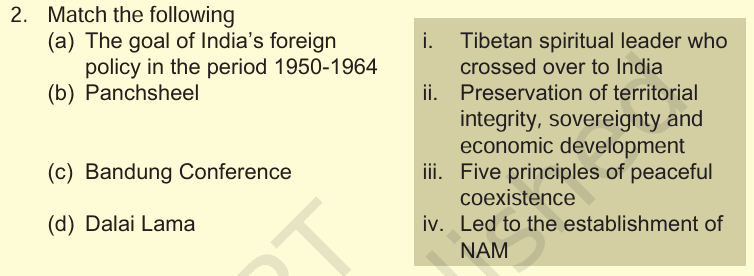
Answer:
(a → ii), (b → iii), (c → iv), (d → i)
| Column A (Given) | Column B (Match) |
|---|---|
| (a) The goal of India’s foreign policy in the period 1950–1964 | ii. Preservation of territorial integrity, sovereignty and economic development |
| (b) Panchsheel | iii. Five principles of peaceful coexistence |
| (c) Bandung Conference | iv. Led to the establishment of NAM |
| (d) Dalai Lama | i. Tibetan spiritual leader who crossed over to India |
3. Why did Nehru regard conduct of foreign relations as an essential indicator of independence? State any two reasons with examples to support your reading.
Answer:
Jawaharlal Nehru believed that a truly independent nation must have the freedom to decide its own foreign policy. If a country followed the policies of powerful nations blindly, then its independence would be incomplete.
Two reasons:
- Preservation of Sovereignty:
- Nehru felt India should not come under the influence of either the USA or USSR during the Cold War.
- Example: India followed the policy of Non-Alignment to stay independent in decision-making.
- Pursuit of Peace and Development:
- Nehru wanted India’s foreign relations to focus on peace, security, and economic growth.
- Example: The Panchsheel Agreement (1954) with China promoted peaceful coexistence and respect for each other’s sovereignty.
In short: Nehru saw foreign policy as the true test of independence, because it allowed India to protect its sovereignty and work for peace and development on its own terms.
4. “The conduct of foreign affairs is an outcome of a two-way interaction between domestic compulsions and prevailing international climate”. Take one example from India’s external relations in the 1960s to substantiate your answer.
Answer:
Foreign policy is shaped by both domestic needs and the international situation. India’s experience in the 1960s proves this.
Example: India–China relations and the 1962 war
- Domestic compulsion: India wanted peace and security to focus on development and poverty removal at home. Nehru promoted friendship through the Panchsheel Agreement (1954) and the slogan “Hindi–Chini Bhai Bhai”.
- International climate: But at the same time, the Cold War was dividing the world into two camps. China was growing closer to the USSR at first, but later clashed with both India and the Soviet Union.
- The 1962 Sino-Indian war showed how global rivalries and border disputes changed India’s peaceful approach. After the war, India had to strengthen its military and also accept foreign aid from both USA and USSR.
Thus, the 1960s show how India’s foreign affairs were shaped by a mix of its internal needs (development, security) and global tensions (Cold War, China’s rise).
5. Identify any two aspects of India’s foreign policy that you would like to retain and two that you would like to change, if you were to become a decision maker. Give reasons to support your position.
Answer:
If I were a decision maker, I would:
Aspects to Retain:
- Non-Alignment Policy – It helps India to take independent decisions without being controlled by big powers. This keeps our sovereignty safe.
- Focus on Peaceful Coexistence (Panchsheel Principles) – Peaceful relations with neighbours and other nations are important for stability and development.
Aspects to Change:
- Strengthening Neighbourhood Relations – India’s ties with neighbours like Pakistan, Nepal, and Sri Lanka have often been tense. I would try to build trust and cooperation to avoid conflicts.
- Modernisation of Defence and Economy Linkage – Earlier foreign policy gave less attention to military preparedness and global trade. I would focus more on defence strength and economic partnerships to secure India’s future.
Conclusion:
India’s foreign policy must balance independence, peace, strong neighbourhood relations, and global competitiveness.
6. Write short notes on the following.
(a) India’s Nuclear policy
(b) Consensus in foreign policy matters
Answers:
(a) India’s Nuclear Policy
- India’s nuclear policy is based on peaceful uses of nuclear energy and global nuclear disarmament.
- India refused to sign the Nuclear Non-Proliferation Treaty (NPT) and Comprehensive Test Ban Treaty (CTBT) because they were discriminatory.
- India always stressed that nuclear weapons should be reduced by all nations, not just restricted for some.
- At the same time, India kept the option of nuclear weapons open for national security, especially after the 1962 war with China and Pakistan’s hostility.
- First nuclear test: 1974 (Pokhran-I, called “Smiling Buddha”).
(b) Consensus in Foreign Policy Matters
- In India, foreign policy has mostly been above party politics.
- Different governments (Congress, Janata Party, BJP, etc.) have followed basic principles of Non-Alignment, peace, and independence.
- This created a broad national consensus (general agreement) on issues like relations with neighbours, nuclear policy, and global peace.
- Example: Even after Nehru, later Prime Ministers like Indira Gandhi, Atal Bihari Vajpayee, and Manmohan Singh broadly continued the same framework of independent foreign policy.
- This consensus has given India continuity and stability in foreign relations.
7. India’s foreign policy was built around the principles of peace and cooperation. But India fought three wars in a space of ten years between 1962 and 1971. Would you say that this was a failure of the foreign policy? Or would you say that this was a result of international situation? Give reasons to support your answer.
Answer:
It would be wrong to call this a complete failure of India’s foreign policy. The wars were largely the result of the international situation and aggressive actions by other countries, not because India wanted war.
- 1962 War with China – India followed peace and Panchsheel, but China betrayed trust and attacked across the border. This was due to China’s expansionist policies, not India’s failure.
- 1965 War with Pakistan – Pakistan tried to take advantage of India’s post-1962 weakness by sending infiltrators into Kashmir. India defended itself. This shows that India’s foreign policy aimed at peace, but Pakistan’s hostility caused the war.
- 1971 War with Pakistan – This war was linked to the Bangladesh Liberation struggle. Millions of refugees came to India. India tried diplomatic solutions, but when Pakistan committed atrocities, India intervened to protect its security and humanity.
Conclusion:
- India’s foreign policy was not a failure; it remained rooted in peace and cooperation.
- However, international realities, neighbour hostility, and Cold War rivalries forced India into wars.
- In fact, after each war, India worked for peace (e.g., Tashkent Agreement 1966, Simla Agreement 1972).
So, the wars show the limits of foreign policy in a hostile international climate, not its total failure.
8. Does India’s foreign policy reflect her desire to be an important regional power? Argue your case with the Bangladesh war of 1971 as an example.
Answer:
Yes, India’s foreign policy reflects her desire to be an important regional power, and the Bangladesh War of 1971 is the best example.
- In 1971, Pakistan carried out brutal repression in East Pakistan (now Bangladesh). This led to a huge humanitarian crisis, with about 8–10 million refugees entering India. India could not ignore this as it affected its economy, security, and stability.
- India first tried diplomatic efforts and appealed to the world community. But when no major power intervened, India took the lead.
- India signed the 1971 Treaty of Peace, Friendship, and Cooperation with the USSR, which gave India strong support in case of pressure from the USA or China (both supported Pakistan).
- Finally, India intervened militarily in December 1971, and within two weeks Pakistan surrendered. This led to the creation of Bangladesh as an independent nation.
Significance for India’s regional role:
- India acted not only in self-defence but also to uphold human rights and stability in South Asia.
- By helping Bangladesh gain independence, India showed that it was the most influential power in the region.
- The war boosted India’s international standing and established it as a decisive regional leader.
Conclusion:
The Bangladesh War proved that India’s foreign policy was not just about non-alignment and peace, but also about playing a proactive role in South Asia, ensuring regional stability, and emerging as an important regional power.
9. How does political leadership of a nation affect its foreign policy? Explain this with the help of examples from India’s foreign policy.
Answer:
Political leadership plays a major role in shaping foreign policy because the vision, decisions, and style of leaders guide how a country deals with the outside world.
- Jawaharlal Nehru (1947–64):
- He laid the foundation of India’s foreign policy.
- Promoted non-alignment, Panchsheel, and peaceful coexistence.
- Example: Bandung Conference (1955), where Nehru supported Asian and African unity.
- Lal Bahadur Shastri (1964–66):
- Faced the 1965 Indo-Pak war.
- His leadership showed firmness in defence while keeping the policy of non-alignment.
- Indira Gandhi (1966–77):
- Took bold decisions during the 1971 Bangladesh War, which proved India’s regional power.
- She also signed the 1971 Treaty of Peace and Friendship with USSR for strategic security.
Conclusion:
Thus, the personal vision and leadership style of prime ministers like Nehru, Shastri, and Indira Gandhi strongly influenced India’s foreign policy—whether through ideals of peace, firmness in war, or assertion of regional power.
10. Read this passage and answer the questions below:
“Broadly, non-alignment means not tying yourself off with military blocs….It means trying to view things, as far as possible, not from the military point of view, though that has to come in sometimes, but independently, and trying to maintain friendly relations with all countries.” — Jawaharlal Nehru
(a) Why does Nehru want to keep off military blocs?
(b) Do you think that the Indo-Soviet friendship treaty violated the principle of non-alignment? Give reasons for your answer.
(c) If there were no military blocs, do you think non-alignment would have been unnecessary?
Answer:
(a) Why does Nehru want to keep off military blocs?
- Nehru believed that joining military blocs (like NATO or Warsaw Pact) would limit India’s independence in decision-making.
- He wanted India to take decisions based on national interest, not on the orders of powerful countries.
- Also, military blocs increased Cold War tensions, while India wanted peaceful relations with all nations.
(b) Do you think that the Indo-Soviet friendship treaty violated the principle of non-alignment? Give reasons for your answer.
- The treaty (1971) was mainly a strategic necessity during the Bangladesh crisis.
- India did not formally join the Soviet military bloc; it only sought security support.
- India still continued relations with USA and other countries.
- So, it was not a total violation of non-alignment, but a practical adjustment to safeguard national interest.
(c) If there were no military blocs, do you think non-alignment would have been unnecessary?
- Yes, because the main purpose of non-alignment was to avoid choosing between US bloc and USSR bloc.
- If military blocs did not exist, there would be no pressure to choose sides.
- But still, non-alignment would be useful to keep independent foreign policy and promote peaceful cooperation.