

The poem Bharat our Land celebrates the beauty, greatness, and rich heritage of India. In this post, you will find complete and easy answers to all textbook exercises from the CBSE Class 9 English Kaveri book. The solutions are written in simple language and cover comprehension questions, poetic devices, vocabulary, critical thinking, speaking and writing tasks, and competency-based learning activities.
Intext Questions Answers – Poem “Bharat Our Land”
These questions and activities are given in the book before the start of the main text of the poem ‘Bharat Our Land’ in class 9 NCERT book Kaveri.
Page – 23
Reflect and Respond
I. Recall the lines of the National Anthem and complete the table given below with the names of the states, mountain ranges, and rivers mentioned in it.
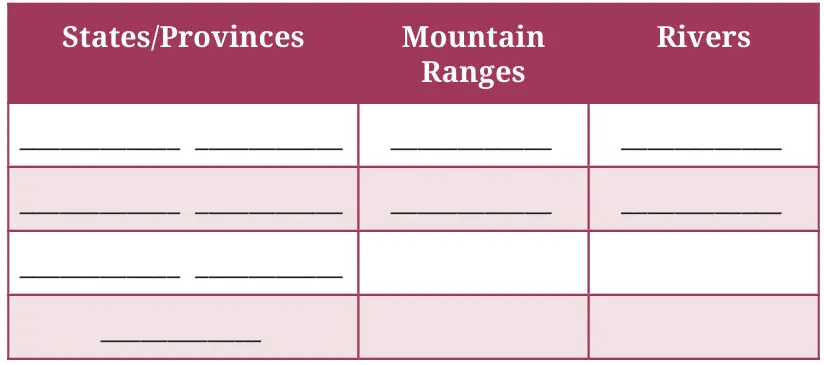
Answer:
| States/Provinces | Mountain Ranges | Rivers |
|---|---|---|
| Punjab, Sindh | Vindhya | Yamuna |
| Gujarat, Maratha | Himachal | Ganga |
| Dravida, Utkala | ||
| Banga |
II. Work in pairs. Discuss what the words ‘जय हे ’ (Jaya he) in the last two lines of the National Anthem convey. Share your answer with your classmates and teacher.
Answer:
The words “Jaya he” in the National Anthem mean “Victory to you” or “Hail to you”. These words are used to praise and honour the nation.
They express feelings of respect, pride, and devotion towards India. By repeating “Jaya he”, the anthem creates a strong sense of patriotism and unity, reminding people to celebrate the greatness of their country.
III. Read the underlined words in the given lines of the poem. Choose the odd one out that does not correspond with the meaning of the underlined word.
1. She’s peerless, let’s praise her!
valuable, incomparable, unmatched
2. Many a sage has sanctified this land.
blessed , purified, applauded
3. And here all auspicious things are found.
fortunate, fantastic, favourable
4. Of hoary antiquity is Bharat,
ancient times, recent past, time immemorial
Answer:
- peerless → valuable, incomparable, unmatched
Odd one: valuable - sanctified → blessed, purified, applauded
Odd one: applauded - auspicious → fortunate, fantastic, favourable
Odd one: fantastic - hoary antiquity → ancient times, recent past, time immemorial
Odd one: recent past
End-of-the-text Questions Answers | Bharat Our Land Poem
Questions and Exercises given at the end of the Poem ‘Bharat Our Land’. (Pages 25 to 32)
Check Your Understanding
I. Fill in the blanks by choosing appropriate words from the box given below to complete the summary of the poem.
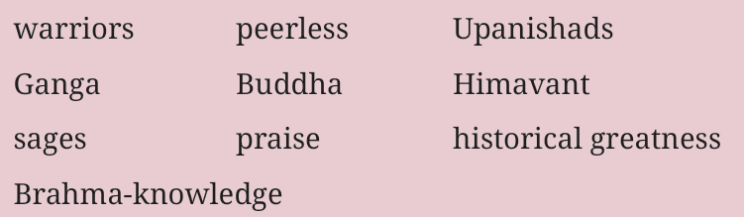
The poem is a tribute to India, celebrating its natural beauty, spiritual heritage, and 1. _____ . The poet praises the 2. _____ , describing it as mighty and unparalleled. The 3 _____ . is depicted as generous and graceful, while the 4. _____ are honoured as sacred and unmatched. The poem highlights the contributions of 5. _____ and 6. _____ who have enriched the land with their bravery and wisdom. It also acknowledges the presence of 7. _____ and the teachings of 8. _____ , highlighting India’s deep-rooted spiritual and philosophical traditions. The poet repeatedly asserts that India is 9. _____ , urging everyone to 10. _____ her.
Answers:
- historical greatness
- Himavant
- Ganga
- Upanishads
- warriors
- sages
- Brahma-knowledge
- Buddha
- peerless
- praise
II. Complete the following features about the poem.
- The impact on the readers (mood): _____
- The poet’s attitude (tone): _____
- The rhyme scheme: _____
- Examples of personification: _____
Answers:
- The impact on the readers (mood): Patriotic and inspiring
- The poet’s attitude (tone): Proud and admiring
- The rhyme scheme: No fixed rhyme scheme (free verse)
- Examples of personification: “the generous Ganga”, “she’s peerless” (India as ‘she’)
III. What is the impact of the refrain, ‘she’s peerless, let’s praise her!’?
Answer:
The refrain “she’s peerless, let’s praise her!” creates a strong feeling of pride and patriotism. It repeatedly reminds the reader that India is unique and unmatched.
This repetition also emphasises admiration for the country and encourages people to respect, honour, and celebrate their motherland.
IV. Complete the following sentence appropriately. India is metaphorically described as ‘this sunny golden land,’ suggesting that it is _______ .
Answer:
India is metaphorically described as ‘this sunny golden land,’ suggesting that it is bright, prosperous, and full of richness and beauty.
V. The poet uses symbolism. Match the symbols in Column 1 to what they suggest in Column 2.
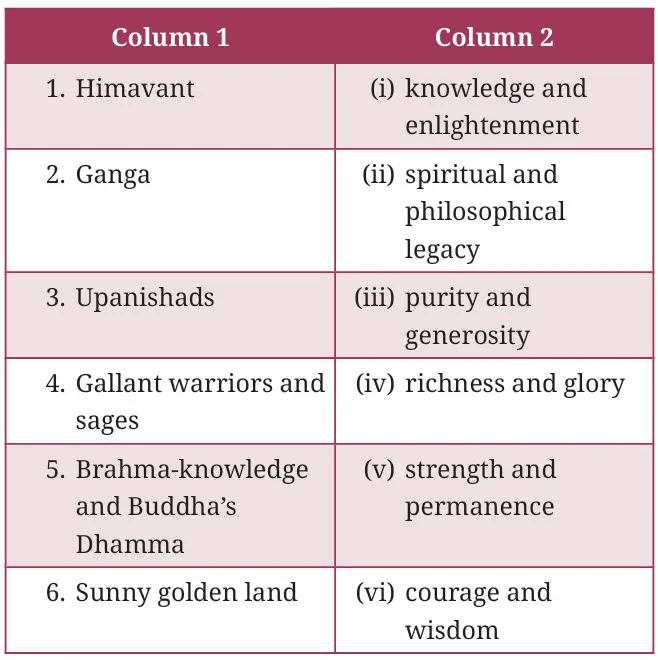
Answer:
- Himavant → (v) strength and permanence
- Ganga → (iii) purity and generosity
- Upanishads → (ii) spiritual and philosophical legacy
- Gallant warriors and sages → (vi) courage and wisdom
- Brahma-knowledge and Buddha’s Dhamma → (i) knowledge and enlightenment
- Sunny golden land → (iv) richness and glory
| Column 1 | Column 2 |
|---|---|
| 1. Himavant | (v) strength and permanence |
| 2. Ganga | (iii) purity and generosity |
| 3. Upanishads | (ii) spiritual and philosophical legacy |
| 4. Gallant warriors and sages | (vi) courage and wisdom |
| 5. Brahma-knowledge and Buddha’s Dhamma | (i) knowledge and enlightenment |
| 6. Sunny golden land | (iv) richness and glory |
VI. The poet uses imagery (descriptive language to create vivid mental pictures that appeal to the senses). Give any two examples from the poem.
Answer: (Any two examples)
- “The mighty Himavant”
- “This sunny golden land”
These phrases create clear and vivid mental pictures of India’s beauty and greatness.
VII. What is the impact of the use of hyphens in the first stanza? Select the options that are true.
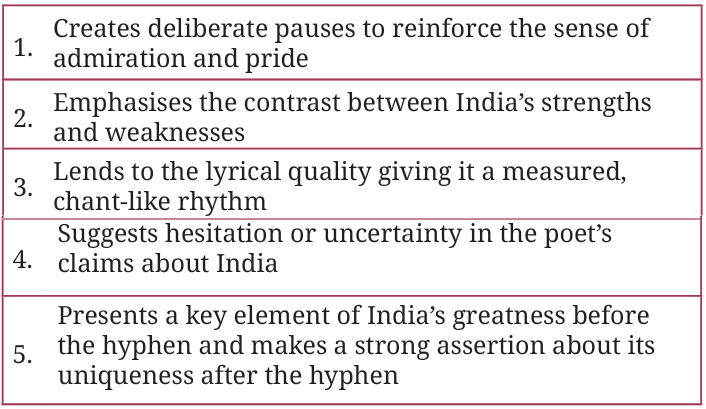
Answers:
Correct Options are –
✔ 1. Creates deliberate pauses to reinforce the sense of admiration and pride
✔ 3. Lends to the lyrical quality giving it a measured, chant-like rhythm
✔ 5. Presents a key element of India’s greatness before the hyphen and makes a strong assertion after it
______________
❌ 2 and 4 are incorrect (no contrast or hesitation is shown in the poem).
IX. The poem is an ode. Now, identify examples from the poem that correspond to it being an ode.
Answer: (Examples showing the poem is an ode)
- “The mighty Himavant is ours — there’s no equal anywhere on earth.”
👉 Shows deep admiration for India’s natural beauty. - “The generous Ganga is ours — which other river can match her grace?”
👉 Expresses praise and reverence. - “The sacred Upanishads are ours — what scriptures else to name with them?”
👉 Highlights spiritual greatness in an elevated tone. - “This sunny golden land is ours — she’s peerless, let’s praise her!”
👉 Directly shows enthusiastic praise. - “Gallant warriors have lived here, many a sage has sanctified this land.”
👉 Celebrates India’s glorious past. - “Of hoary antiquity is Bharat, she’s peerless, let’s praise her!”
👉 Uses grand and expressive language to honour India.
These examples prove that the poem expresses admiration, pride, and praise, which are key features of an ode.
X. The poet uses allusion in the poem. Now, read the explanations and identify the matching allusions from the poem for the following.
- An allusion to the ancient Indian scriptures that form the philosophical core and symbolise deep wisdom and enlightenment.
- An allusion to the concept of spiritual knowledge associated with self-realisation and ultimate truth.
- An allusion to Gautama Buddha’s teachings, which include compassion, non-violence, and enlightenment. This highlights India’s role in shaping major religious and philosophical traditions.
Answer:
- Ancient Indian scriptures showing deep wisdom and enlightenment → “The sacred Upanishads are ours”
- Concept of spiritual knowledge and ultimate truth → “Here Brahma-knowledge has taken root”
- Teachings of compassion, non-violence, and enlightenment → “the Buddha preached his dhamma here”
Critical Reflections
I. Read the extract given below and answer the questions that follow.
The mighty Himavant is ours
there’s no equal anywhere on earth.
The generous Ganga is ours
which other river can match her grace?
The sacred Upanishads are ours
what scriptures else to name with them?
- Complete the sentence.
The word ‘mighty’ refers to the ____ of the Himavant. - Choose the correct option to complete the sentence given below.
The question mark at the end of the fourth and sixth line of the extract is used to ____ .
(i) show doubt and uncertainty
(ii) emphasise a point
(iii) highlight confusion and hesitation
(iv) reveal inquiry and curiosity - The poet uses the word ‘generous’ to describe the Ganga. Why?
- Why has the movement of the river been described as graceful?
- Fill in the blank with the correct option from the words given in the brackets.
The poet is implying that the Upanishads are ____ (unmatched/abundant) in their wisdom and spiritual depth.
Answers:
- The word ‘mighty’ refers to the strength and grandeur of the Himavant.
- The question mark is used to (ii) emphasise a point.
- The poet calls the Ganga “generous” because it gives water, supports life, and benefits people selflessly.
- The river’s movement is described as graceful because it flows smoothly, calmly, and beautifully.
- The poet is implying that the Upanishads are unmatched in their wisdom and spiritual depth.
II. Answer the following questions.
- How does the poem reflect a strong connection to cultural identity and heritage?
- What can you infer about the poet’s attitude towards India from the repeated phrase ‘she’s peerless, let’s praise her!’?
- What does the line ‘many a sage has sanctified this land’ suggest about India’s spiritual heritage?
- How does the poet connect warriors and music to India’s greatness?
- How does this poem foster a sense of national pride?
Answers:
Very short, short, and long answers are provided to help students.
1. How does the poem reflect a strong connection to cultural identity and heritage?
Very Short:
Through India’s scriptures, sages, and traditions.
Short Answer:
The poem highlights India’s Upanishads, sages, and Buddha, showing its rich cultural and spiritual heritage.
Long Answer (V1):
The poem reflects a strong connection to cultural identity by presenting India as a land of ancient traditions and spiritual wisdom. The mention of the Upanishads shows the country’s deep philosophical roots. The reference to sages suggests that wise men lived here and guided society with moral values. The poet also refers to Buddha’s teachings, which represent peace and enlightenment. Together, these elements show that India’s identity is built on knowledge, spirituality, and long-standing traditions.
Long Answer (V2):
The poet connects India’s cultural identity with its rich heritage of knowledge, philosophy, and spirituality. By mentioning sacred texts like the Upanishads and figures like Gautama Buddha, he shows that India has contributed greatly to human thought and values. The presence of sages and spiritual learning highlights a tradition of self-realisation and moral guidance. Thus, the poem presents India not just as a place, but as a centre of cultural depth and timeless heritage.
2. What can you infer about the poet’s attitude towards India from the repeated phrase ‘she’s peerless, let’s praise her’?
Very Short:
He feels a deep pride in India and holds great admiration for her.
Short Answer:
The repeated phrase reflects the poet’s strong sense of pride, deep admiration, and patriotic love for India.
Long Answer (V1):
The repeated phrase shows that the poet has a deep sense of pride and admiration for India. By calling the country “peerless,” he believes that no other nation can match its greatness. The use of “let’s praise her” also invites readers to share this feeling. This repetition strengthens the emotional impact and shows the poet’s strong patriotic attitude.
Long Answer (V2):
The poet’s attitude is highly respectful, emotional, and patriotic. Through repetition, he emphasises that India is unique in its beauty, culture, and heritage. The phrase also acts as a call to action, encouraging people to recognise and celebrate their nation’s greatness. It reflects not only admiration but also a desire to create a sense of collective pride and unity among citizens.
3. What does the line ‘many a sage has sanctified this land’ suggest about India’s spiritual heritage?
Very Short:
India is a holy and spiritual land.
Short Answer:
It shows that sages enriched India with purity and sacredness through their teachings and wisdom.
Long Answer (V1):
This line suggests that India has a strong spiritual heritage shaped by the presence of many sages and wise men. These sages spread knowledge, values, and moral teachings, which made the land sacred. Their influence helped build a society based on truth, discipline, and spirituality, making India respected across the world.
Long Answer (V2):
The line highlights India as a centre of spiritual learning and moral development. The sages mentioned were not ordinary people; they were thinkers and teachers who guided society towards truth and righteousness. Their teachings enriched Indian culture and made the land spiritually significant. This shows that India’s greatness lies not only in its physical features but also in its deep spiritual traditions and values.
4. How does the poet connect warriors and music to India’s greatness?
Very Short:
They show strength and culture.
Short Answer:
Warriors show bravery, while music shows cultural richness.
Long Answer (V1):
The poet connects warriors and music to show that India is great in both strength and culture. Warriors represent courage and sacrifice, protecting the nation. On the other hand, divine music represents artistic and cultural development. This combination shows that India is balanced in both power and creativity.
Long Answer (V2):
By mentioning gallant warriors and divine music, the poet presents a complete picture of India’s greatness. Warriors symbolise the country’s ability to defend itself with courage and honour. At the same time, music reflects its refined culture and artistic excellence. Together, they show that India is not only powerful but also deeply cultured, making it a truly great and well-rounded civilisation.
5. How does this poem foster a sense of national pride?
Very Short:
By praising India’s unmatched greatness.
Short Answer:
The poem captures India’s beauty, rich history, and timeless wisdom, inspiring a sense of pride in its readers.
Long Answer (V1):
The poem fosters national pride by describing India’s natural beauty, spiritual richness, and glorious past. The poet uses strong and positive language to show that India is unique and महान. This makes readers feel proud of their country and appreciate its value.
Long Answer (V2):
The poem creates a strong sense of national pride by presenting India as a land of unmatched beauty, deep knowledge, and rich heritage. The repeated phrase “she’s peerless” reinforces the idea that India is special. By mentioning great elements like the Himalayas, Ganga, sages, and Buddha, the poet builds a powerful image of the nation. This encourages readers to feel connected, respectful, and proud of their motherland.
Vocabulary in Context
I. Complete the table by choosing words from the poem.
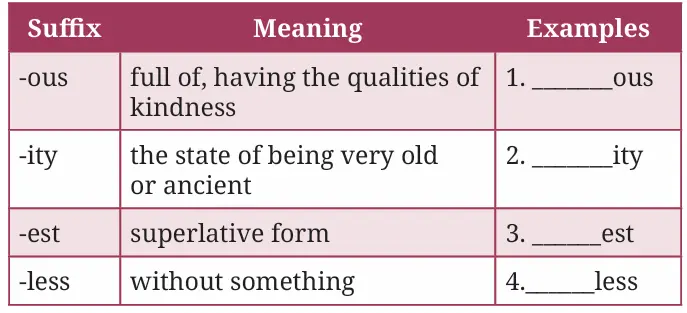
Answers:
- generous
- antiquity
- mightiest
- peerless
II. Complete the following table by adding a different suffix to form new words. Also, create a sentence using the created word. One example has been done for you.
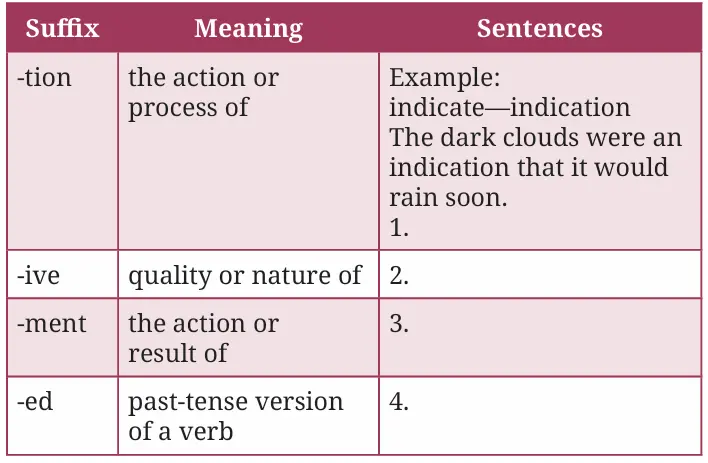
Answers:
- act — action
Sentence: His quick action saved the child. - create — creative
Sentence: She gave a very creative answer in class. - develop — development
Sentence: The development of the village improved people’s lives. - bless — blessed
Sentence: The land was blessed by the sages.
The completed table combining the suffixes, definitions, and your answers.
| Suffix | Meaning | Sentences |
|---|---|---|
| -tion | the action or process of | Example: indicate — indication The dark clouds were an indication that it would rain soon. 1. act — action His quick action saved the child. |
| -ive | quality or nature of | 2. create — creative She gave a very creative answer in class. |
| -ment | the action or result of | 3. develop — development The development of the village improved people’s lives. |
| -ed | past-tense version of a verb | 4. bless — blessed The land was blessed by the sages. |
Listen and Respond
I. You will listen to four people talk about the places they like to travel to. As you listen, write the speaker number for the two pictures given. (Transcript for teacher on page 260)
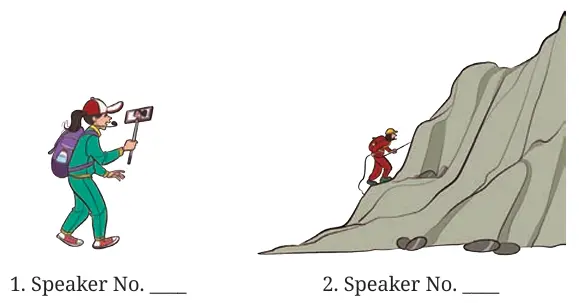
Answers:
- Speaker No. 3
- Speaker No. 2
II. You will once again listen to the four speakers. As you listen, match the given statements to the speaker. There are two statements that you do not need. (Transcript for teacher on page 260)
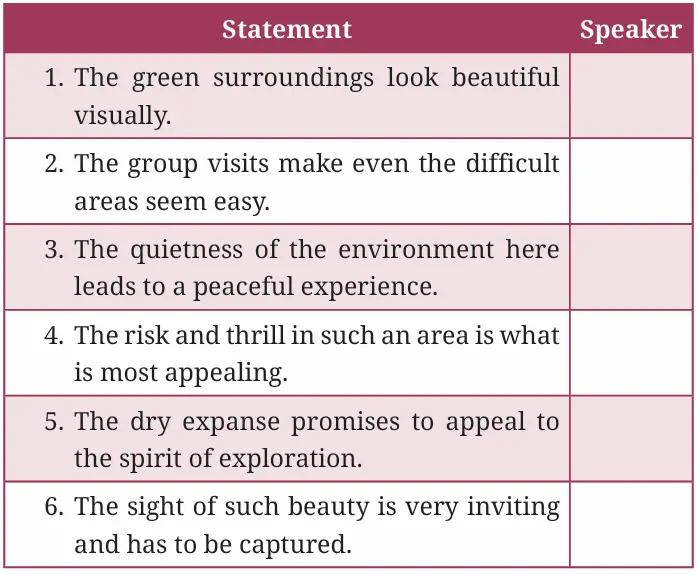
Answers:
- The green surroundings look beautiful visually. → Speaker 4
- The group visits make even the difficult areas seem easy. → Not needed
- The quietness of the environment here leads to a peaceful experience. → Speaker 1
- The risk and thrill in such an area is what is most appealing. → Speaker 2
- The dry expanse promises to appeal to the spirit of exploration. → Speaker 3
- The sight of such beauty is very inviting and has to be captured. → Speaker 3
The completed table matching each statement to its corresponding speaker based on your answers.
| Statement | Speaker |
|---|---|
| 1. The green surroundings look beautiful visually. | Speaker 4 |
| 2. The group visits make even the difficult areas seem easy. | Not needed |
| 3. The quietness of the environment here leads to a peaceful experience. | Speaker 1 |
| 4. The risk and thrill in such an area is what is most appealing. | Speaker 2 |
| 5. The dry expanse promises to appeal to the spirit of exploration. | Speaker 3 |
| 6. The sight of such beauty is very inviting and has to be captured. | Speaker 3 |
Speaking Activity
I. In pairs, take turns to speak about the aspects of your village/town/city that you feel are an asset. It could be about geographical, cultural, traditional features, or even its history.
Answer: (Sample responses)
Sample 1
One thing that I find truly wonderful about my village is its peaceful environment and greenery. If I had to describe my village in one word, it would be “serene.” I have always been fascinated by the way the people of my village help and support each other. What I want other people to know about my village is that it has a rich cultural tradition and strong values. When it comes to the scenery, my village truly shines because of its fields, trees, and fresh air. I feel a deep sense of pride when I think about my village because it is simple, beautiful, and full of warmth.
Sample 2:
What I love most about my village is its peaceful vibe and lush greenery. If I had to sum it up in one word, it would be “serene.” I’m always impressed by how the people here help and support one another. My village is rich in cultural traditions and strong values, something I wish more people knew. The scenery is stunning, with open fields, tall trees, and fresh air that feels refreshing. Thinking about my village fills me with pride because it’s simple, beautiful, and full of warmth.
Writing Task
I. Write a paragraph about a place that you have visited which has stayed in your memory.
Answer: (Sample Responses)
Sample Paragraph-1
A Memorable Visit to Shimla
Last year, I visited Shimla, and it has stayed in my memory because of its beautiful mountains and cool weather. I went there during my summer holidays to relax and enjoy nature. I travelled with my parents and younger brother. Before the trip, we packed warm clothes and made hotel bookings in advance. We stayed in a small hotel near Mall Road, which had a lovely view of the hills. During our visit, we went sightseeing, walked through the markets, and enjoyed the scenic beauty. We also visited Kufri and took many photographs. The fresh air and peaceful surroundings made the trip very special for me.
Sample Paragraph-2
A Memorable Trip to Manali
Last summer, my family and I travelled to Manali to escape the scorching city heat and experience the beauty of the Himalayas. To prepare for the journey, we packed plenty of warm woollen clothes, researched popular sightseeing spots, and pre-booked a reliable local cab for local transport. Upon reaching, we stayed at a cozy wooden cottage overlooking the snow-capped mountains and the Beas River. During our stay, we participated in thrilling activities like paragliding in Solang Valley, trekking through pine forests, and playing in the snow at Rohtang Pass. In the evenings, we strolled through Mall Road to shop for local handicrafts and taste traditional street food, making it an unforgettable journey.
Learning Beyond the Text
I. Search for poems or songs dedicated to India, your motherland, in your regional language. Share them with your classmates and explain their meaning too.
Answer: (Sample Response)
One popular patriotic song in Hindi is Vande Mataram. It praises India as a motherland full of beauty, strength, and richness. The song describes the land with green fields, flowing rivers, and pleasant winds, showing deep love and respect for the country.
Another famous song is Saare Jahan Se Achha. It expresses pride in India and says that our country is better than the whole world. It highlights unity, cultural richness, and the strong bond among people.
Both songs convey the message of patriotism, unity, and admiration for India.
II. In groups of six, prepare an interdisciplinary project on India’s major geographical features. For each feature, describe the region, explain its importance in the lives of the people living there and mention the languages spoken in that region. Include one example of each of the following.
Answer: (Sample Response)
The sample content below will help students in preparing their projects.
Interdisciplinary Project (Sample)
Mountains – Himalayas
The Himalayas are located in the northern part of India. They protect the country from cold winds and are the source of many rivers. People depend on tourism and farming here. Languages spoken include Hindi, Nepali, and regional dialects.
Rivers – Ganga
The Ganga flows through northern India and is very important for agriculture and daily life. It provides water for drinking and irrigation. People living near it depend on farming and trade. Languages include Hindi, Bengali, and Bhojpuri.
Deserts – Thar Desert
The Thar Desert is found in Rajasthan. Life here is difficult due to less water, but people adapt through animal rearing and crafts. It is also a tourist attraction. Languages include Rajasthani and Hindi.
Valleys – Kangra Valley
Kangra Valley is in Himachal Pradesh. It is known for its natural beauty and tea gardens. People depend on agriculture and tourism. Languages spoken include Hindi and Kangri.
Islands – Andaman and Nicobar Islands
These islands are located in the Bay of Bengal. Fishing and tourism are main occupations. The region has rich biodiversity. Languages include Hindi, English, and local tribal languages.
Plateaus – Deccan Plateau
The Deccan Plateau lies in southern India. It is rich in minerals and supports agriculture. People engage in farming and mining. Languages include Kannada, Telugu, Marathi, and Tamil.
End …