
These NCERT solutions for “How I Taught My Grandmother to Read” by Sudha Murty from the Class 9 English book Kaveri provide clear answers to all textbook questions – intext questions, chapter-end questions, extract-based questions, grammar exercises, writing tasks, listening and speaking task, and activities in a simple and exam-focused manner, helping students understand the chapter better and prepare effectively for CBSE exams.
Intext Questions – How I Taught My Grandmother to Read | Kaveri 9
Reflect and Respond
I. Complete the given word web.
Why is it important to learn how to read and write?
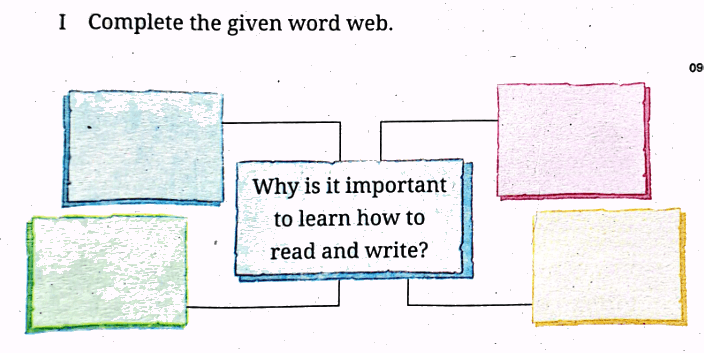
Ans. The importance of learning to read and write is centred on communication, personal development, and full participation in society. Literacy skills allow individuals to share ideas and navigate daily life independently.
Filling in the word web:
- To become independent
- To gain knowledge and information
- To improve communication skills
- To build confidence and self-respect
Detailed answer
It is important to learn to read and write because it helps in:
Future Success: Proficiency in reading and writing is a fundamental requirement for most jobs and academic achievements, opening up more career opportunities and paths for growth.
Effective Communication: It allows you to express your thoughts clearly through writing and understand the messages, ideas, and stories shared by others through reading.
Access to Knowledge: Being literate enables you to gain information from books, newspapers, and the internet, helping you learn about the world and new subjects.
Daily Independence: These skills are essential for navigating everyday tasks, such as reading street signs, following instructions on medicine labels, or managing personal finances and emails.
II. Read the questions given below and share your answers with your classmates and teacher.
- Which language(s) do your grandparents or elderly relatives speak?
- How do they spend their time? How do you spend time with them?
- What is your favourite experience with them?
- What is something that the elderly in your family cannot do easily but enjoy watching you do?
Example Answers:
- Which language(s) do your grandparents or elderly relatives speak?
Ans. My grandparents speak Hindi and our regional language. They are more comfortable speaking in their mother tongue.
- How do they spend their time? How do you spend time with them?
Ans. They spend their time praying, reading religious books, watching TV, and talking with family members. I spend time with them by listening to their stories, helping them in small tasks, and sitting and talking with them.
- What is your favourite experience with them?
Ans. My favourite experience is listening to their childhood stories and life experiences, which are interesting and teach valuable lessons.
- What is something that the elderly in your family cannot do easily but enjoy watching you do?
Ans. They cannot easily use mobile phones or technology, but they enjoy watching me use them and often ask me to help them.
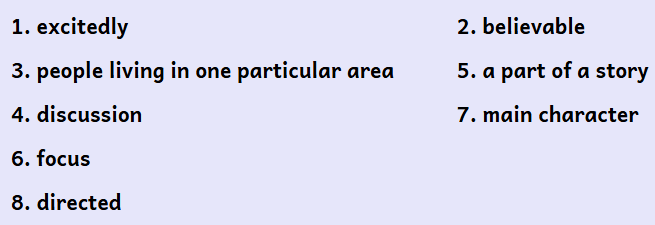
III. Read the following passage. Match the highlighted words with their meanings given in the box below.
The casting for the (i) protagonist of our school’s annual play was done after a lot of (ii) debate as many good actors had auditioned for the role. We had decided to present an (iii) episode from an inspirational story. It was a life story of a group of children who worked with the (iv) community to spread literacy. Every day, we reached school early to practise with (v) concentration. We waited (vi) eagerly for the final presentation. All of us played our roles in a very (vii) convincing manner as our theatre teacher had (viii) guided us well.
Answer: Matching the highlighted words with their meanings
(i) protagonist → 7. main character
(ii) debate → 4. discussion
(iii) episode → 5. a part of a story
(iv) community → 3. people living in one particular area
(v) concentration → 6. focus
(vi) eagerly → 1. excitedly
(vii) convincing → 2. believable
(viii) guided → 8. directed
Check Your Understanding
I. Complete the cause and effect table given below based on Part I of the story. Share your answers with your classmates and teacher.
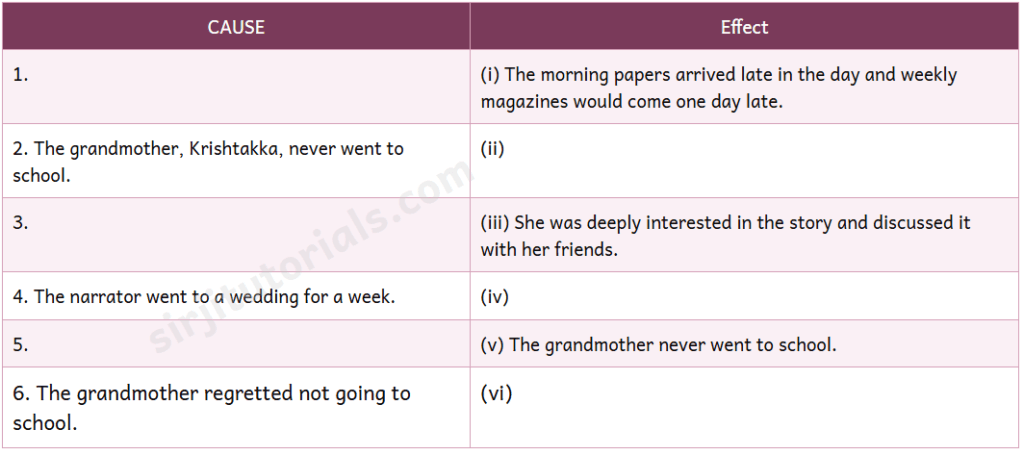
Answer: matching cause and effect from the Part I of the story
| Cause | Effect |
|---|---|
| 1. The transport system in the village was not very good. | (i) The morning papers arrived late in the day and weekly magazines would come one day late. |
| 2. The grandmother, Krishtakka, never went to school. | (ii) She never learned to read and write at a young age and remained illiterate. |
| 3. The narrator read the story Kashi Yatre aloud to her. | (iii) She was deeply interested in the story and discussed it with her friends. |
| 4. The narrator went to a wedding for a week. | (iv) The grandmother could not read the next episode of the story and felt helpless and dependent. |
| 5. She got married at a very young age (and girls’ education was not considered important then). | (v) The grandmother never went to school. |
| 6. The grandmother regretted not going to school. | (vi) She decided to learn the Kannada alphabet to become independent. |
II. Do you think the narrator expected to see her grandmother in tears when she returned to the village? If yes, why? If no, why not?
Ans. No, the narrator did not expect to see her grandmother in tears. She was surprised because she had never seen her cry, even in tough situations. This made her feel worried and curious about the reason. Besides, she was only 12 years old and might not have thought so deeply about her grandmother missing her for this reason.
III. How might the narrator help her grandmother to fulfil her desire to learn to read and write?
Ans. The narrator helped her grandmother by teaching her the Kannada alphabet. She acted as her teacher and guided her step by step. The grandmother practised reading, writing, and revising regularly, and the narrator supported her with patience until she became able to read on her own.
Check Your Understanding
I. State whether the following sentences are true or false. Share your answers with your classmates and teacher.
| No. | Sentence | True/False |
|---|---|---|
| 1. | The grandmother wanted to learn the Kannada alphabet to gain independence. | |
| 2. | The grandmother asked someone in the village to read Kashi Yatre to her while the narrator was away. | |
| 3. | The narrator was the grandmother’s first teacher and taught her how to read Kannada. | |
| 4. | The grandmother believed that there was no age limit for learning. | |
| 5. | The grandmother touched the narrator’s feet as a mark of respect for her as a teacher. | |
| 6. | The narrator was disappointed with the progress her grandmother made in learning to read. |
Answer: Filling in true and false
| 1 | The grandmother wanted to learn the Kannada alphabet to gain independence. | True |
| 2 | The grandmother asked someone in the village to read Kashi Yatre to her while the narrator was away. | False |
| 3 | The narrator was the grandmother’s first teacher and taught her how to read Kannada. | True |
| 4 | The grandmother believed that there was no age limit for learning. | True |
| 5 | The grandmother touched the narrator’s feet as a mark of respect for her as a teacher. | True |
| 6 | The narrator was disappointed with the progress her grandmother made in learning to read. | False |
NCERT Textbook Q&A – How I taught my grandmother to Read | Class 9 Kaveri
Critical Reflection
I. Read the extracts given below and answer the questions that follow.
- When I came back to my village, I saw my grandmother in tears. I was surprised, for I had never seen her cry even in the most difficult situations. What had happened? I was worried.
‘Avva, is everything all right? Are you okay?’
I used to call her Avva, which means mother in the Kannada spoken in north Karnataka.
She nodded but did not reply. I did not understand and forgot about it. In the night, after dinner, we were sleeping in the open terrace of our house. It was a summer night and there was a full moon. Avva came and sat next to me. Her affectionate hands touched my forehead.
(i) Complete the following sentence with the appropriate option.
The phrase ‘never seen her cry in the most difficult situations’ tells us that the grandmother was _____
A. strong-willed
B. understanding
C. considerate
D. bold
Ans. → A. strong-willed
(ii) Complete the following with the correct option from those given in the brackets.
Grandmother did not reply when the narrator. asked if she was alright because she might have been
too (emotional/tired) to respond.
Ans. → emotional
(iii) Identify the clue from the extract that indicates a rural setting with traditional customs.
Ans. “we were sleeping in the open terrace of our house.”
(iv) Which lines of the extract establish a tender atmosphere?
Ans. “Avva came and sat next to me. Her affectionate hands touched my forehead.”
(v) Which of the following aspect is NOT emphasised in the given extract?
A. the emotional turmoil of the grandmother
B. the affectionate bond between the narrator and her grandmother
C. the grandmother’s regret over her lack of education
D. the narrator’s concern for her grandmother
Ans. → C. the grandmother’s regret over her lack of education
- ‘I have decided I want to learn the Kannada alphabet from tomorrow onwards. I will work very hard. I will keep Saraswati Puja day during Dassara as the deadline. That day I should be able to read a novel on my own. I want to be independent.’
I saw the determination on her face. Yet I laughed at her.
‘Avva, at this age of sixty-two you want to learn the alphabet? All your hair is grey, your hands are wrinkled, you wear spectacles and you work so much in the kitchen…’
Childishly I made fun of the old lady. But she just smiled.
‘For a good cause if you are determined, you can overcome any obstacle. I will work harder than anybody but I will do it. For learning there is no age bar.’
(i) What does the grandmother’s statement, “I want to be independent,” reveal about her character?
A. She wanted to be literate.
B. She desires self-sufficiency.
C. She wants to prove her intelligence to others.
D. She feels pressured by society to learn.
Ans. → B. She desires self-sufficiency.
(ii) Fill in the blank with the appropriate option from those given in brackets.
The grandmother’s determination shows that learning has no _______.
(age limit/gender bias/cultural barriers)
Ans. → age limit
(iii) Complete the following with a suitable reason.
The narrator laughs at her grandmother’s decision to learn the alphabet at the age of sixty-two because
________.
Ans. she thinks that old age makes learning difficult and believes her grandmother may not be able to do it.
(iv) List any two qualities displayed by the grandmother.
Ans. The two qualities are:
- Determination
- Hardworking nature
(v) How can we say that the narrator is making assumptions about her grandmother?
Ans. She judges her grandmother’s ability based only on her age and physical condition without understanding her strong will and determination.
II. Answer the following questions.
- Why do you think the grandmother felt embarrassed to ask someone else to read to her while the narrator was away?
- Why does the narrator initially laugh at her grandmother’s determination to learn at the age of sixty-two?
- What significance does the story of Kashi Yatre have in both the grandmother’s life and the story?
- What does the grandmother’s desire to learn the Kannada alphabet reflect about her?
- What lessons can we infer from the grandmother’s action of touching the narrator’s feet?
- What does the following line tell us about the broader theme of the story?
‘For a good cause if you are determined, you can overcome any obstacle.’ - How effectively does the story highlight the value of education in supporting personal independence?
Answers:
Multiple versions are provided as very short, short, and long (v1 and v2) to help students develop and draft their own responses as well.
1. Why did the grandmother feel embarrassed to ask someone else to read to her?
Answers:
Very Short Ans:
She felt ashamed of being illiterate and did not want others to know about her weakness.
Short Ans:
She felt embarrassed because she was illiterate and did not want others to know about her weakness. She also felt dependent, which hurt her self-respect.
Long Ans. v1:
The grandmother felt embarrassed because she was illiterate and did not want others to know about her inability to read. In her society, this could make her feel ashamed. Although she was financially well-off, she realised that without education she was dependent on others, which hurt her self-respect. She also preferred listening to the story from her granddaughter due to their emotional bond. Asking someone else would expose her weakness and make her uncomfortable.
Long Ans. v2:
The grandmother felt embarrassed because she was illiterate and did not want others to know about her inability to read. In her society, being unable to read at her age could make her feel ashamed. Although she was financially well-off, she realised that without education she was dependent on others. This dependence hurt her self-respect. She also had a close emotional bond with her granddaughter and preferred listening to the story from her. Asking someone else would not only expose her weakness but also make her uncomfortable. Her hesitation shows her inner dignity and strong desire to become independent through education.
2. Why does the narrator initially laugh at her grandmother’s determination?
Answers:
Very Short Ans:
She thought old people cannot learn easily and reacted in a childish way.
Short Ans:
The narrator laughs because she thinks that old age makes learning difficult. Being young, she assumes her grandmother may not be able to learn at sixty-two.
Long Ans. v1:
The narrator laughs because she is young and does not understand her grandmother’s feelings. She believes learning is only for children and thinks that at sixty-two, learning would be difficult. She notices her grandmother’s age and physical condition and assumes she cannot learn. This shows her immature thinking. Later, she realises her mistake and understands the power of determination.
Long Ans. v2:
The narrator initially laughs because she is young and does not fully understand the seriousness of her grandmother’s feelings. At the age of twelve, she believes that learning is meant only for children and thinks that old people cannot easily learn new things. She notices her grandmother’s age, grey hair, and physical condition and assumes that learning at sixty-two would be too difficult. This reaction shows her childish thinking and lack of maturity. However, later she realises her mistake and understands the strength of her grandmother’s determination. This moment also highlights the contrast between immature thinking and true determination.
3. What significance does the story of Kashi Yatre have?
Answers:
Very Short Ans:
It motivates the grandmother to learn reading and brings a change in her life.
Short Ans:
The story creates a deep emotional connection for the grandmother. It becomes the main reason for her desire to learn reading, as she wants to read it on her own.
Long Ans. v1:
The story of Kashi Yatre is very important in the grandmother’s life. She becomes emotionally attached to it and relates herself to the main character. When she cannot read it during the narrator’s absence, she feels helpless. This becomes the turning point and inspires her to learn reading so that she can become independent and enjoy the story on her own.
Long Ans. v2:
The story of Kashi Yatre plays a very important role in the grandmother’s life. She becomes deeply attached to the story and relates herself to the main character. It gives her emotional satisfaction and becomes a source of interest and discussion among her friends. When she is unable to read the story during the narrator’s absence, she feels helpless and dependent. This situation becomes the turning point in her life. It motivates her to learn reading so that she can enjoy the story independently. Thus, the novel acts as a source of inspiration and brings a major change in her life.
4. What does the grandmother’s desire to learn reflect about her?
Answers:
Very Short Ans:
It shows her determination, self-respect, and desire for independence.
Short Ans:
It shows her determination, self-respect, and desire for independence. She wants to become self-reliant despite her age.
Long Ans. v1:
Her desire to learn reflects strong determination and self-respect. Even at sixty-two, she decides to study, proving that learning has no age limit. She wants to become independent and not depend on others. She accepts her weakness and works hard to overcome it. Her goal-setting and dedication show her positive attitude towards learning.
Long Ans. v2:
The grandmother’s desire to learn reflects her strong determination and self-respect. Even at the age of sixty-two, she decides to learn reading and writing, showing that she believes learning has no age limit. Her wish to become independent highlights her awareness of the importance of education. She does not want to depend on others for simple things like reading a story. Her decision also shows her courage to accept her weakness and work on it. She sets a clear goal and works hard to achieve it. Overall, her desire reflects a positive attitude towards learning and a strong will to improve herself.
5. What lessons can we infer from her touching the narrator’s feet?
Answers:
Very Short Ans:
It teaches respect for teachers and shows humility and gratitude.
Short Ans:
It teaches respect for teachers, regardless of age. It also shows humility and gratitude towards the one who gives knowledge.
Long Ans. v1:
The grandmother touches her granddaughter’s feet as a mark of respect for her as a teacher. This shows that a teacher deserves respect regardless of age. It reflects humility and gratitude for the knowledge received. The act also highlights cultural values where touching feet shows respect. It teaches that knowledge is greater than age and that teachers should always be honoured.
Long Ans. v2:
The grandmother’s action of touching the narrator’s feet teaches us important values. It shows that a teacher deserves respect, regardless of age or relationship. Even though the narrator is her granddaughter, the grandmother respects her as a teacher because she helped her gain knowledge. This act also reflects humility and gratitude. It teaches us that learning is sacred and the one who teaches us should be honoured. The incident also highlights cultural values where touching feet is a sign of respect. Overall, it conveys that knowledge is greater than age and that respect for teachers is an important part of our tradition.
6. What does the given line tell us about the broader theme?
Answers:
Very Short Ans:
It shows that determination helps overcome obstacles and learning has no age limit.
Short Ans:
The line shows that strong determination can help overcome any difficulty. It highlights the theme that learning is possible at any age.
Long Ans. v1:
The line highlights the importance of determination in achieving success. It shows that no obstacle is too big if a person has strong willpower. The grandmother proves that even at an old age, learning is possible with effort. The line reflects the theme of perseverance, self-belief, and continuous learning.
Long Ans. v2:
The line shows that determination plays a key role in achieving success. It highlights the idea that no obstacle is too big if a person has strong willpower. The grandmother’s example proves that even at an old age, one can learn new things with dedication and effort. The line also reflects the theme that learning has no age limit and that a good purpose gives strength to overcome difficulties. It inspires readers to stay focused and work hard towards their goals. Overall, the line conveys a positive message about perseverance, self-belief, and the importance of continuous learning.
7. How effectively does the story highlight the value of education?
Answers:
Very Short Ans:
It shows that education brings independence, confidence, and self-respect.
Short Ans:
The story clearly shows that education brings independence and confidence. The grandmother’s transformation from dependence to self-reliance proves the importance of being educated.
Long Ans. v1:
The story clearly highlights the value of education through the grandmother’s transformation. Initially, she feels dependent and helpless because she cannot read. After learning, she becomes independent and confident. Reading the novel on her own gives her happiness and dignity. The story shows that education empowers individuals and improves their quality of life.
Long Ans. v2:
The story effectively highlights the value of education by showing the transformation in the grandmother’s life. At first, she is dependent on others because she cannot read. This makes her feel helpless and reduces her confidence. However, once she decides to learn and starts working hard, she gradually becomes independent. Her ability to read the novel on her own brings her happiness and self-respect. The story clearly shows that education is not just about knowledge but also about dignity and freedom. Through simple events, it conveys a strong message that education empowers individuals and improves their quality of life.
Vocabulary and Structures in Context
I. Match the binomials in Column 1 with their meanings in Column 2. You may refer to a dictionary.
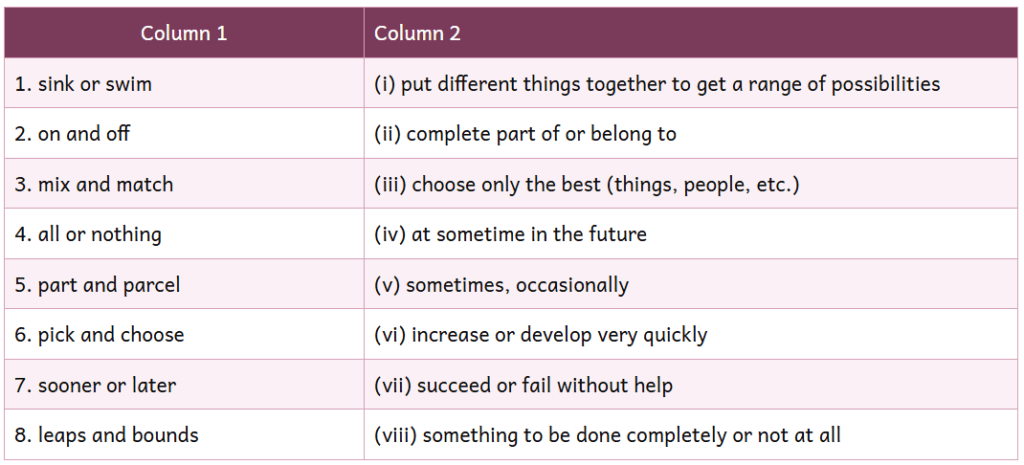
Answer: Matching Column with Column 2
| Column 1 | Column 2 (Correct Match) |
|---|---|
| 1. sink or swim | (vii) succeed or fail without help |
| 2. on and off | (v) sometimes, occasionally |
| 3. mix and match | (i) put different things together to get a range of possibilities |
| 4. all or nothing | (viii) something to be done completely or not at all |
| 5. part and parcel | (ii) complete part of or belong to |
| 6. pick and choose | (iii) choose only the best (things, people, etc.) |
| 7. sooner or later | (iv) at sometime in the future |
| 8. leaps and bounds | (vi) increase or develop very quickly |
Now Use any five of the above binomials in sentences of your own.
Answer: Sentences using binomials are given below.
- In the exam, it was a sink or swim situation for him.
- She studies on and off during the day.
- You can mix and match colours to create a new design.
- Success requires an all or nothing attitude.
- Hard work is part and parcel of success.
- He likes to pick and choose only the best options for his project.
- Sooner or later, hard work always brings success.
- The child’s skills improved in leaps and bounds within a few months.
II. Make words by adding the suitable prefixes given in the box to the words from the text in Column 1. Write the prefixed words in Column 2. One example has been done for you.
| Column 1 | Column 2 |
| 1. popular | (i) unpopular |
| 2. belief | (ii) |
| 3. important | (iii) |
| 4. respect | (iv) |
| 5. correct | (v) |
| 6. continue | (vi) |
| 7. understand | (vii) |
| 8. ordinary | (viii) |
| 9. interesting | (ix) |
| 10. possible | (x) |
Answer: Prefixes – Column Completion
| Column 1 | Column 2 (Prefixed Word) |
|---|---|
| 1. popular | (i) unpopular |
| 2. belief | (ii) disbelief |
| 3. important | (iii) unimportant |
| 4. respect | (iv) disrespect |
| 5. correct | (v) incorrect |
| 6. continue | (vi) discontinue |
| 7. understand | (vii) misunderstand |
| 8. ordinary | (viii) extraordinary |
| 9. interesting | (ix) uninteresting |
| 10. possible | (x) impossible |
III. Identify any five words with prefixes from the story and make sentences using each.
Answer: Sentences are given below.
- unhappy – She felt unhappy when she could not read the story.
- unusual – It was unusual for the grandmother to touch her granddaughter’s feet.
- independent – The grandmother wanted to become independent.
- unfortunately – Unfortunately, she did not get a chance to study in her childhood.
- disrespect – We should never show disrespect to our teachers.
IV. Match the idioms related to ‘learning’ given in Column 1 with their meanings in Column 2. You may refer to a dictionary.
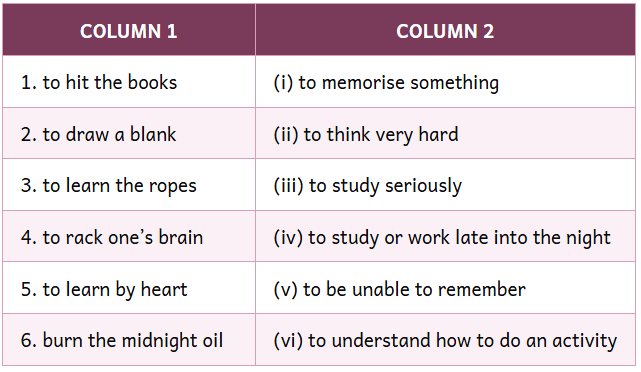
Answer: Matching correct idioms.
| Column 1 | Column 2 (Correct Match) |
|---|---|
| 1. to hit the books | (iii) to study seriously |
| 2. to draw a blank | (v) to be unable to remember |
| 3. to learn the ropes | (vi) to understand how to do an activity |
| 4. to rack one’s brain | (ii) to think very hard |
| 5. to learn by heart | (i) to memorise something |
| 6. burn the midnight oil | (iv) to study or work late into the night |
Now, use these idioms in sentences of your own.
- I need to hit the books before my exams begin.
- I drew a blank when the teacher asked me the answer.
- It took him some time to learn the ropes of the new job.
- She racked her brain to solve the difficult question.
- I learnt the poem by heart for the competition.
- He burnt the midnight oil to complete his project.
V. Read the following sentences from the text and underline the verbs.
- Secretly, I bought Kashi Yatre which had been published as a novel by that time.
- I knew, then, that my student had passed with flying colours
Answer:
- Secretly, I bought Kashi Yatre which had been published as a novel by that time.
- I knew, then, that my student had passed with flying colours
(i) Fill in the blanks with simple past and past perfect tense form of the verbs given in brackets.
A. When the delegates _____ (arrive) at the conference, the keynote speaker _____(already begin) the session.
B. After the students _____(learn) how to identify fake news online, they _____(start) verifying information before sharing it.
C. Before Kiran _____(start) using digital payment platforms, she _____(ensure) her understanding of online fraud prevention.
D. By the time Varun _____(recognise) the importance of budgeting, he _____(exhaust) most of his savings.
E. When Raghu _____(log in) to the cybersecurity webinar, the instructor _____(already discuss) the importance of strong passwords.
Answers:
A. When the delegates arrived at the conference, the keynote speaker had already begun the session.
B. After the students learnt how to identify fake news online, they started verifying information before sharing it.
C. Before Kiran started using digital payment platforms, she had ensured her understanding of online fraud prevention.
D. By the time Varun recognised the importance of budgeting, he had exhausted most of his savings.
E. When Raghu logged in to the cybersecurity webinar, the instructor had already discussed the importance of strong passwords.
(ii) Fill in the blanks with the correct form of verbs given in brackets.
Last year, my parents and I A. _____ (take) a financial planning course. When we B. _____ (review) our expenses, we realised we C. _____ (spend) too much on unnecessary purchases. After my parents D. ______ (discuss) ways to save, I E. ______ (open) a savings account.
By the time we F. ______ (set) our budget, the course G. ______ (already introduce) investment strategies. We H. ______ (hurry) to take notes, but many participants I. ______ (complete) their financial plans. Despite that, we J. ______ (enjoy) learning how to manage money wisely.
Answer:
Last year, my parents and I A. took (take) a financial planning course. When we B. reviewed (review) our expenses, we realised we C. had spent (spend) too much on unnecessary purchases. After my parents D. had discussed (discuss) ways to save, I E. opened (open) a savings account.
By the time we F. set (set) our budget, the course G. had already introduced (already introduce) investment strategies. We H. hurried (hurry) to take notes, but many participants I. had already completed (complete) their financial plans. Despite that, we J. enjoyed (enjoy) learning how to manage money wisely.
Listen and Respond
I. You will listen to a speaker talk about digital literacy. As you listen, complete the following sentences with one to three exact words that you hear. (Transcript for teacher on page 259)
- Literacy these days includes the ability to use ______.
- Digital literacy is also about protecting ______.
- Digital literacy enables the elderly to ______.
- Digital literacy encourages using the internet safely by helping us recognise ______ and ______.
- The National Digital Literacy Mission helps people across the country by imparting ______.
Answer: Listening Activity –
- Literacy these days includes the ability to use digital tools effectively.
- Digital literacy is also about protecting personal data.
- Digital literacy enables the elderly to stay connected.
- Digital literacy encourages using the internet safely by helping us recognise misinformation and scams.
- The National Digital Literacy Mission helps people across the country by imparting IT training.
Speaking Activity
I. Choose your topic and speak ‘for’ and ‘against’ for no more than one minute each.
Topic 1: It is important to learn a new language apar from your mother tongue.
Topic 2: Learning can happen only when you are young.
Answer: Speaking Activity –
This speaking activity asks you to participate in a “Turncoat” debate. In this format, you act as a solo debater who argues both sides of a single topic.
Sample Turncoat Example
Topic 1: It is important to learn a new language apart from your mother tongue
For:
To begin with, I would like to speak for the topic. Learning a new language helps us communicate with more people. My first argument in favour is that it opens better career opportunities. Most importantly, it helps us understand different cultures and ideas. In addition to that, it improves our confidence and thinking skills. I strongly feel that knowing more than one language is a great advantage. There’s no doubt that learning a new language is very useful in today’s world.
Against:
On the other hand, there are two sides to this topic. I am pretty sure that learning a new language is not always necessary for everyone. Some people can manage well using their mother tongue and one common language. Moreover, learning a new language takes time and effort, which may not be possible for all. Well, I am not sure whether everyone really needs it in daily life. So, to put it in a few words, it may be helpful but not always essential.
Topic 2: Learning can happen only when you are young
For:
To begin with, I would like to speak for the topic. It is easier to learn when we are young because our memory is sharp. My first argument is that children can grasp new ideas quickly. Most importantly, they have more time and energy to practise. In addition, young learners are more flexible and curious. I strongly feel that learning at a young age builds a strong base. There’s no doubt that childhood is the best time to learn.
Against:
On the contrary, I would like to speak against the topic. Learning does not depend on age. There are many examples of people who learn new skills even in old age. Most importantly, interest and determination matter more than age. If I could make a point here, experience also helps in better understanding. I am pretty sure that anyone can learn at any stage of life. So, to put it in a few words, learning is a lifelong process.
Another Sample of Turncoat
Topic 1: It is important to learn a new language apart from your mother tongue.
‘For’ (The Pro-Side)
- To begin with, I would like to speak ‘for’ the topic because learning a new language opens doors to different cultures and ways of thinking.
- My first argument in favour of this is that it enhances cognitive abilities, like problem-solving and memory.
- Most importantly, I want to mention that in our globalized world, being multilingual makes you more competitive in the job market.
- Moreover, I feel it allows you to connect with people you otherwise could never communicate with.
‘Against’ (The Con-Side)
- On the contrary, mastering one’s mother tongue should be the priority to preserve cultural identity and heritage.
- There are two sides to this topic; while learning languages is good, the time and resources spent could be used to master other vital skills like coding or mathematics.
- There’s no doubt that many people live successful lives speaking only one language, especially if it is a widely spoken one.
- So, to put it in a few words, while beneficial, it is not a “necessity” for everyone.
Topic 2: Learning can happen only when you are young.
‘For’ (The Pro-Side)
- To begin with, I would like to speak ‘for’ the topic because the young brain is like a sponge, highly neuroplastic and designed for rapid absorption.
- I have a reason to believe that children pick up nuances, like perfect accents in languages, far more naturally than adults.
- I strongly feel that the lack of responsibilities in youth provides the mental “space” required for deep learning.
‘Against’ (The Con-Side)
- On the other hand, “neuroplasticity” continues throughout life; the brain never actually stops being able to learn.
- I am pretty sure that adults often learn more efficiently because they have existing knowledge to connect new information to.
- Well, I am not sure whether you can really ignore the millions of seniors who pick up new hobbies or degrees later in life.
- So, to put it in a few words, learning is a lifelong process, not a race that ends when you grow up.
Writing Task
I. As a socially responsible citizen, you strongly believe that students can contribute significantly in promoting adult literacy. Write a letter to the Editor of a local newspaper emphasising the importance of student participation in adult literacy camps conducted by various organisations. Discuss the benefits of such initiatives for both students and society. Suggest effective ways to spread awareness and encourage more students to volunteer for this noble cause.
Answer: Example letters to the editor are provided below. Change names and other details as needed or preferred.
Example 1 (Letter to Editor)
Reena
Student, Kendriya Vidyalaya No. 1 (AMC)
Lucknow
April 22, 2026
The Editor
The Times of India
Lucknow
Subject: Students’ Role in Adult Literacy
Sir/Madam,
As a concerned citizen, I would like to draw your attention towards the critical need for student involvement in adult literacy. Literacy is the backbone of a developing society, yet many adults in our community still struggle with basic reading and writing.
The issue at hand affects a large section of society by limiting economic opportunities. It is imperative that we encourage students to volunteer at literacy camps. Such initiatives nurture a sense of empathy in youth while providing adults with essential life skills. By engaging in these programs, students can become the driving force behind a more informed society.
One effective way to address this might be for schools to organize weekend workshops. I hope this letter gets published in your esteemed daily to inspire more students to volunteer for this noble cause.
Yours truly,
Reena
Example 2 (Letter to Editor)
Ajeet
Student, Kendriya Vidyalaya
Jhansi
April 22, 2026
The Editor
The Times of India
New Delhi
Date: 27 April, 2026
Subject: Promoting Adult Literacy Through Student Participation
Sir/Madam,
This is with reference to the growing need for adult literacy in our society. As a concerned citizen, I would like to draw your attention towards the importance of student participation in adult literacy programmes conducted by various organisations. A large number of adults still lack basic reading and writing skills, which affects their daily lives.
The issue affects not only individuals but society as a whole. Illiteracy leads to lack of awareness, unemployment, and dependence on others. It is imperative that we involve students in such initiatives. By engaging in these programmes, students develop a sense of responsibility and empathy, while adults gain confidence and independence. Such efforts create a more educated and aware society.
One effective way to address this issue could be organising awareness campaigns in schools and communities. Authorities could also encourage volunteer programmes and provide proper training to students. I trust that this matter will be considered seriously for the benefit of all. I hope this letter gets published in your esteemed newspaper to spread awareness.
Yours truly,
Ajeet
Learning Beyond the Text
I. India has 22 major languages according to the Eighth Schedule of the Indian Constitution. Each language has its own unique identity. Talk to your classmates and teacher and complete the given table with words from any five Indian languages.
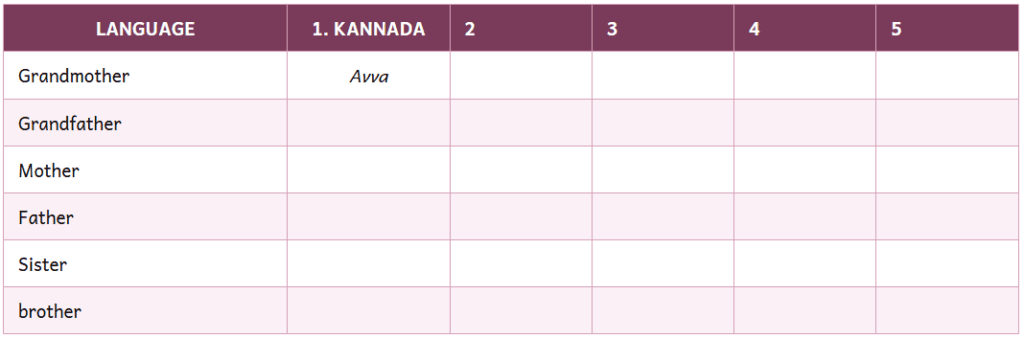
Answer:
Learning Beyond the Text – Sample Completion (in five languages)
| Language | Kannada | Hindi | Tamil | Bengali | Marathi |
|---|---|---|---|---|---|
| Grandmother | Avva | Dadi/Nani | Paati | Thakuma/Nani | Aaji |
| Grandfather | Ajja | Dada/Nana | Thatha | Dadu/Nana | Ajoba |
| Mother | Amma | Maa | Amma | Ma | Aai |
| Father | Appa | Papa/Pita | Appa | Baba | Baba |
| Sister | Akka | Behen | Akka | Bon | Tai |
| Brother | Anna | Bhai | Anna | Bhai | Bhau |
II. Do you know?
National Literacy Mission Authority (NLMA) is responsible to design, develop, and implement the Adult Education Programme in India. Directorate of Adult Education (DAE), under the Department of School Education and Literacy, Ministry of Education, Government of India, functions to facilitate the implementation of adult education programmes in the country. Find more information on it with the help of the link given below:
https://dsel.education.gov.in/ault_education
Answer:
Here is a summary and some additional information (https://dsel.education.gov.in/ault_education did not load):
The Key Organizations
- NLMA (National Literacy Mission Authority): This is the policy-making body. Its job is to design the strategies and set the goals for adult literacy across the country.
- DAE (Directorate of Adult Education): Think of this as the “hands-on” department. It works under the Ministry of Education to make sure those policies are actually put into action on the ground.
Core Objectives of Adult Education
The primary goal of these bodies is to reach non-literate adults (aged 15 and above) to provide:
- Foundational Literacy and Numeracy: Basic reading, writing, and math skills.
- Critical Life Skills: Information on things like financial literacy, digital skills, healthcare, and family welfare.
- Vocational Skills: Training that helps adults improve their earning potential.
- Basic Education: Allowing adults to complete their equivalent of formal schooling.
Current Major Initiative
The latest major program being implemented is the New India Literacy Programme (NILP), also known as Nav Bharat Saksharta Karyakram, which focuses heavily on using digital tools and volunteerism to achieve 100% literacy.
Would you like to know more about the specific courses offered or how people can volunteer for these literacy programs?
III. Talk to your grandparents and find out which book or magazine they enjoy reading. Buy a copy of it and present it to them as a gift.
Answer: Activity – Sample Responses
Since this task is about personal connection, here are two samples of how you (students) might write about it for a class assignment:
Sample Answer-1
“I talked to my grandfather, and he told me that he really enjoys reading ‘The Gita Press Kalyan’, a spiritual magazine he has followed since he was young. He likes it because it contains inspiring stories and ancient wisdom.
I also spoke with my grandmother, who loves reading ‘Grihshobha’ (a popular Hindi women’s magazine). She enjoys the articles on home management, cooking recipes, and social issues.
I have decided to buy a yearly subscription to ‘Kalyan’ for my grandfather and the latest special edition of ‘Grihshobha’ for my grandmother to gift to them this weekend.”
Sample Answer – 2
I talked to my grandparents and found that they enjoy reading religious books and weekly magazines. My grandmother likes reading Ramayana stories, while my grandfather prefers reading newspapers and magazines about current events.
I bought a copy of a religious storybook for my grandmother and a magazine for my grandfather and presented them as a gift. They felt very happy and appreciated the thoughtful gesture.
◻◻ End